Labeling Machine Price: Manual, Semi-Automatic, Inline and Rotary Cost Factors
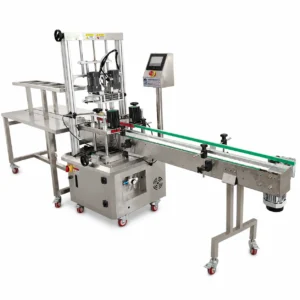
A useful labeling machine price must cover your bottle, label, required output and installation scope. LEKA prepares that price from the bottle, the label, the output, and the handling included in the order. A label applicator is the part that dispenses and applies a label to the container. A hand-loaded applicator and a conveyor-fed system do different jobs. Before comparing their prices, establish how bottles enter the machine, how labels are applied and what work remains for your operators.
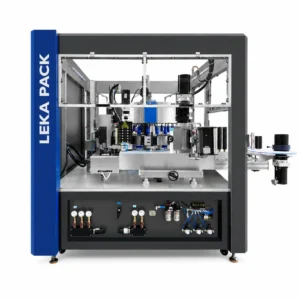
For a typical LEKA labeling machine, allow approximately US$4,500–6,000 as an FOB planning budget. The final price depends on your bottle shape, label size and placement, required output, and selected options. Ask LEKA to confirm the machine model, included modules and named FOB loading port in your quotation. This is a planning reference for one machine. It is not a combined labeling-and-capping package, and it is not a fixed price for every model. FOB describes the delivery basis; it does not by itself name the port or the modules included. Incoterms need to be read together with the equipment list.
High-speed rotary or starwheel configurations require a project-specific quotation. LEKA’s reference budget for these custom machines is CNY350,000–500,000, approximately US$52,200–74,600 using the European Central Bank euro reference rates dated 5 October 2026. The conversion is for budget comparison only. Confirm the tooling, bottle formats and performance requirements before setting the final budget. This reference is not the cost of an entire filling, capping and labeling line, and the project quotation controls the currency and price.
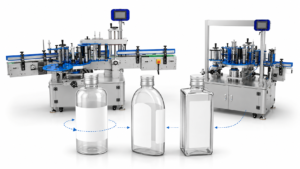
A bench semi-automatic applicator is enough when an operator can load and remove each container at the required pace. An automatic inline labeler is the next step when bottles arrive on a conveyor, when front-and-back or wrap labeling has to hold a steady spacing, or when the labeler must keep pace with a filler. Round bottles can take a wrap or one side label. Flat or tapered panels need a flat-surface applicator. Two-side labeling needs a set gap or a second head. A label that must meet a seam, handle or window needs a positioning device, which many machines list as an option rather than standard equipment.
Public Price Examples
These public prices illustrate how machine configuration and included equipment affect the purchase budget. Compare the bottle or cap application, supplied modules and delivery terms before selecting a machine.
| Manufacturer / Model | Machine Configuration | Public Price | Included Equipment / Items to Confirm |
|---|---|---|---|
| Primera AP360 | Semi-automatic applicator for cylindrical containers and many tapered containers. SKU ap360. The operator loads each container. | US$1,395 | Applies one label. Confirm accessories, shipping, tax and the plug selected at order. Checked 6 October 2026. |
| Primera AP550 | Semi-automatic flat-surface applicator for rectangular, tapered and other flat containers. SKU ap550. The operator loads each container. | US$2,395 | One label, optical sensor. Clear labels on this applicator need a black mark on the liner. Confirm shipping and tax. Checked 6 October 2026. |
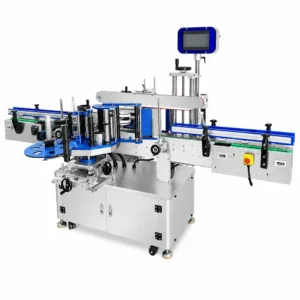
| ZONESUN ZS-TB822 | Automatic round-bottle labeler for single-side, double-side or wrap-around labeling. | US$5,499.99 | A positioning device and a date printer are described as equipment the machine can be fitted with. Do not assume either is included. Shipping is calculated at checkout. Checked 4 October 2026. |
Primera AP360 and AP550 prices checked 6 October 2026. The ZONESUN ZS-TB822 price was checked 4 October 2026. Models have different applications and included equipment. Online prices and LEKA FOB planning budgets use different quotation bases; confirm your selected configuration and delivery terms before comparing total project cost.
For an automatic bottle labeler, request an itemized quotation. Bottle handling, extra label heads, printing, inspection and connection to your existing line can change the equipment supplied. This guide explains what to compare and what to send for a useful LEKA labeling machine recommendation.
Compare Manual, Semi-Automatic, Inline and Rotary Configurations
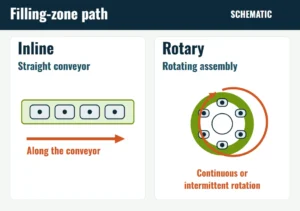
Manual and semi-automatic describe how much work the operator performs. Inline and rotary describe how containers move through a system. They are not four fixed price bands: an automatic machine can use either layout, and its configuration determines the quotation.
| Machine configuration | Production use | Main quotation factors | Work to confirm |
|---|---|---|---|
| Manual applicator or jig | Small runs with hands-on bottle handling | Bottle support, guides and the label formats it can handle | Loading, operating the applicator and removing each bottle |
| Semi-automatic applicator | Bench production with a powered application cycle | Container fixture, label sensor, label count and change parts | Loading, unloading and maintaining the required pace |
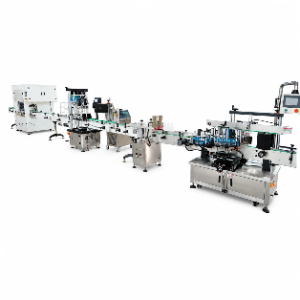
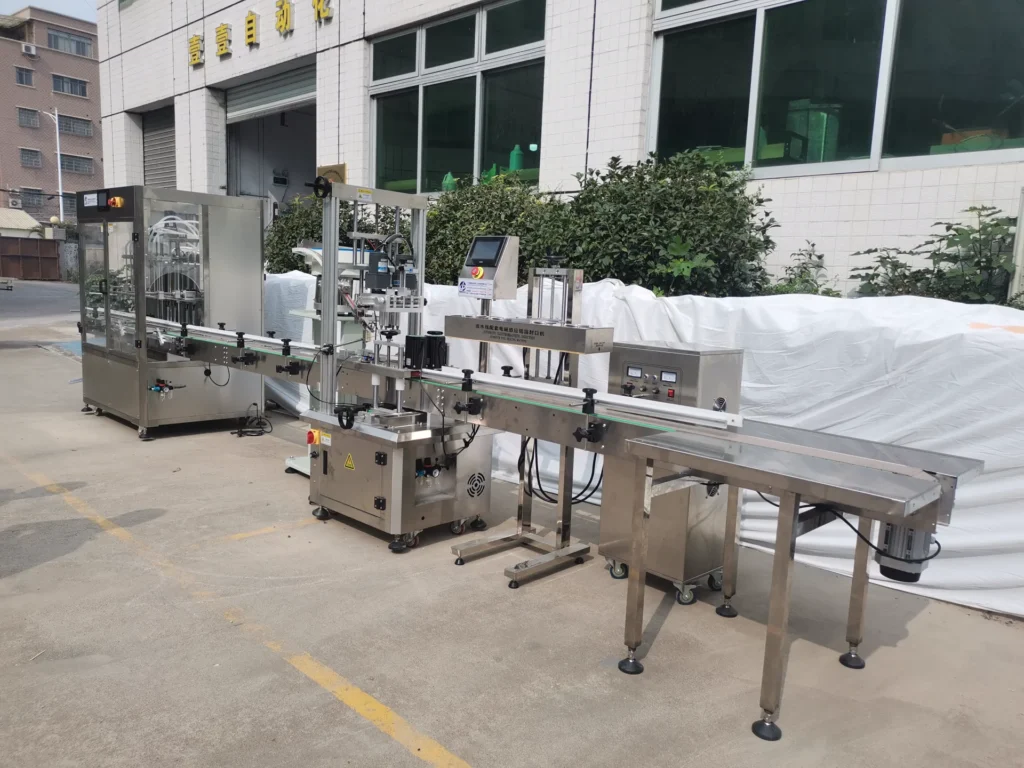
| Automatic inline system | Conveyor-fed labeling as a standalone station or part of a line | Conveyor, spacing, bottle stabilization, label heads and line controls | How bottles reach the conveyor and leave for packing |
| Automatic rotary system | Applications requiring controlled bottle movement around a carousel | Bottle handling, positioning, labeling stations and format sets | Format changes, line transfers and the output agreed for each bottle |
A low purchase price can suit a small batch if the available labor meets the schedule. For repeated production, compare the complete loading-to-packing process. An automatic label applicator does not necessarily include automatic bottle feeding or case packing.
For a broader comparison of container shapes and label positions, see the bottle labeling machine types guide.
Representative LEKA Models for Common Labeling Jobs
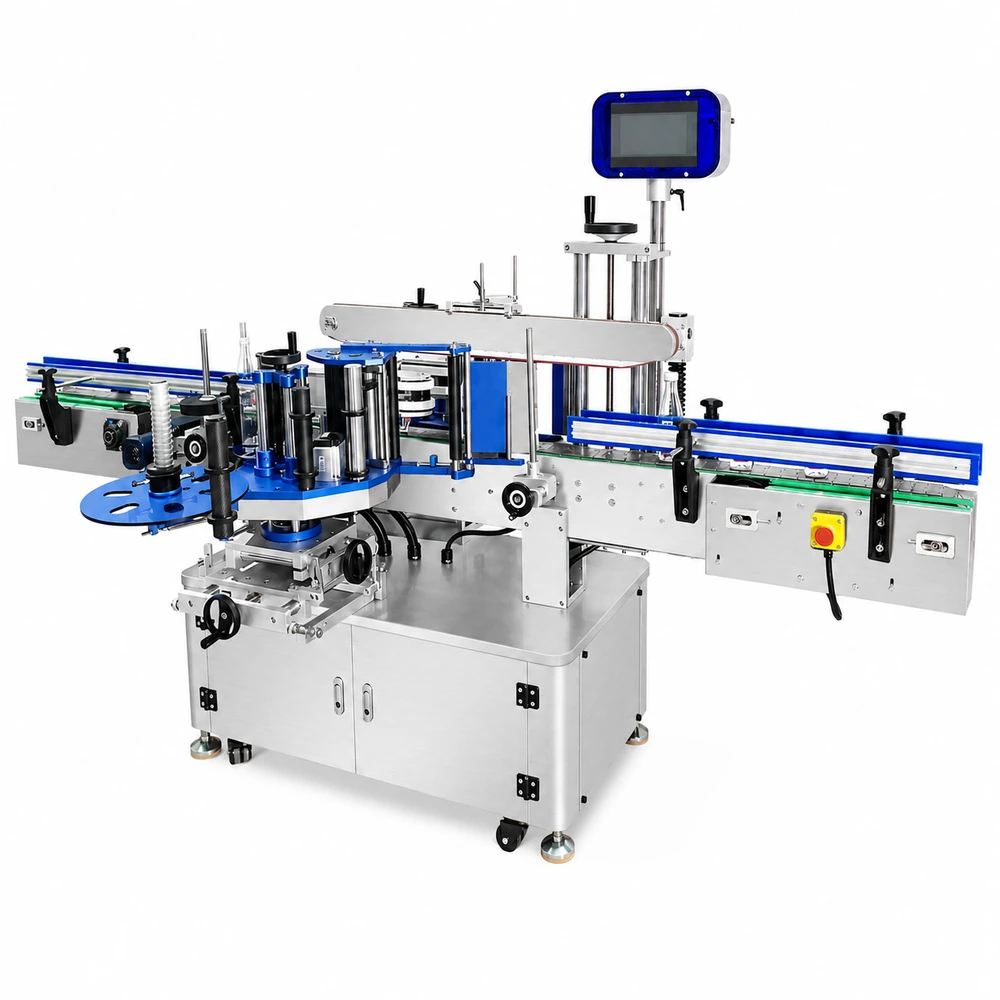
Choose the row that matches the labeling job, then let the quotation name the heads, conveyor, sensors, format parts and any printer in that order. Where a model page gives more than one speed reference, the output in the quotation is the rate confirmed with your bottle, label and configuration.
| Application | Representative model | What the quotation should include |
|---|---|---|
| Flat or square bottles with one side, two sides, or optional multi-side labels | LEKA-LB020 | The sides included in the order, and whether round-bottle support is part of that order |
| Round bottles with wrap-around, fixed-position, or front-and-back labels | LEKA-LB050 | The positioning setup and the output confirmed with your bottle, label and line configuration |
| Flat, square, oval, tapered or similar bottles with up to three label positions | LEKA-LB030 | Which stations and which bottle shapes are included |
| Top, plane or selected corner labels on boxes, cards, lids, trays, bags, flat bottles or stable packs | LEKA-LB070 | Label position, product list, and an optional paging feeder when stacked flat products must be separated before labeling |
| Flat labeling with a barcode, QR code, date, batch code or other variable data | LEKA-LB070P | The print content and whether Zebra ZE511 is the selected print engine. When ZE511 is selected, 203 dpi is its standard resolution and 300 dpi is available. Stored-label printing and real-time print-and-apply are quoted at the rate for that content and label |
| High-speed rotary self-adhesive labeling, including positioned labeling | LEKA-LBGDP36 | The positioning method supplied with the order, and the output confirmed for your bottle, label and line |
| Straight-line hot-melt labeling for round bottles | LEKA-ZR15 | Destination voltage, the glue system, and the output confirmed for your bottle, label and line |
Other models in the same families remain on the labeling machine pages. This price guide uses one representative for each job above.
Quick Glossary for Labeling Machine Quotations
These terms often appear in supplier quotations. Use the plain-English meanings below when comparing what each supplier includes.
| Term | Plain-English meaning | Why it matters in a quote |
|---|---|---|
| Label applicator | The assembly that dispenses a label from its backing and applies it to the container | A price may cover only this assembly or a complete machine with conveyor and bottle handling |
| Inline labeling system | Bottles move along a straight conveyor past one or more labeling stations | Confirm the conveyor, bottle spacing and connection to upstream and downstream equipment |
| Rotary labeling system | Containers are held and moved around a rotating carousel while labels are applied | Check the bottle-handling method, included bottle formats and required change parts |
| Format parts or change parts | Bottle-specific guides, holders or fixtures used to run a particular container | Ask which bottle formats are included and what extra sets will cost |
| Liner | The backing material that carries self-adhesive labels on the roll | Its thickness and surface can affect label feeding, tension and sensor detection |
| Commissioning | Installation checks, setup and start-up support after the machine arrives | Confirm whether travel, on-site labor, training and production start-up are included |
What Changes an Automatic Labeling Machine Price?
Bottle shape, stability and label position
A round bottle with one wrap-around label presents a different job from an oval detergent bottle with front and back labels. Tall, light or flexible containers may need extra support. A label that must align with a handle or molded feature also needs a defined positioning method.
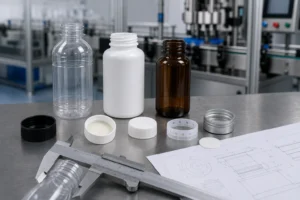
Send bottle drawings, dimensions and filled weight. State whether labeling takes place before or after filling, and show the required label position. Ask the supplier to identify the guides, hold-downs, fixtures or positioning devices included.
Complete labeling systems can include transport, product separation, alignment, stabilization and inspection. HERMA lists these as system components or options, illustrating why the applicator alone is only part of a line quotation. [2]
Label material, roll specification and number of labels
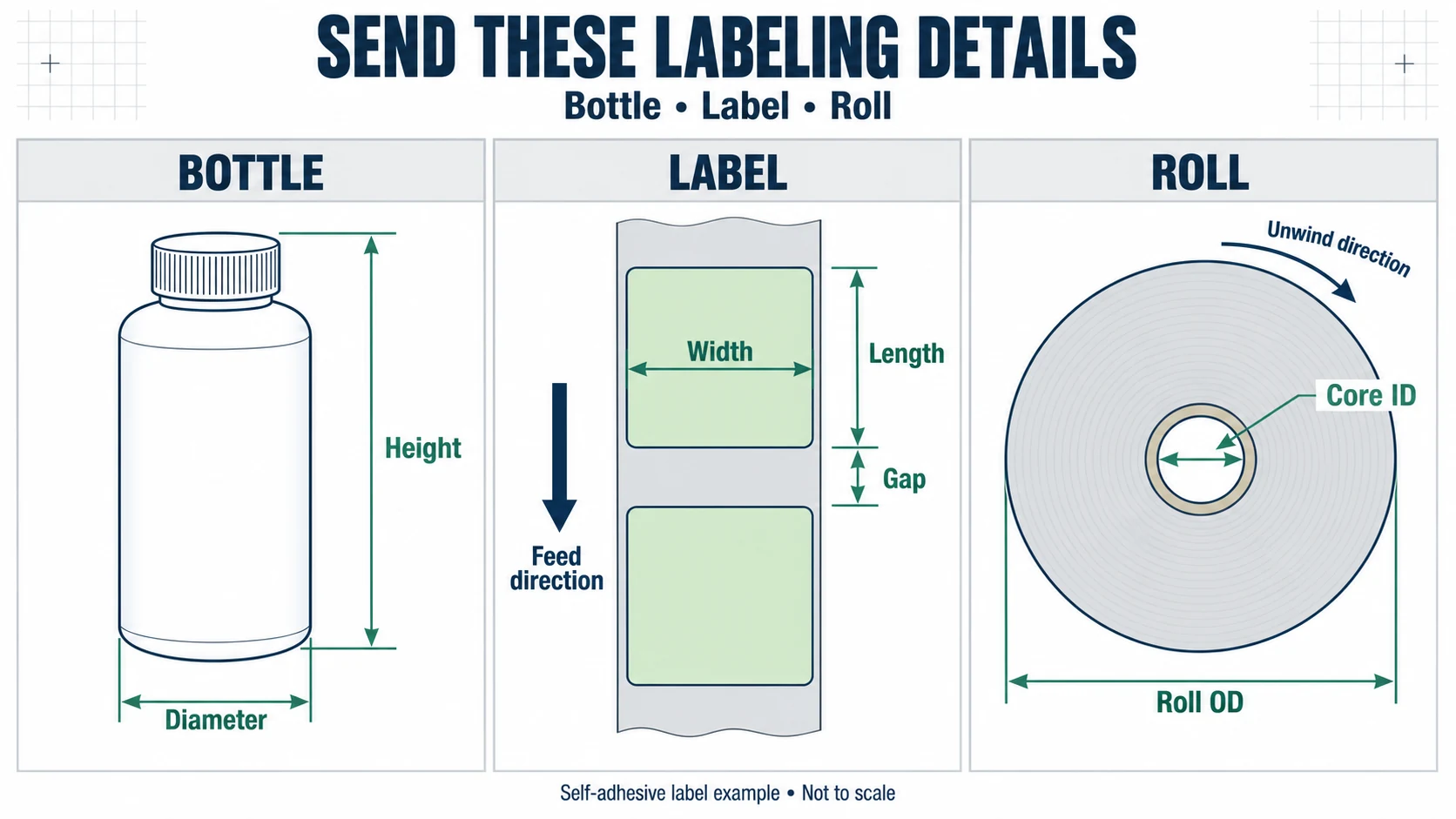
For self-adhesive labels, send the label width and length, the gap between labels, the roll core inside diameter, the maximum roll outside diameter and the unwind direction. The liner is the backing material that carries the labels. Also send one finished roll or a clear roll photo. Clear labels may need a special sensor, so ask the supplier to test the actual label stock.
Sensor and interface choices are real configuration items. For example, HERMA documents several label-scanning options and printer interfaces for its HERMA 500 applicator. [3]
Also specify whether each bottle needs one label, a front-and-back pair, or an additional neck label. The supplier should explain the head arrangement and confirm all positions in the quotation.
If you are also comparing adhesive systems, use the hot melt versus pressure-sensitive labeling guide to assess label stock and running costs. Inline or rotary construction alone does not identify the adhesive method.
View full-size diagram
Required output and the meaning of speed
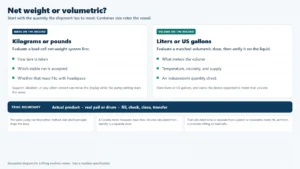
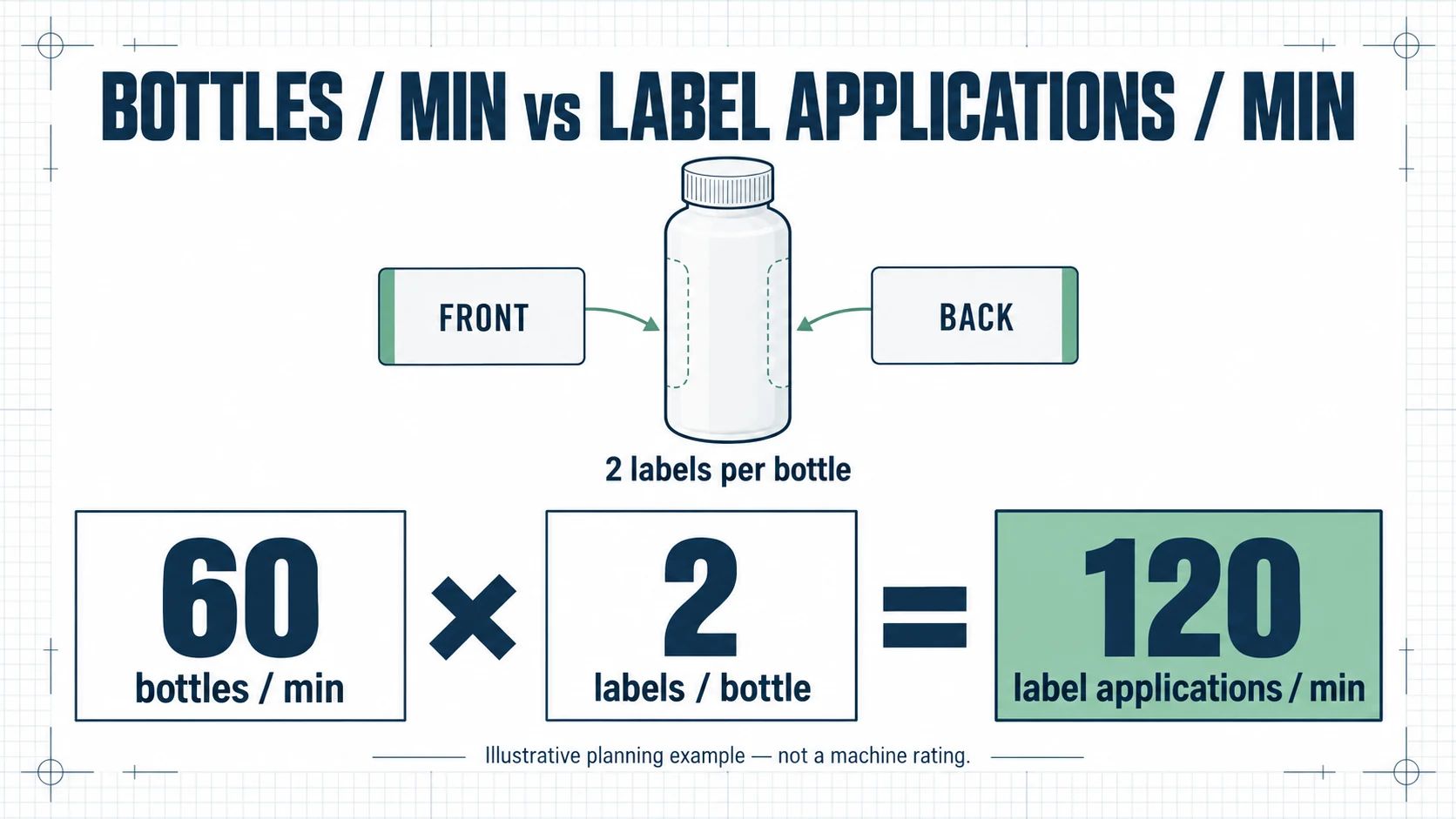
Request output in correctly labeled bottles per minute for your actual bottle-and-label combination. Keep that separate from label dispensing speed, conveyor speed and the number of labels applied per minute.
As a planning example, 60 bottles per minute with two labels on each bottle requires 120 label applications per minute across the system. That calculation is not a machine capacity claim. Ask how the proposed heads and bottle handling meet the requirement together.
View full-size diagram
Give the supplier your normal production target, batch sizes and upstream filling and capping output. During testing, record roll changes, bottle jams, rejected bottles and setup time as well as the steady running rate.
Product changes and included format sets
A bottle size range on a brochure does not show which change parts come with your order. List every bottle-and-label combination. Ask which formats can be changed by adjustment and which require separate parts.
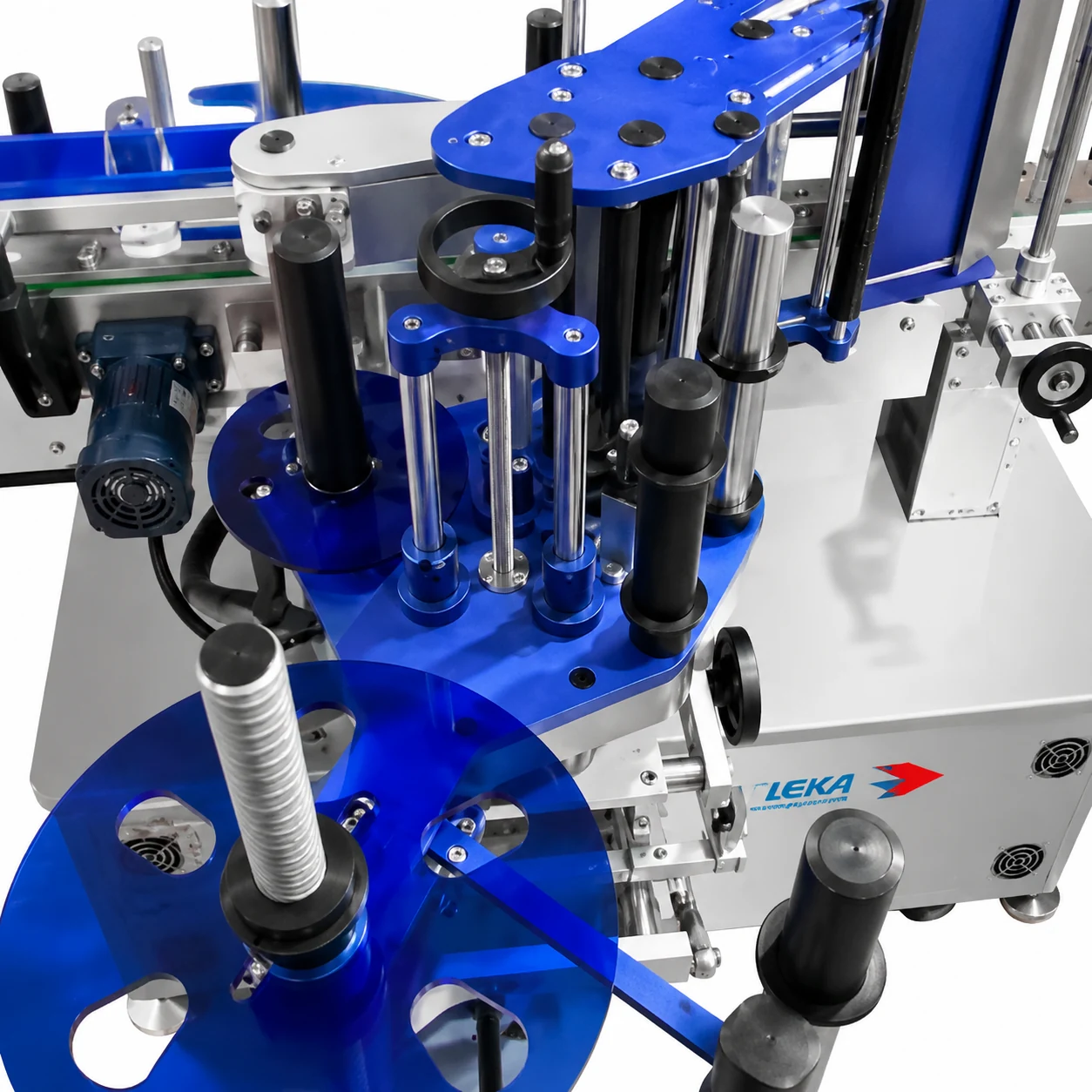
For a rotary labeling configuration, ask for the bottle-handling and positioning parts required for each format. Confirm part identification, storage and the changeover procedure. These details matter when your factory switches products during the week.
Conveyors, printing and line controls
Define conveyor width and height, travel direction, transfer points and available floor space. State how the labeler should respond when the upstream machine stops or downstream bottles accumulate.
Pack Leader’s PL-501 product family includes different conveyor lengths, reverse-flow arrangements and additional label-head configurations. Its pricing is requested by configuration, showing why two machines with a similar name may cover different work. [4]
A label applicator places labels; a label printer produces the printed information. If you need batch numbers, dates or barcodes, specify whether they are printed on the label or directly on the bottle. Include the printer or coder, mounting, triggering, consumables and any inspection or rejection requirement in the quotation.
Need an initial configuration review? Send a bottle photo with dimensions, a label sample and your target bottles per minute.
Ask LEKA to review your labeling requirement, including whether the machine will run alone or connect to an existing line.
Compare Two Quotations Using the Same Supply Scope
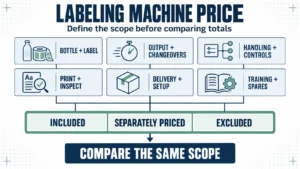
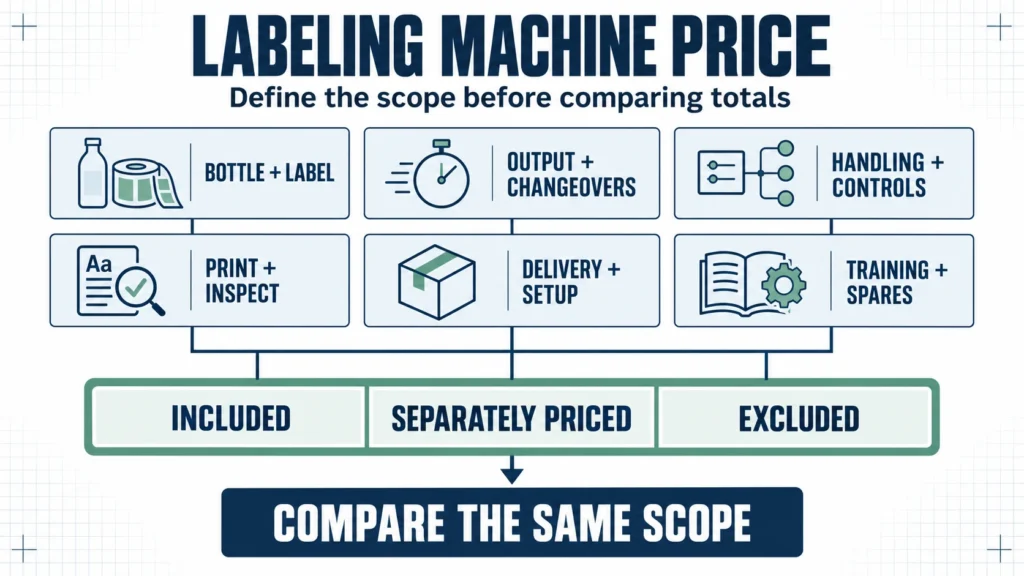
Ask each supplier to mark every item as included, separately priced or excluded. An unanswered line is a point to clarify before placing an order.
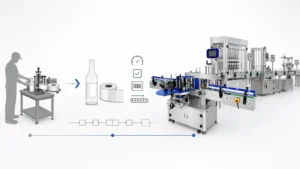
Technical illustration. Define bottle and label, output, handling, printing, delivery and support as included, separately priced or excluded before comparing labeling machine quotations.
| Quotation item | What to confirm in writing |
|---|---|
| Machine and application | Model, label heads, application method, container list and label positions |
| Handling and format parts | Conveyor, guides, stabilizers, fixtures and parts for every agreed bottle format |
| Printing and inspection | Coder or printer, sensors, inspection scope, rejection equipment and consumables |
| Line integration | Transfers, control signals, electrical work, installation responsibility and site preparation |
| Testing and acceptance | Samples, test duration, target output, acceptable label placement, reject criteria and records |
| Delivery, installation and start-up | Currency, quote validity, delivery terms, packing, freight, insurance, installation, travel and training |
| Maintenance and support | Spare-parts list, warranty scope, support method, response arrangements and chargeable services |
Calculate your project budget by adding the quoted equipment, required options, delivery, installation and site work that are not already included. Check destination duties and taxes separately with your import or logistics adviser. Use the same currency and delivery basis when comparing suppliers.
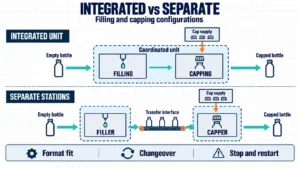
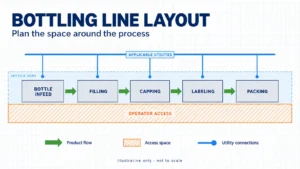
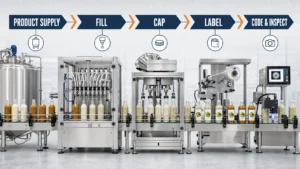
For a complete bottle packaging line, agree who is responsible for each connection between filling, capping, labeling and packing. A standalone machine quotation should not be treated as a complete installed-line price.
Check Running Cost Before Choosing the Lower Price
After matching the supply scope, compare labor, label consumption, setup waste, maintenance and rework over the same production schedule. Use accepted bottles as the output measure; bottles needing relabeling still consume time and material.
Labeling operating cost per accepted bottle = total labeling operating cost for the period ÷ accepted bottles produced in that period.
Keep purchase and installation costs separate from this operating calculation. When comparing total ownership cost, add those investment costs once over the same evaluation period. Use measured labor and waste figures from your factory or an agreed trial.
Automation can change where operators spend their time. Confirm the loading, replenishment and packing work that remains before assuming labor savings. The guide on when to upgrade to automatic bottle labeling covers that decision in more detail.
Test the Configuration Behind the Quotation
Ask for a factory acceptance test using your actual containers and production label stock. Agree the test conditions before the run: bottle format, filled or empty condition, label position, output, duration and acceptance criteria.
The trial should show normal feeding, label application and discharge. Review alignment, wrinkles, bubbles, missed labels and bottle handling. If the order covers several products, include representative formats and a demonstrated changeover.
For a standalone trial, note which line interfaces remain to be checked at your factory. Request the test record, operating instructions and training scope with the quotation. A video should make the tested configuration and result clear.
What to Send for a Labeling Machine Quotation
Before comparing quotations, send bottle samples or dimension drawings, the target output and the available installation space. Also send label dimensions, material and roll specifications, and say whether positioning or date coding is required. Confirm the complete machine, the labeling method, the bottle range, the sample-tested output, the supply modules, spare and change parts, the delivery terms and the export-support scope. A domestic RMB listing is not an FOB price unless the quotation says so.
A complete request helps suppliers quote the same application. Include:
- Product and container: product name, bottle material, shape, dimensions, capacity and filled weight; confirm filled or empty labeling.
- Label specification: artwork or sample, material and dimensions; for self-adhesive rolls, add the gap, liner, core size, roll diameter and unwind direction.
- Application: labels per bottle, required positions and any alignment to a handle, seam or other feature.
- Production: target bottles per minute, batch size, working hours and product-change frequency.
- All formats: a list of bottle sizes and label combinations to include in the first order.
- Line and layout: standalone or connected use, conveyor height and width, travel direction, available space and adjacent machines.
- Printing and inspection: the information to print, its location and any required checking or rejection.
- Site and services: destination, voltage, phase, frequency, available compressed air if required, installation and training needs.
- Commercial requirements: budget, desired delivery date, delivery scope and required documents.
If you also need filling and capping, include product viscosity, fill volume and cap type so the labeling station can be reviewed as part of the whole line.
Frequently Asked Questions
How much does an automatic labeling machine cost?
For a typical individual LEKA labeling machine, use about US$4,500–6,000 FOB as a planning budget. A high-speed rotary or starwheel machine uses the separate custom-project reference in the opening section. Neither figure is a fixed quotation. Ask for a quote covering your bottle formats, labels, output, conveyors, printing and installation scope. A price for a hand-loaded applicator cannot establish the budget for a connected automatic system.
Does a labeling machine price include label printing?
Check the equipment list. Many applicators use labels that are already printed. A print-and-apply system includes a printing function, while a separate coder may add variable information. Specify what must be printed and confirm the relevant hardware and consumables.
Can one machine handle all my bottle sizes?
Ask the supplier to review each bottle-and-label combination. Some changes use adjustments; others need dedicated format parts or a different application arrangement. Obtain the included format list and test scope in writing.
Can I connect a standalone labeler to my filling line later?
Ask about that plan before ordering. Conveyor height, direction, transfers, controls and available space must suit the later connection. Obtain a defined upgrade scope rather than assuming a standalone unit will connect without additional work.
Get a Labeling Configuration and Quotation from LEKA
LEKA Pack Line supplies labeling equipment and integrated bottle packaging solutions. Share your bottle, label, output target and factory layout so we can review the suitable configuration and its connection to filling, capping and packing.
Start with a bottle photo, dimensions, label sample and target speed. Include your destination and budget if available.
Send bottle type, label size, capacity and factory layout
Sources
- Primera AP360, SKU ap360, and Primera AP550, SKU ap550, rechecked 6 October 2026. Prices and scope are in the public price table above. AP360 product page. AP550 product page.
- HERMA labeling machines, checked 3 October 2026: https://www.herma.co.uk/machines/products/labeling-machines/. Transport, separation, alignment, stabilization, and review or rejection as functions or options.
- HERMA 500, checked 8 September 2026: https://www.herma.com/machines/products/label-applicators/herma-500/.
- Pack Leader PL-501, checked 3 October 2026: https://www.packleaderusa.com/equipment/pl-labeling-machines/pl-501. Named conveyor, flow and head configurations, each offered through Get Pricing.