
Net Weight vs Volumetric Filling for Pails and Drums: Which Method Fits Your Product?
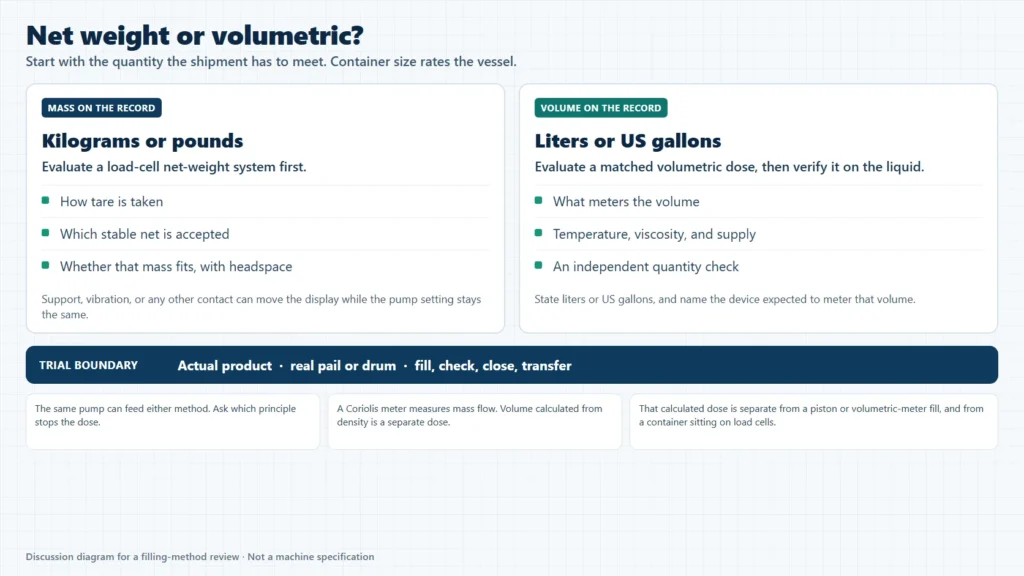
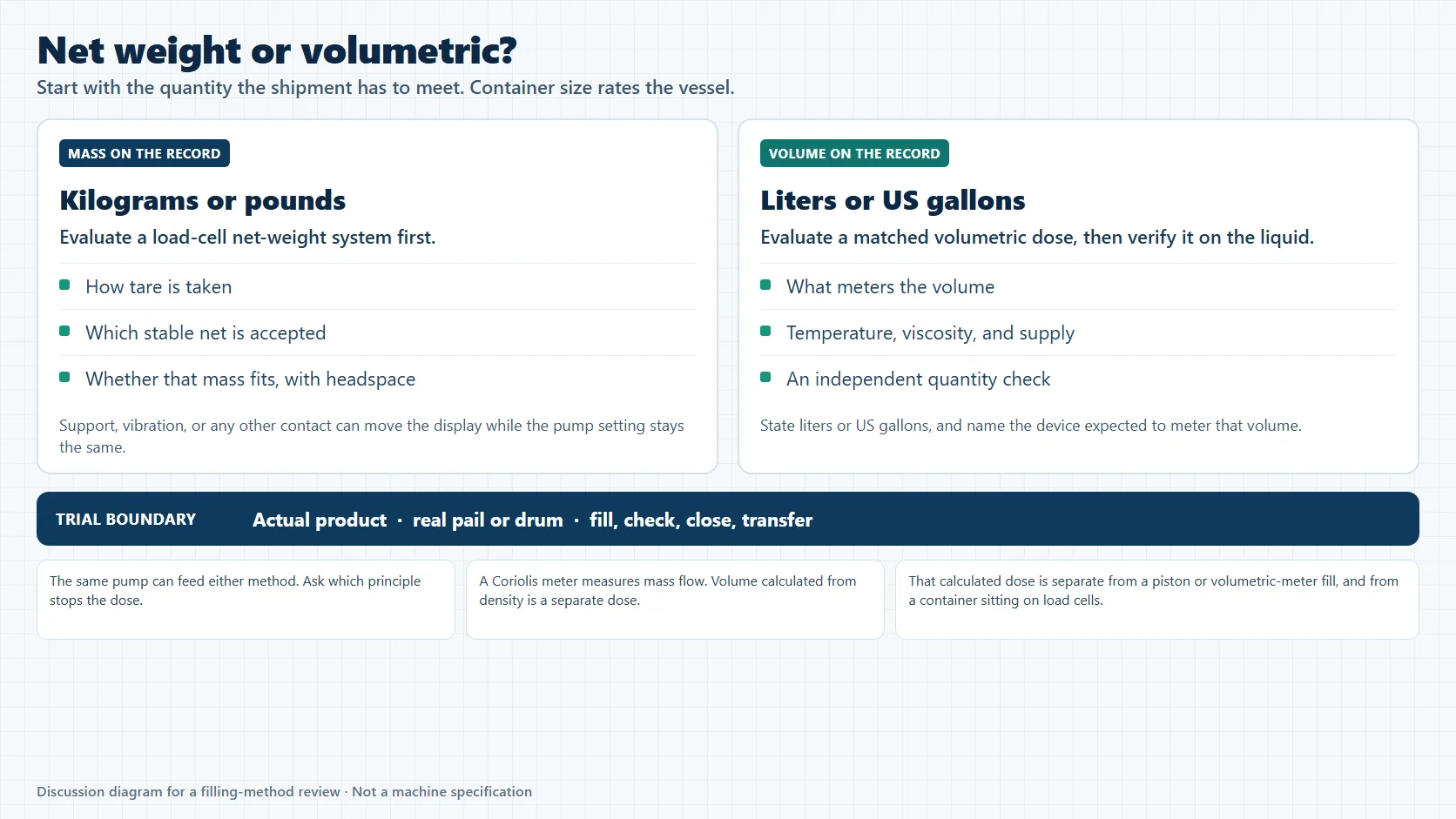
For industrial liquids packed in pails and drums, start with the quantity the shipment has to meet. If the contract, the label, or the internal record is in kilograms or pounds, evaluate a load-cell net-weight system first. If the target is liters or US gallons, and a matched dosing system can be verified on your liquid, volumetric filling can be the right path. Test either method with the actual product, the real container, and the sequence that fills, checks, closes, and transfers the container.
The scope is industrial liquids in open pails and bung-top drums: density, tare, cutoff, foam, drip control, lid or bung closing, and pallet transfer. Container size rates the vessel. The method follows the target quantity and the way that quantity will be accepted.
Net Weight vs Volumetric Filling: What Does Each Method Control?
In filling practice, weight usually means the mass of product in the container. Net mass is that quantity in kilograms or pounds. Net-weight filling is the scale method that controls it.
Net-weight filling with a container scale
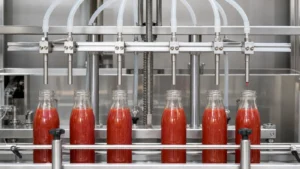
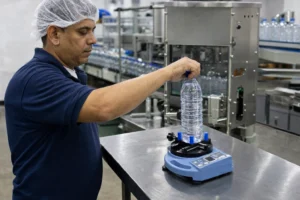
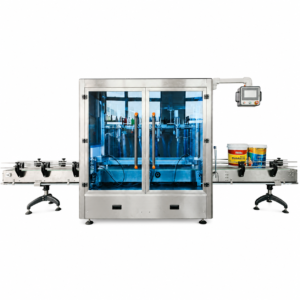
The container sits on load cells, or on a frame those cells support. The controller subtracts tare and compares net mass with the target. The pump, valve, and lance move the liquid and close the stream. Two quotations can share a similar pump and still differ in tare, cutoff, and which reading is accepted. Support, vibration, and any other contact can move the display while the pump setting stays the same.
Volumetric filling with a matched dosing system
Volume may come from piston displacement, from counted strokes or revolutions of a positive-displacement metering pump, or from a volumetric flow meter. The same pump can feed a net-weight filler, so ask which principle stops the dose, how it is calibrated, and at which temperature, viscosity, and supply conditions it was verified.
| Selection factor | Load-cell net-weight filling | Volumetric filling |
|---|---|---|
| Controlled quantity | Product mass added after tare | Delivered volume from the selected dosing system |
| First question | How is tare taken, and how is the final net checked? | What meters the volume, and under which conditions is it verified? |
| Density changes | A mass target needs no fixed density-to-volume conversion | Equal volumes can hold different masses |
| Container support | Needs a suitable scale and controlled outside forces | The container need not be weighed during dosing; the final quantity still needs a check |
| Product delivery | Pump, valve, and nozzle must support the flow and the cutoff | Pump, meter, or displacement device must suit the product and the dose range |
| Foam and drips | Handled by nozzle, fill position, and container movement | Handled by the same nozzle and movement choices |
| Production output | Count fill, check, close, and transfer together | Count that same finished-container cycle |
| Selection basis | Start here when the controlled quantity is mass | Start here when the controlled quantity is volume and the dosing system fits the liquid |
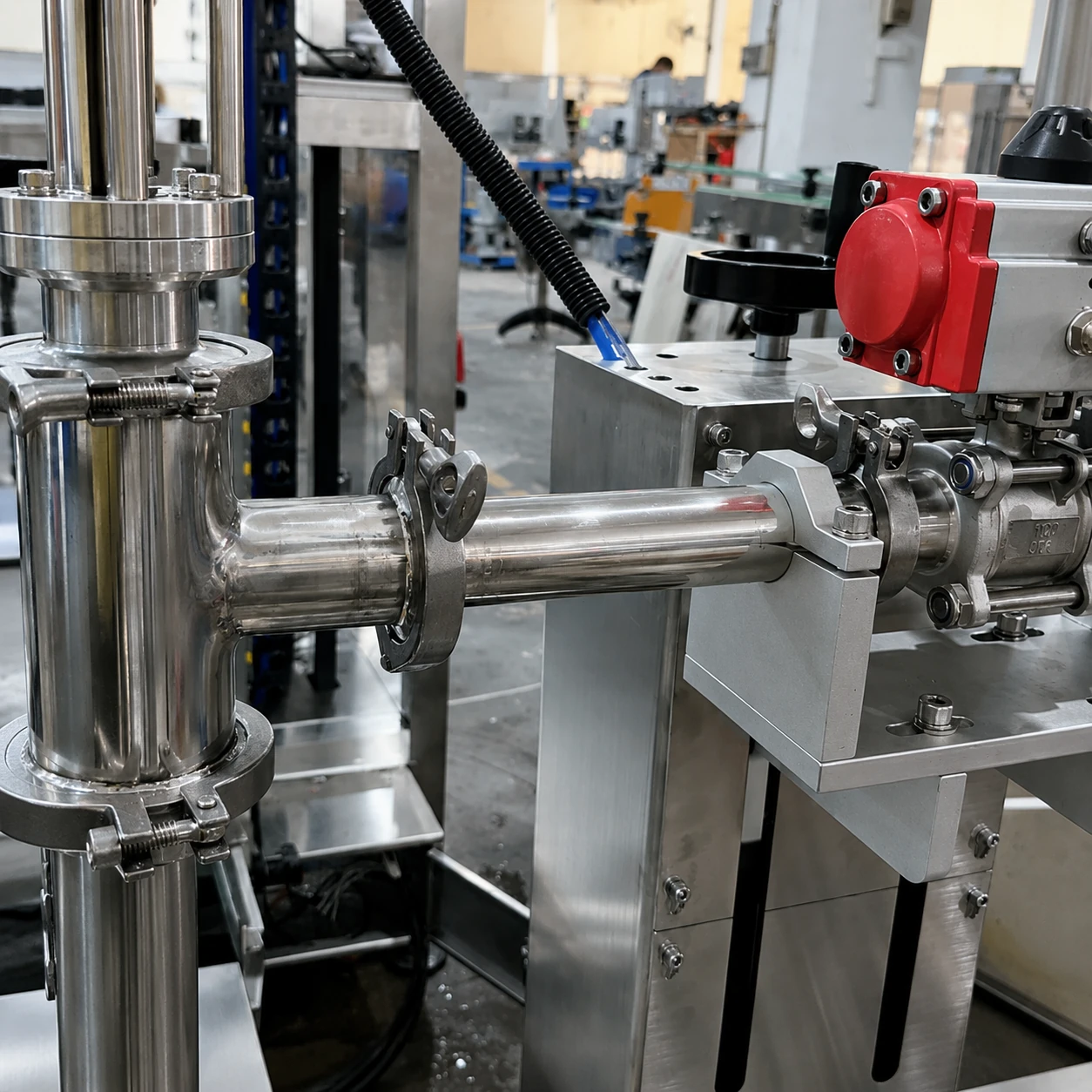
A flow meter is a class of hardware. A Coriolis meter measures mass flow directly and can calculate volume from density. That dose is separate from a piston or volumetric-meter fill and from a container on load cells. Emerson’s flow-meter overview describes the mass-flow measurement, and the Micro Motion F-Series product data sheet describes the volume calculation. State kilograms or pounds, or liters or US gallons, and name the metering device you expect.
For 1–25 L edible-oil bottles, see the separate guide to flow meter vs net weight filling for edible oil. The rest of this article stays with industrial pails and drums.
How Product Density Changes Fill Weight and Volume
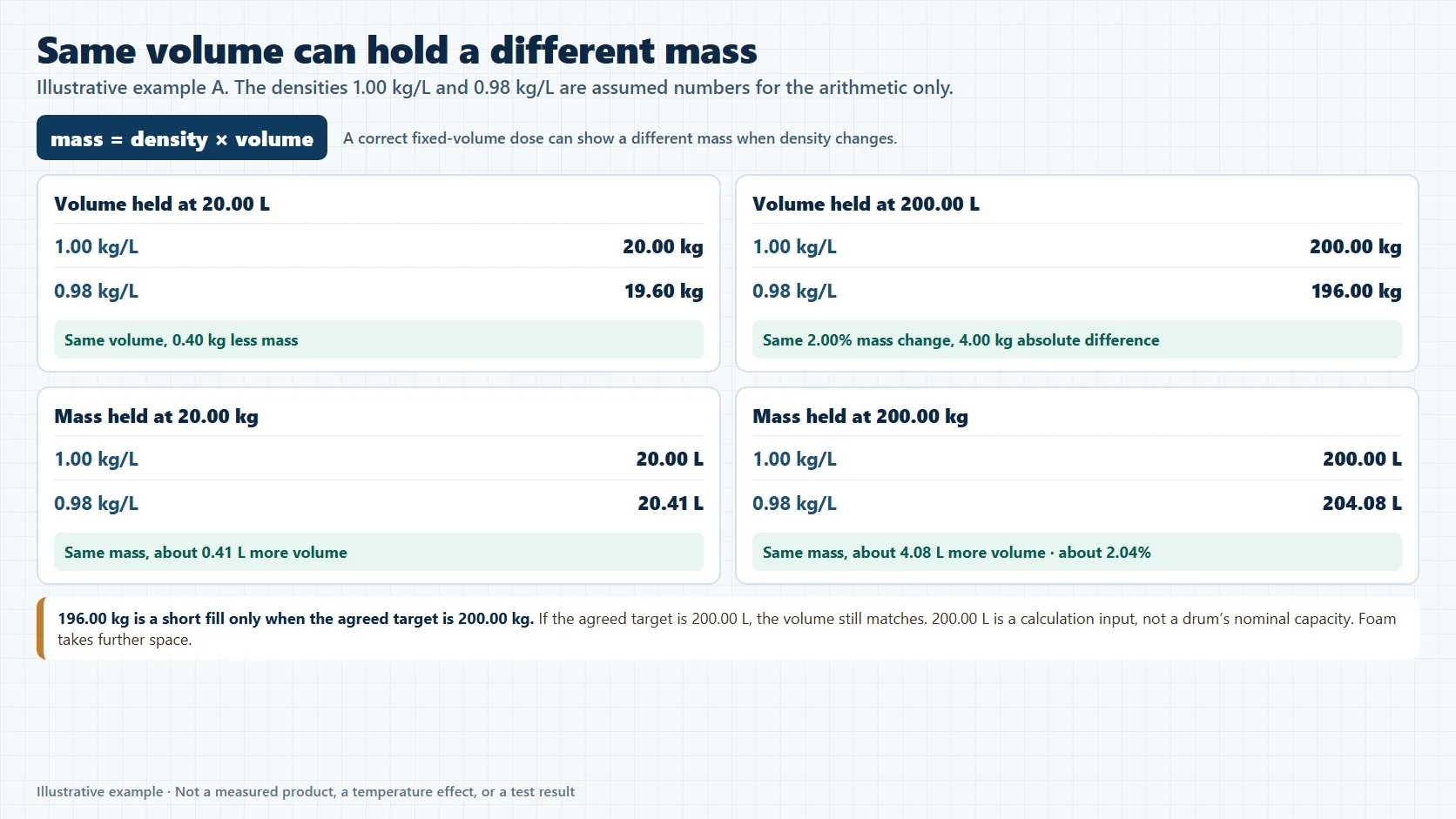
Mass, density, and volume follow m = ρ × V. A correct fixed-volume dose can show a different mass when density changes, and a fixed mass can occupy a different volume. Keep that density shift separate from a viscosity change at cutoff and from air mixed into the liquid. Confirm any temperature compensation against a stated reference condition on the quoted instrument.
The same volume can have a different mass
Illustrative example A. The densities 1.00 kg/L and 0.98 kg/L are assumed numbers for the arithmetic only. They are not a measured product, a typical temperature effect, or a LEKA test result.
| Held constant | At 1.00 kg/L | At 0.98 kg/L | What the change means |
|---|---|---|---|
| 20.00 L delivered | 20.00 kg | 19.60 kg | Same volume, 0.40 kg less mass |
| 200.00 L delivered | 200.00 kg | 196.00 kg | Same 2.00% mass change, 4.00 kg absolute difference |
| 20.00 kg delivered | 20.00 L | 20.41 L | Same mass, about 0.41 L more volume |
| 200.00 kg delivered | 200.00 L | 204.08 L | Same mass, about 4.08 L more volume |
Call 196.00 kg a short fill only when the agreed target was 200.00 kg. If the agreed target was 200.00 L, the volume still matches. The 200.00 L row is a round calculation input, not a drum’s nominal capacity.
A weight target still needs enough container space
A fixed net mass still has to fit, with headspace for the closure. In Example A, 200.00 kg occupies 200.00 L at 1.00 kg/L and about 204.08 L at 0.98 kg/L, about 2.04% more volume because volume is mass divided by the lower density. Foam takes further space. Check that volume against the mass target, the lowest expected density, and the path into the opening.
Send density at the temperature where it was measured.
Why Tare Weight Matters for Pails and Drums
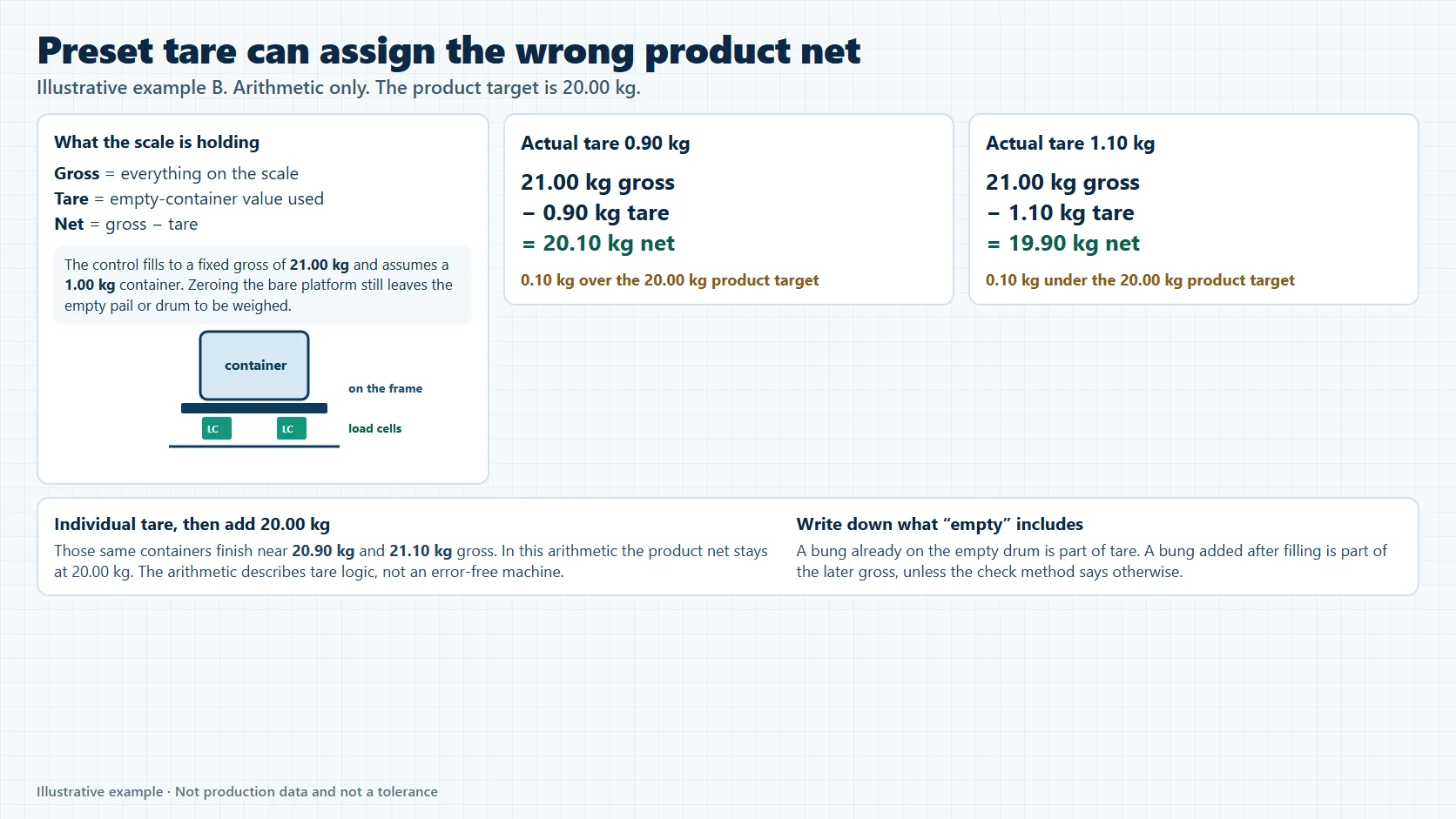
Net mass equals gross minus tare. A wrong tare assigns the wrong product mass even after the display has settled. METTLER TOLEDO’s weighing guidance defines gross, tare, and net for analytical balances. Use it for those terms only, not as a pail or drum filling procedure.
Individual tare versus a preset container weight
Individual tare weighs each empty pail or drum before product is added. Preset tare applies one stored empty-container value to every fill. That stored value holds while real containers stay close to it.
Illustrative example B. This is arithmetic, not production data. The product target is 20.00 kg. The control fills to a fixed gross of 21.00 kg and assumes a 1.00 kg container.
| Actual empty-container tare | Final gross | Actual product net |
|---|---|---|
| 0.90 kg | 21.00 kg | 20.10 kg |
| 1.10 kg | 21.00 kg | 19.90 kg |
One gross setting produced two nets because the containers were not 1.00 kg. If the scale tares each container and then adds exactly 20.00 kg, those containers finish near 20.90 kg and 21.10 kg gross. The arithmetic describes tare logic, not an error-free machine.
Shell material, a new batch, a liner, and fittings all change what “empty” includes. Ask the quotation to state individual or preset tare, and run empty containers from more than one batch in the trial.
Define what is on the scale at each check
Zeroing the bare platform leaves the empty pail or drum still to be weighed. Write down what is included before filling, at the stable filled reading, and after closing. A bung already on the empty drum is part of tare. A bung added after filling is part of the later gross, unless the check method says otherwise. A finished pallet weight is one total for the load. How each drum is proved belongs with pallet transfer below.
Coarse and Fine Filling: Control the Final Approach
A common pattern runs a fast bulk fill, then a slower approach near the target, so cutoff has a smaller stream to control. Switch point, supply stability, valve response, and product still in the lance after the close command all affect the result. There is no universal fast/slow percentage, delay, or gram allowance.
The controller can close the valve before the display equals the target, so product already in motion can finish entering the container. The acceptance reading is the later stable value, taken with the lance and any other contact in the state named for the check. The first moment the display crosses the target is an intermediate signal.
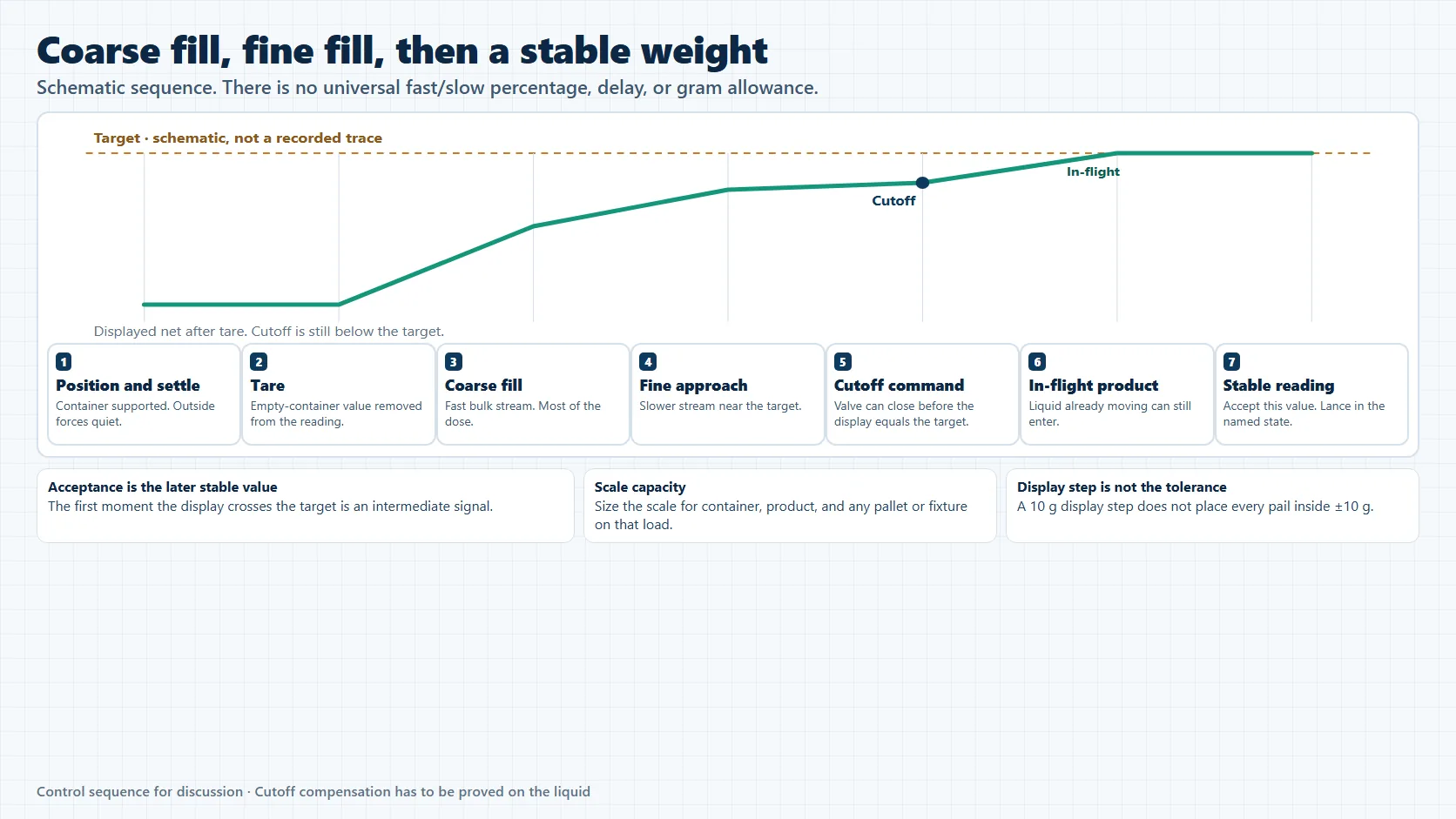
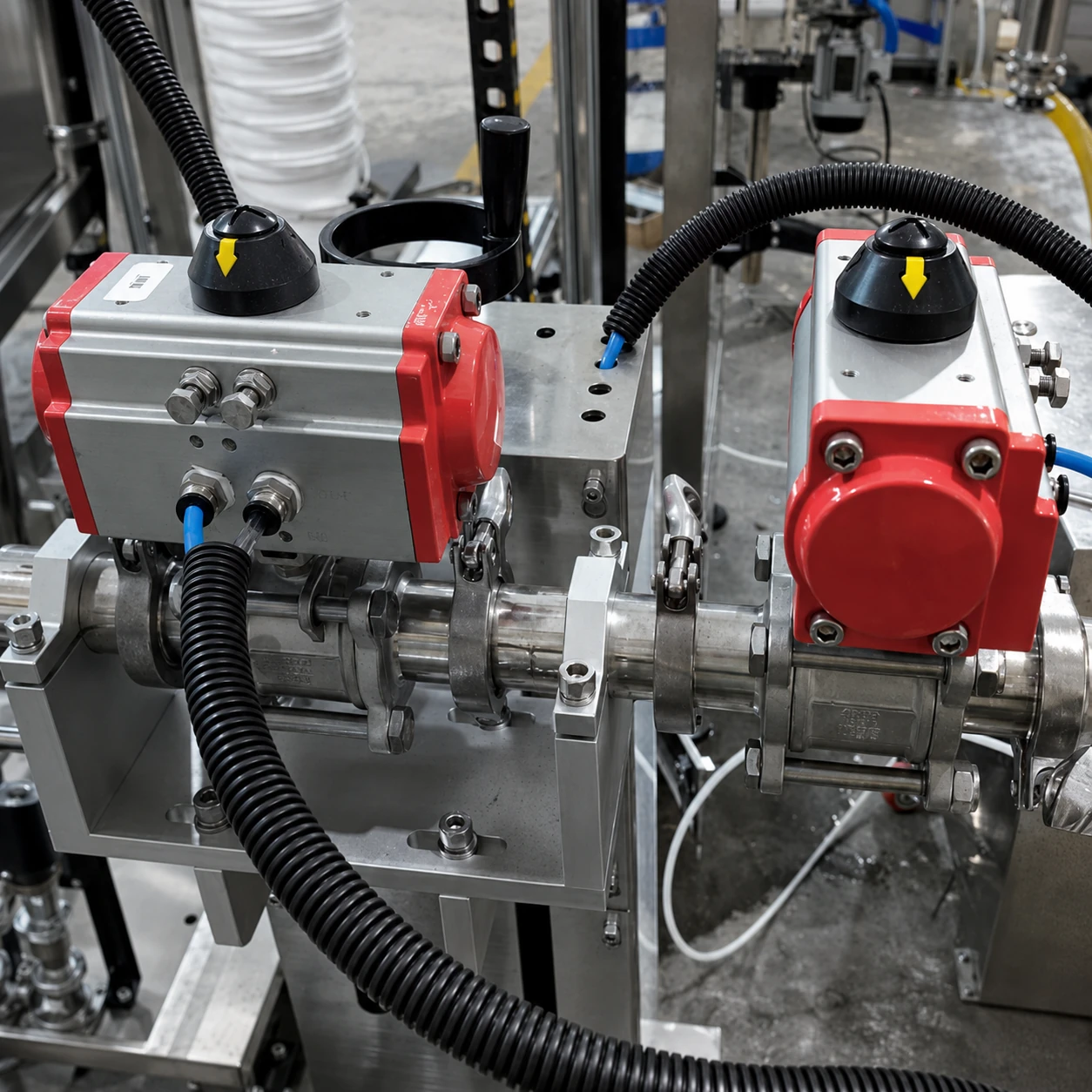
METTLER TOLEDO’s SLP85xD installation manual treats positioning, filling, and removal as separate stages and describes cutoff signals to a valve or PLC. Rice Lake’s vessel-weighing guidance covers support, outside forces, two-speed feeding, in-flight product, and cutoff compensation. Apply them as weighing principles from those documents, not as a test record or a cutoff allowance for your liquid.
On the product trial, watch position and settle, tare, bulk fill, the slow approach, cutoff and the in-flight drop, the recheck, and release or deviation handling. Treat a later top-off as a separate quoted function.
Scale capacity, display increment, repeatability, and fill tolerance are different numbers. Size the scale for the gross load on it: container, product, and any pallet or fixture on that load. A 10 g display step does not place every pail inside ±10 g. Any accuracy figure needs the dose, product, temperature, tare method, speed, and sample record beside it.
Match Top Fill, Subsurface Fill, and Drip Control to the Liquid
A mass target leaves foam, splash, stringing, and drips to the lance, the flow profile, and the opening. Viscosity still changes how the product feeds and how the stream breaks.
Choose the fill position around foam and splash
Top fill and subsurface fill locate the lance relative to the liquid surface. Either metering method can use either position. In top fill the nozzle stays above the rising surface, which suits splash that stays inside the opening. Subsurface fill uses a diving or level-following lance and releases product at or below the surface when the mouth foams, provided the existing opening gives the lance a path. Neither position is required for every coating, cleaner, or lubricant.
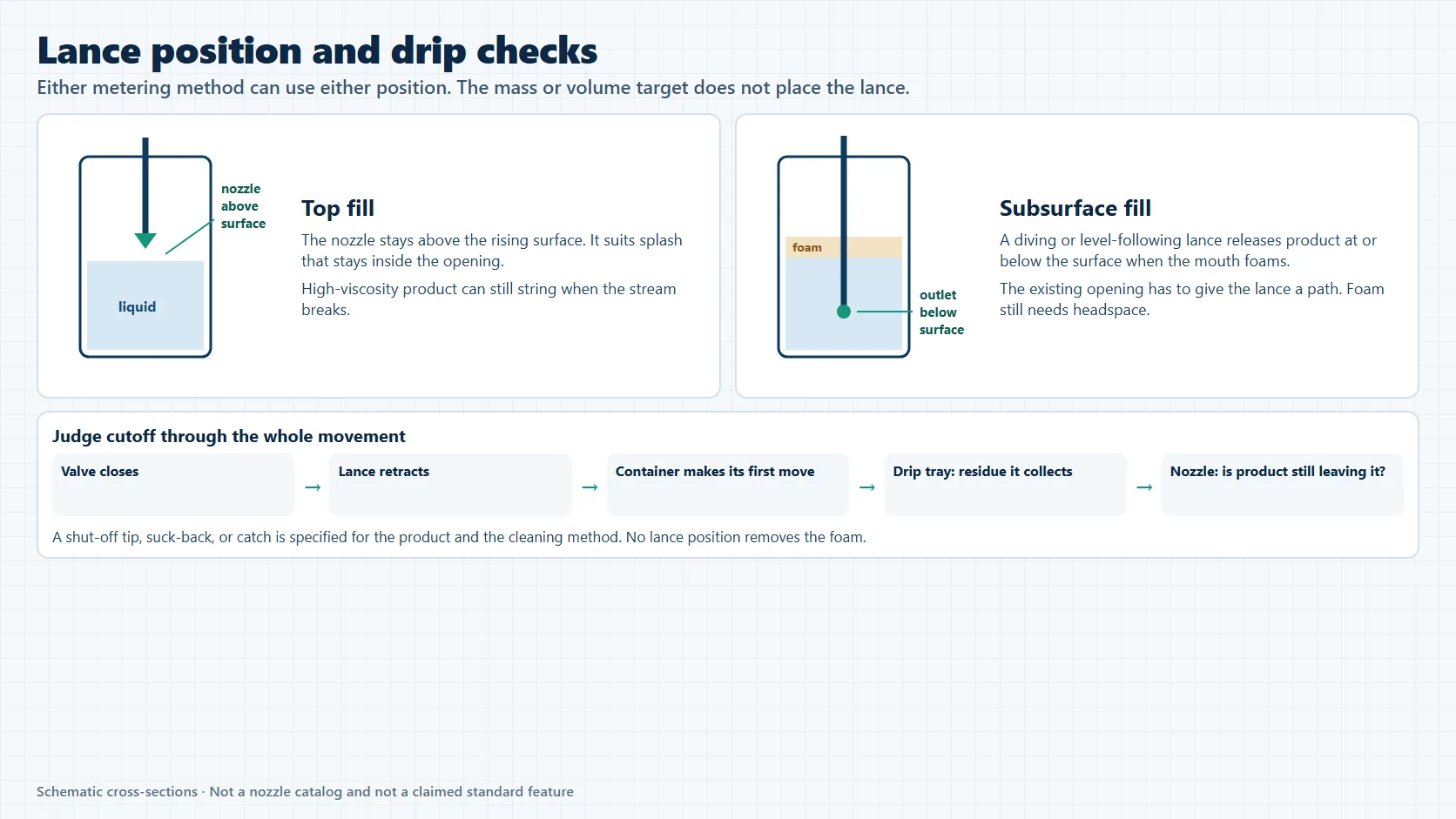
For a foaming cleaner, review a low-splash start, a subsurface or level-following lance if the opening allows it, the starting flow, and the end of the fill. Run the actual formula. The useful result stays in the container and leaves a closable mouth after the foam collapses. No lance position removes the foam.
Check cutoff and drips through the whole movement
Watch the valve as it closes, the lance as it retracts, and the container as it makes its first move. A drip tray collects residue. Judge the nozzle separately, by whether product is still leaving it. High-viscosity coatings may string at cutoff. Match any shut-off tip, suck-back, or catch to the product and the cleaning method. Specify those devices in the quotation. They are options to confirm, not a listed standard feature of every LEKA machine.
Send the product, cleaning chemicals, temperature, and required seals together. A material that suits one coating or cleaner can fail on the next. The reference on wetted-part materials for liquid filling lines is the checklist for that review.
Plan Pail Lid Handling and Drum Pallet Transfer Together
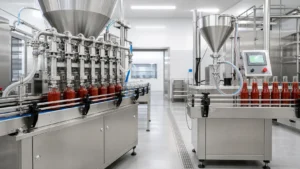
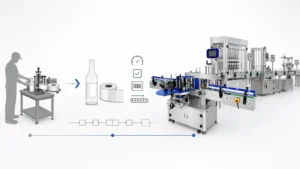
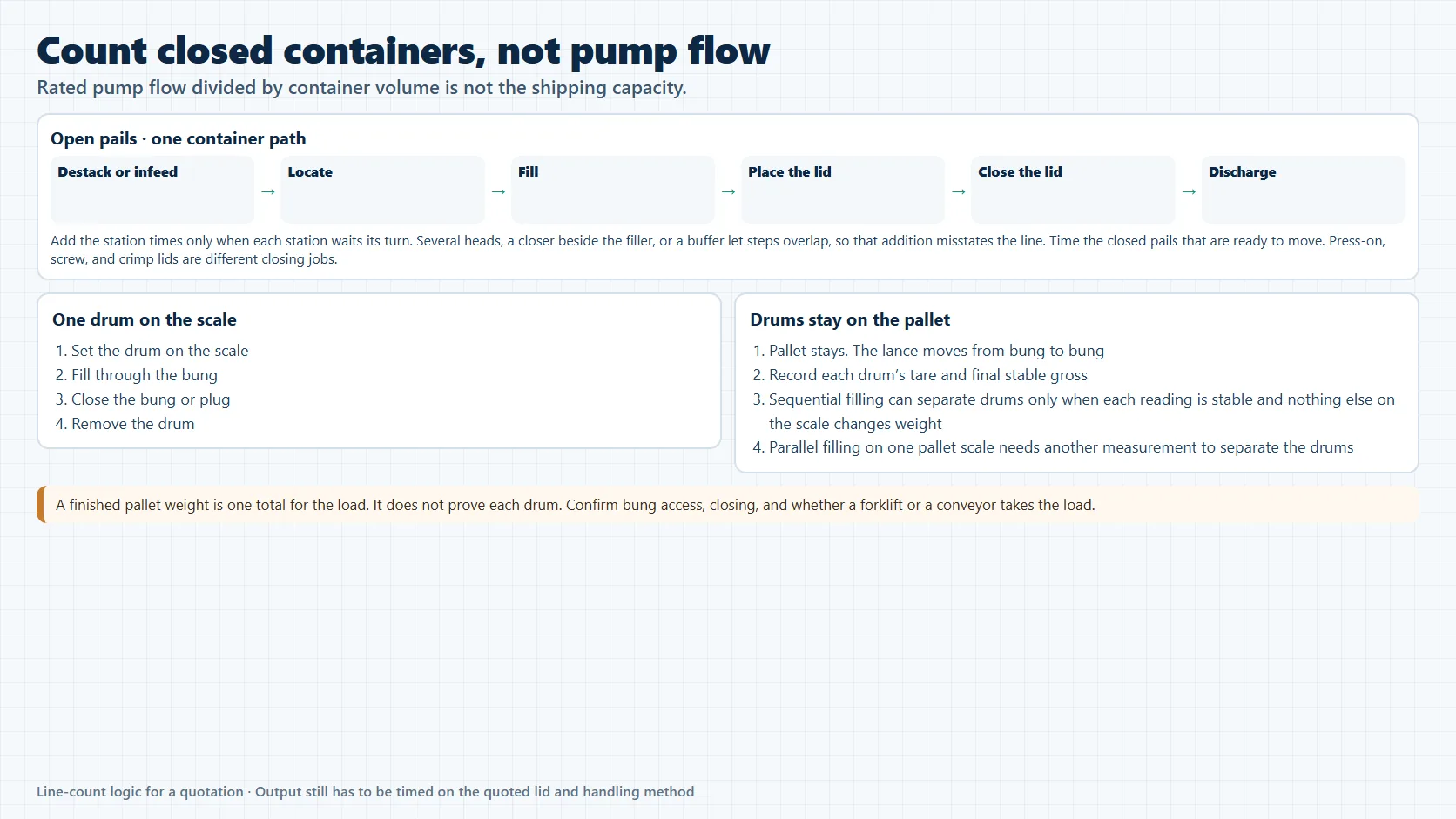
Count finished, closed containers per hour under one product, container, lid, and handling method. Rated pump flow divided by container volume is not that shipping capacity.
Pails: filling is only one part of the cycle
A typical pail path is destack or infeed, locate, fill, place the lid, close it, and discharge. A press-on lid, a screw lid, and a metal crimp or lug cover are different closing jobs. Confirm the lid with samples before you assume one closer can run it.
Where each station waits its turn, add the steps to explain output. Several heads, a closer running beside the filler, or a buffer let steps overlap, so that same addition misstates the line. Time the closed pails that are ready to move.
Drums: single-container and palletized workflows
One layout sets a single drum on the scale, fills it, closes the bung, and removes it. Another leaves the drums on a pallet and moves the lance from bung to bung. Confirm bung access, manual or automatic location, how the bung or plug is closed, how the load leaves the scale, and whether a forklift or a conveyor takes it.
Verify each drum, not only the completed pallet
Ask for each drum’s tare and final stable gross, or another increment the supplier can defend. Sequential filling on a pallet scale can support that increment only when each reading is stable and nothing else on the scale changes weight. Parallel filling on one pallet scale cannot separate the drums without another measurement. Confirm the boundary in the proposal. It is not a described LEKA control feature.
Take the product, container, target quantity, lid, and output into a review of drum and pail filling system solutions. LEKA Pack Line can review those inputs and evaluate a suitable filling and line configuration. Specific machine features, guaranteed output, and accuracy require confirmed project documentation.
Compare the Methods Using Your Actual Product and Container
Use the rows to open the discussion. A trade name still leaves viscosity, particles, formula, and cleaning to be specified.
| Production requirement | Starting point for evaluation | Confirm before selection |
|---|---|---|
| Liquid sold or controlled by mass, with density that changes | Load-cell net-weight filling | Tare method, final weight check, container space, cycle time |
| Stable liquid with a defined volume target | A matched volumetric dosing system | Metering principle, operating conditions, calibration, independent quantity check |
| Foaming cleaner in open pails | Quantity control and fill position as separate decisions | Foam, nozzle travel, headspace, cutoff, lid handling |
| Viscous coating that strings at cutoff | Delivery and nozzle control with the dosing method | Supply consistency, compatibility, cutoff, cleaning |
| Heavy drums moved as a pallet load | A palletized filling arrangement suited to that load | Full gross load, bung access, per-drum records, closing, transfer |
Ask two suppliers to quote the same product, target, container, output definition, and acceptance method. These checks are a buying aid, not a completed factory test or a legal-metrology procedure.
- Target. Net mass or net volume, with units, reference conditions, and limits. Keep mass error and volume error separate.
- Medium and conditions. The actual product, or a substitute with a written reason, plus fill temperature, density at that temperature, viscosity conditions, particles, and supply state.
- Container and tare. Real pails or drums, liners, openings, and lids or bungs. State individual or preset tare and what is on the scale before filling, after the stable reading, and after closing.
- Meter and reference. Name the scale, meter, or displacement device and its working range. Check the result on an independent reference in a known calibration state.
- When the reading counts. Accept it after in-flight product has landed, with the reading stable and the lance in a defined state.
- The sample, unedited. Keep consecutive results, including outliers, stops, and rework. Report average deviation, minimum, maximum, spread, and how many fell outside the limits.
- Finished output. Time closing and transfer. Record foam and drips at fill, cutoff, withdrawal, and the move. For a pallet, state how each drum is identified.
- A change of conditions. Repeat a check after a shift in temperature, viscosity, or supply, after stops and restarts, and after cleaning or a formula change.
A single average or a short video leaves the list open.
Frequently Asked Questions
Does a 5-gallon pail filling machine have to use net weight?
No. Match the method to the fill target, the product, and the lid. By the NIST factor of 3.785412 L per US gallon, 5 US liquid gallons equal about 18.93 L, and 55 US liquid gallons equal about 208.20 L. Keep those figures apart from 20 L, 20 kg, and the imperial gallon. A “5-gallon pail” is often a nominal size. Confirm allowable fill and headspace. Both volumetric and net-weight fillers are used on pails.
Can volumetric filling be used for drums?
Yes, when the dosing system is matched to the liquid and checked on the drum. Confirm the metering principle, supply, cutoff, bung access, and an independent quantity check. Naming the pump is not that check.
Does net-weight filling remove the need for foam control?
No. The scale can meet the mass target while foam still fills the headspace or wets the lid seat. Match the lance and the flow to the liquid, and leave room for the foam to fall before closing.
Is a Coriolis flow meter a volumetric filler?
No. It measures mass flow directly and can calculate volume from density. Judge it by the control target and the rest of the configuration, using the mass-flow description already cited from Emerson.
Can drums be filled while they remain on a pallet?
Yes. Confirm gross load, bung access, closing, transfer, and the record for each drum. A pallet total leaves each drum’s net quantity unproved. Any LEKA Pack Line layout for that work is reviewed project by project.
What filling accuracy should I request?
State the acceptable net range and the check conditions: product, temperature, container, tare method, complete-cycle speed, and the independent measurement. One figure does not cover every liquid, dose, and machine.
Name net mass or net volume, with units and limits, then accept a configuration only after a trial that includes closing, transfer, and an independent check.
Send your product details, pail or drum size, target fill quantity, lid type and required output for a filling-method review.
Request a Filling-Method Review
Not sure which method fits? Start with your product, container and target quantity.