
How to Diagnose Bottle Capping Problems: Loose, Overtightened and Cross-Threaded Bottle Caps
The capping line ran well yesterday. Today, some caps feel loose, some are difficult to open, and others sit at an angle. The first reaction is often to increase the machine setting. That can hide the real cause or create another defect.
Do not begin by increasing torque. First confirm the symptom, then identify whether the cause belongs to the bottle-and-cap combination, cap placement, bottle handling, the tightening cycle, product condition or the measurement method. Torque is only one possible cause of bottle capping problems.
This guide focuses on continuous-thread closures used on plastic or glass bottles. ROPP, crown, snap-on, lug, pump, trigger and child-resistant closures use different application and opening mechanisms, so they require closure-specific evaluation.
Quick Answer: Do Not Start by Increasing Torque
Start with what you can see, measure and reproduce. Is the cap actually loose, or only easy to open? Is it square, fully seated or leaking? Each observation leads to a different check.
More torque will not correct incorrect thread engagement or a spinning bottle.[8][9][10] It also will not resolve an incompatible bottle-and-cap combination or a leak caused by the liner, sealing surface or another sealing feature.[4][7]
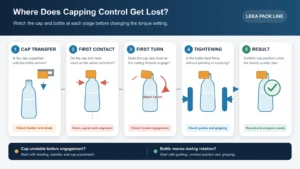
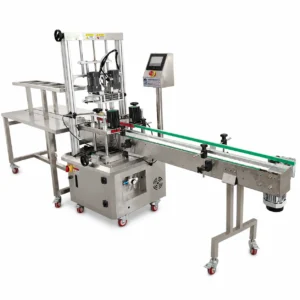
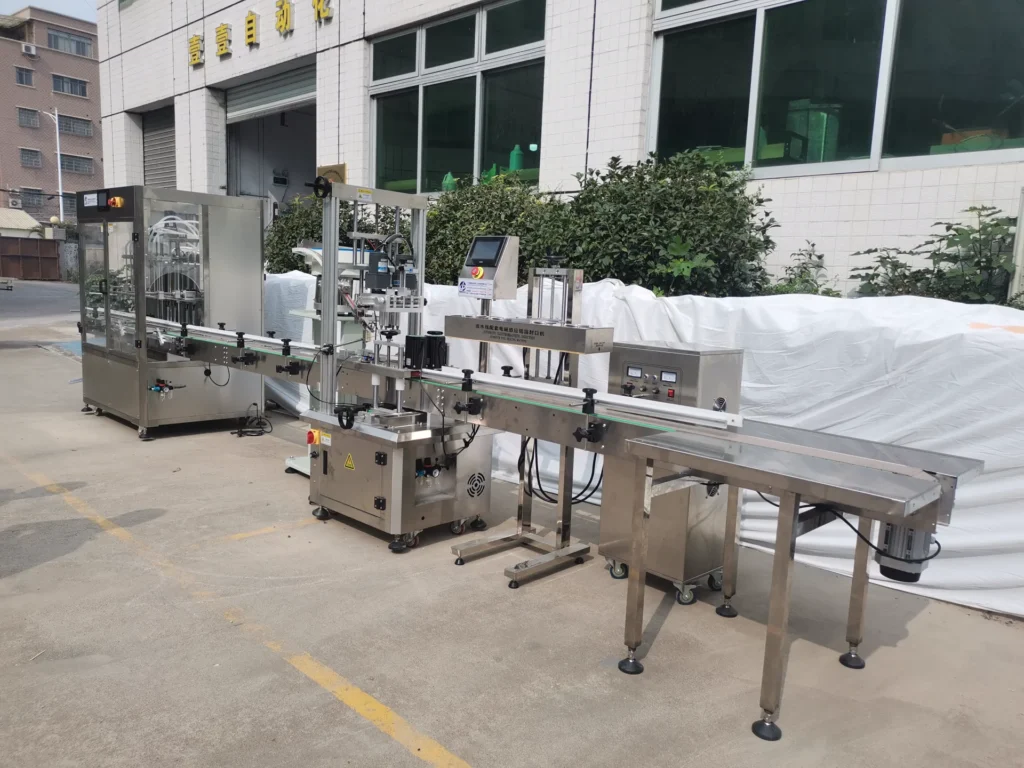
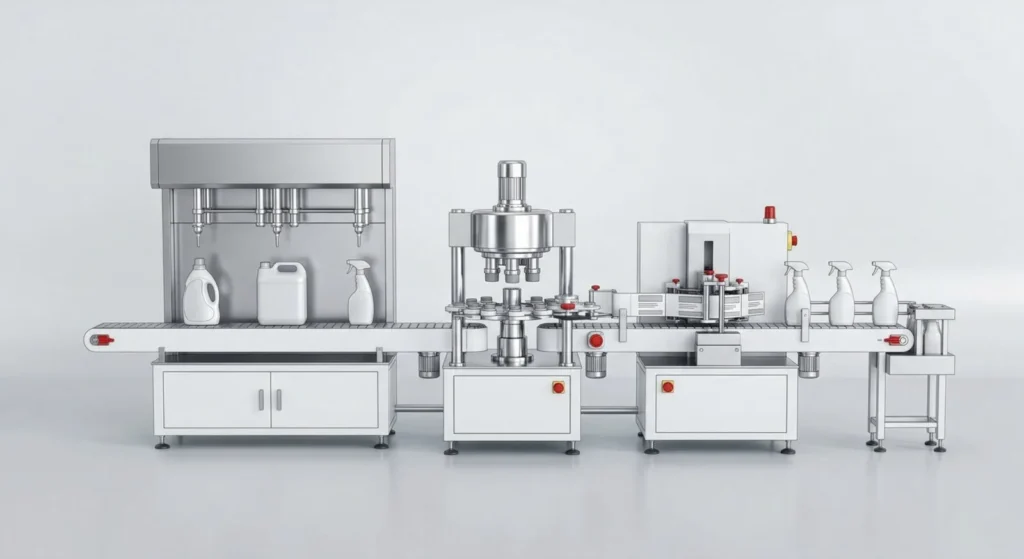
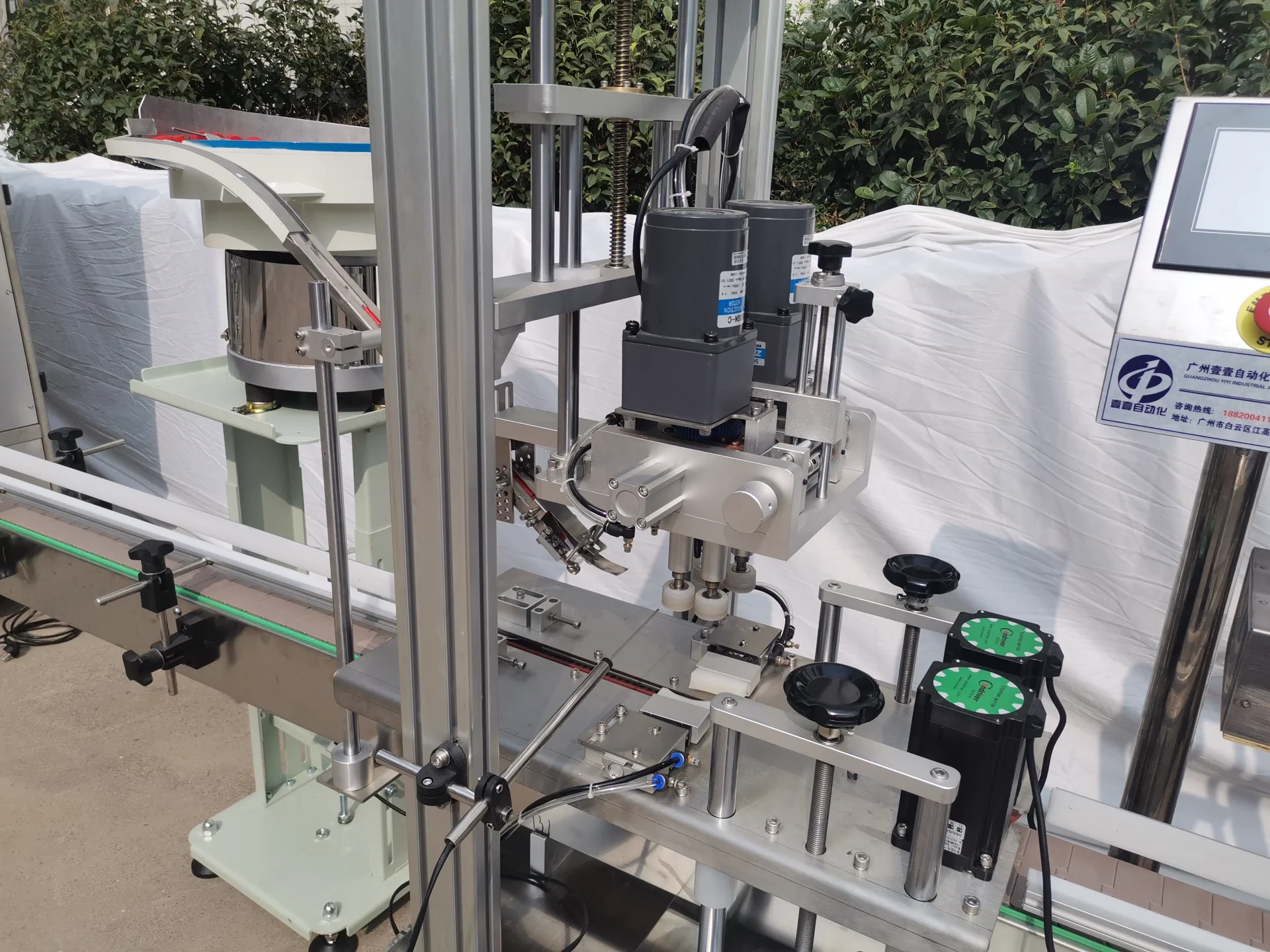
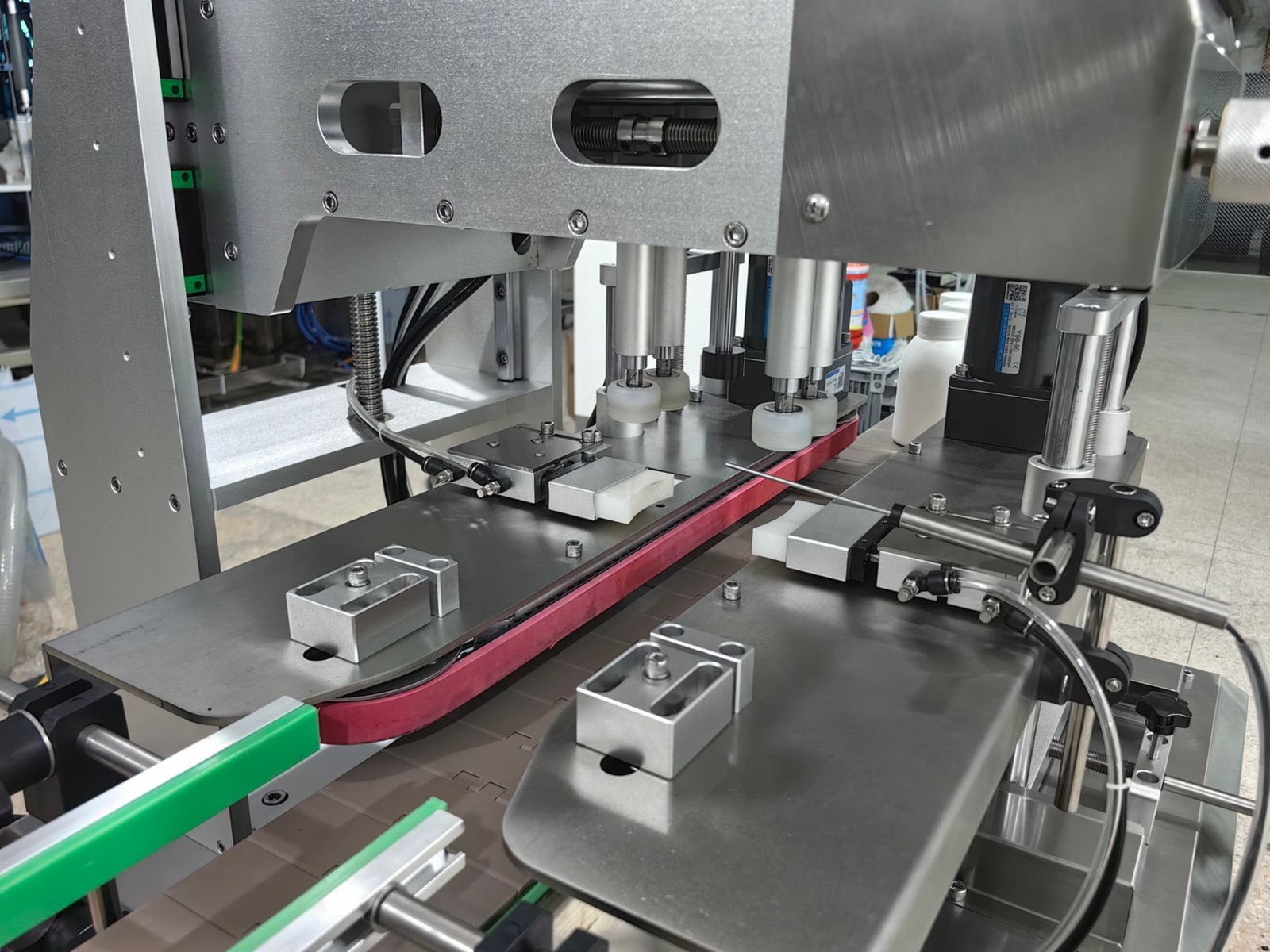
For relevant LEKA intermittent capping configurations, the operating sequence includes cap feeding, placement, pre-seating, bottle clamping, roller tightening and bottle release. A problem at any stage can change the final result, so observe the complete cycle before blaming one setting.
What Bottle Capping Problem Are You Actually Seeing?
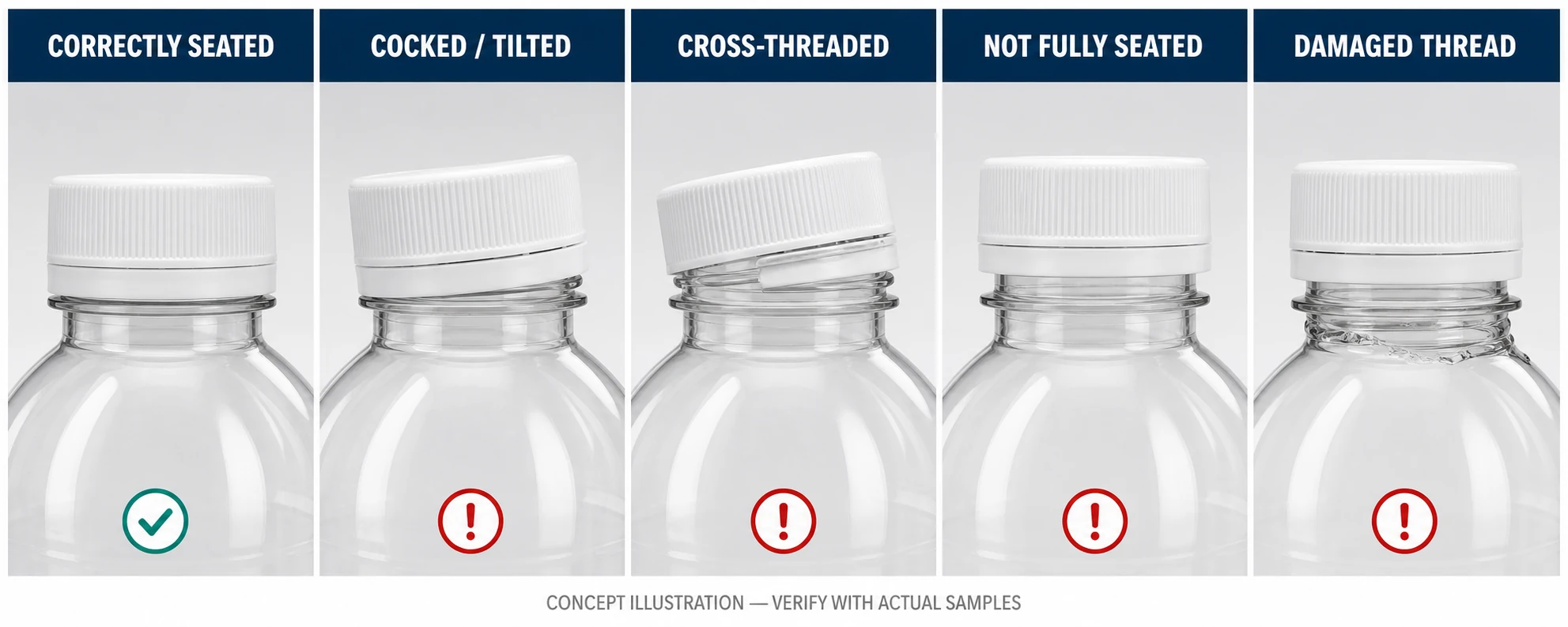
Use this table for the first sorting step. It does not replace the closure supplier’s specification or testing of the actual package.
| Symptom | First Check | Possible Cause Layer | Do Not Assume |
|---|---|---|---|
| Cap feels loose or opens easily | Measure the defined opening event and inspect seating | Closure fit, incomplete seating, bottle spinning or measurement method | Low application torque has been proven |
| Opening value is high | Identify the event, such as initial release or tamper-band break | Liner, tamper-evident band, product residue or measurement method | The machine definitely over-applied the cap |
| Cap sits at an angle | Inspect thread engagement before tightening | Cap placement, bottle centering, closure fit or component damage | More torque will straighten it |
| Cap is not fully seated | Compare its final position with an approved reference | Closure fit, placement, bottle spinning or an incomplete cycle | The visible gap is a torque reading |
| Bottle rotates during tightening | Mark the bottle and cap, then observe both | Bottle grip, rigidity, contact surfaces or product residue | The tightening head achieved its intended result |
| Package leaks after capping | Inspect the sealing land and test package integrity | Liner, closure fit, residue or another sealing feature | A tight-feeling cap proves a sound seal |
A Practical Bottle Capping Diagnosis Sequence
- Preserve defective samples. Keep the bottle, cap and product condition as found. Record the line, time, component lot and machine condition. Do not remove or reapply the cap before documenting its position.
- Define the actual symptom. Separate loose feel, low opening value, proven back-off, leakage, high opening resistance, tilted position, damaged threads and incomplete seating. One package may show several symptoms.
- Check the measurement method. Confirm the measured event, elapsed time, bottle fixture, rotation method and whether the instrument was suitable and calibrated.[1][2]
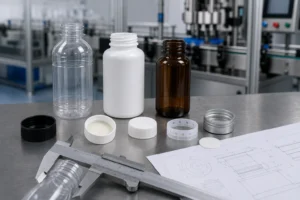
- Compare good and bad components. Check the bottle finish, threads, cap dimensions, liner, tamper-evident features, component lot and product contamination.
- Observe placement, bottle movement and tightening. Watch the cap before contact, during engagement and at release. Slow-motion video and reference marks can reveal tilted placement or bottle spinning.
- Change one variable and retest. Isolate one component, handling or setting change, then use the same test method and agreed sampling plan.
Loose Caps, Low Opening Torque and Cap Back-Off
These descriptions are not interchangeable. Operator feel is not a controlled measurement, and a package can leak without feeling loose.
Removal torque, or measured opening resistance, is the value recorded when a closure is opened under a defined method. A low value identifies low opening resistance under the stated test conditions; it does not reveal the original application torque by itself.[1][11] Compare it with the range provided by the closure supplier or validated by the package owner, not a universal chart.
Cap back-off means that the closure moves in the loosening direction after application or during a later process.[5] To investigate it, place aligned reference marks on the cap and bottle immediately after application. Record the timing and conditions, then look for actual relative movement. A later low removal value alone does not prove back-off.
If the cap is high, uneven or incompletely seated, investigate placement, thread engagement, bottle restraint and the tightening cycle. If its position is correct but the opening value is low, compare component lots, liner condition, storage time, temperature, contamination and the test method before changing torque.
Overtightened Caps, High Opening Values and Damaged Threads
A cap that is difficult to open may be over-applied, but high opening resistance is not proof.[4][10] The measured peak may include more than the initial release of the threaded closure.
A tamper-evident band can create a separate opening event, such as the point at which the band breaks or releases.[4] Liner adhesion, thread friction, product residue and the test method can also change the result. Record which event is being evaluated instead of treating every peak as the same value.
Product residue may lubricate threads during application or increase resistance after drying, so test its effect with the actual product.[11][12] Compare clean and production-condition samples without assuming that contamination always changes torque in one direction.
Inspect both the cap and bottle finish for stripped or damaged threads, deformation, cracks and stressed tamper-evident features. These findings are physical evidence. Without component damage or controlled application data, high opening resistance does not prove machine over-application.
Cross-Threaded, Cocked and Not-Fully-Seated Caps
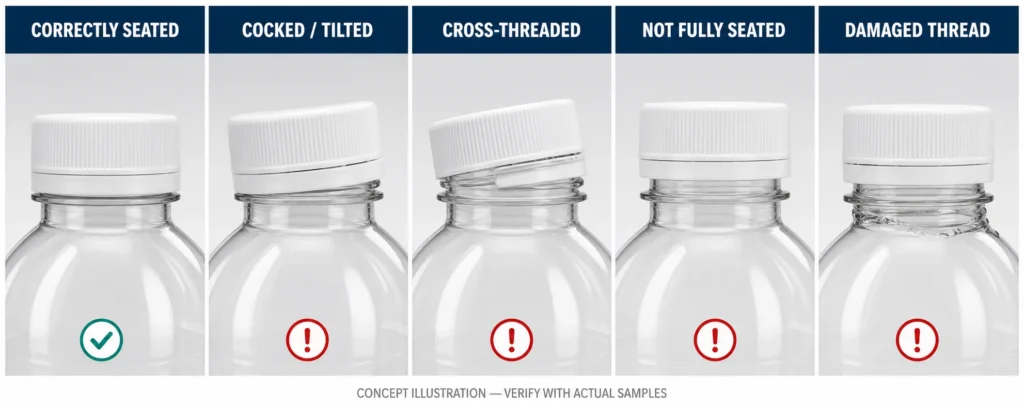
A cross-threaded cap has engaged the bottle thread incorrectly. Increasing torque is not the corrective action for confirmed cross-threading; correct engagement and alignment first.[8][9] Additional force can damage the cap, bottle thread or tamper-evident feature.
A cocked or tilted cap describes its angled position. It may be cross-threaded, but the angle alone does not prove the exact thread condition. A cap may also remain relatively square while not being fully seated.
A visible gap or abnormal cap height can indicate an application-position problem, but it is not a torque measurement.[6] Compare the position with an approved drawing, closure-supplier guidance or a validated good package.
Observe when the cap first tilts. If it is off-center before tightening, inspect feeding, placement and bottle centering. If it tilts during tightening, inspect thread engagement, bottle stability, tightening-head contact and component variation.
Inaccurate cap placement can cause unstable capping in applicable LEKA configurations. Observe the cap at placement and pre-seating, not only after tightening has finished.
Bottle Spinning and Inconsistent Cap Tightness
Bottle spinning occurs when the bottle rotates with the cap or tightening mechanism instead of remaining restrained. This reduces the effective relative rotation between the closure and bottle finish. The cap may stop high or fail to reach a consistent final position.[8][10]
Mark the bottle and cap, then record the cycle from a safe position. Check for movement during initial contact, tightening and release. Video can reveal rotation that is difficult to see at production speed.
For relevant LEKA configurations, bottle spinning can prevent complete tightening. Evaluate bottle clamping, container rigidity, surface condition and contact geometry with the actual bottle rather than assuming that a similar package will behave the same way.
Mixed component lots, variable placement, bottle-height variation, worn contact parts, product residue and inconsistent testing can also create variation. An unchanged machine setting does not eliminate these possible causes.
Why a Bottle Can Leak Even When the Cap Feels Tight
A tight feel describes opening resistance, not seal integrity. Depending on the package design, sealing may rely on a liner, plug feature, top seal or another sealing feature.
Inspect the sealing land, the bottle surface contacted by the liner or seal, for damage, contamination, flash or unevenness. Also check liner presence and position, bottle-finish dimensions, thread damage and product trapped in the sealing area.
Torque and package-integrity tests answer different questions; passing a torque test does not prove leak resistance.[3][11] Use the package owner’s validated integrity method for the product and closure. Check the sealing path and components before classifying a leak as a torque problem.
When Torque Adjustment Is—and Is Not—Appropriate
- Application torque and removal torque are different measurements. One is applied during closing; the other is measured during later opening. They are related for a specific package but are not interchangeable.
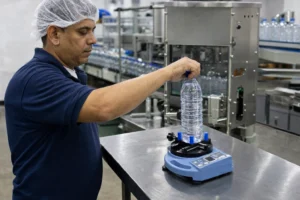
- Use a repeatable bottle cap torque test. Define the opening event, sample condition, test interval and fixture before comparing readings or adjusting the machine.
- Timing and conditions affect opening results. Materials, liner behavior, temperature, storage and the test method can change the measured value.
- Machine settings are control inputs. A setting is not automatically an independent measurement of closure torque.
- The package specification takes priority. Use the closure supplier’s specification and validate the actual bottle, finish, cap and liner combination. No universal torque value or application-to-removal ratio fits every cap.
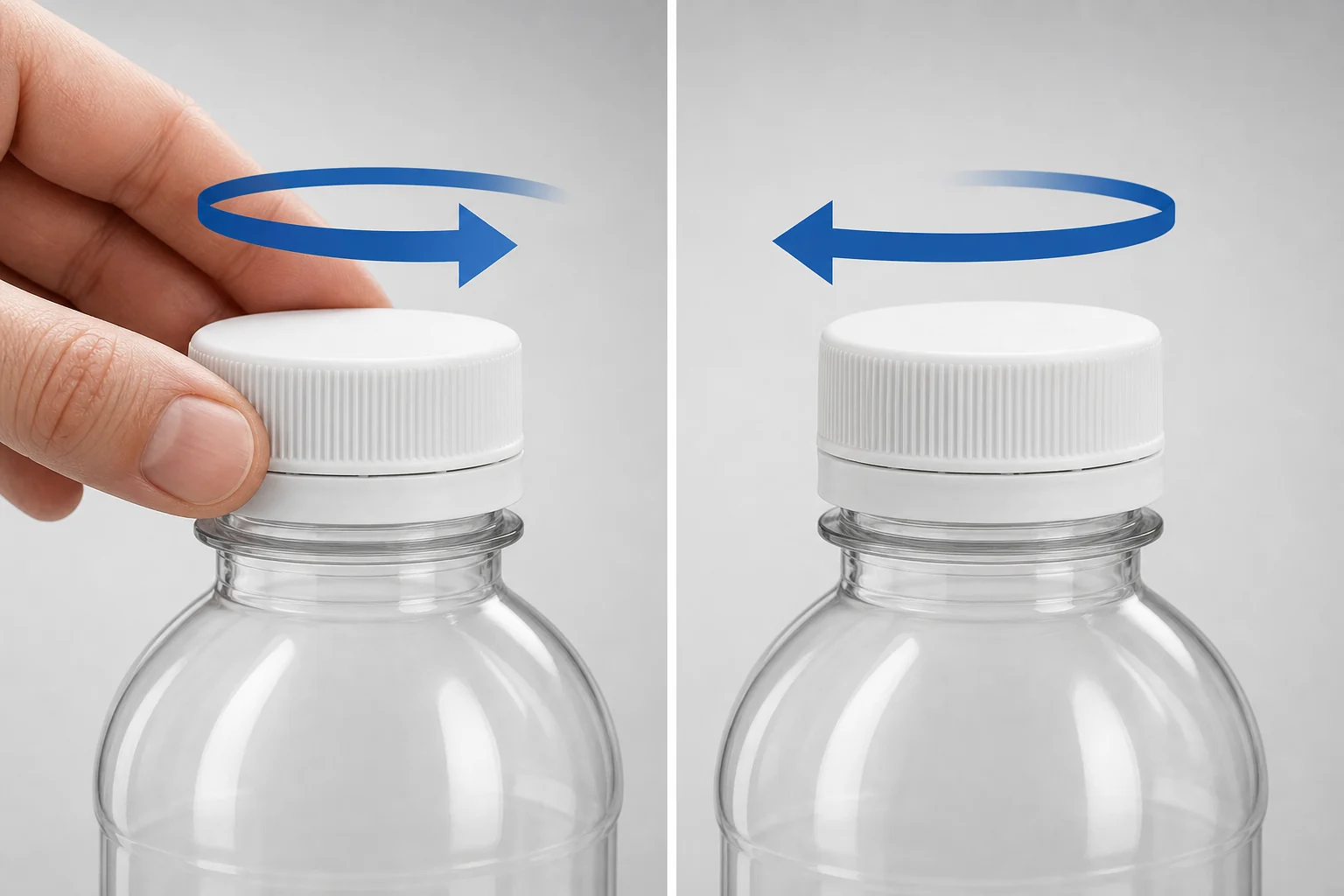
Torque adjustment may be appropriate when…
- The cap is correctly presented, centered and engaged.
- The bottle remains stable throughout tightening.
- The bottle, finish, cap and liner are approved as compatible.
- The measured event, timing, fixture and method are controlled.
- Results remain outside the approved package range.
- A controlled change improves results without causing damage or seating problems.
Do not adjust torque yet when…
- The cap is tilted, cross-threaded or visibly damaged.
- The bottle spins or moves during tightening.
- The cap is not consistently placed or pre-seated.
- Component identity, lot or compatibility is uncertain.
- Product residue or sealing-surface damage is present.
- The instrument, fixture, timing or measured event is not controlled.
LEKA’s standard ten-step mechanical adjustment is a relative machine setting, not a calibrated N·m measurement. On applicable servo configurations, current or load parameters are control inputs, not independent measurements of closure torque. Check the finished package using the agreed test method.
What Evidence to Send a Capping-Machine Supplier
A supplier can diagnose faster when the evidence describes the package, process and measurement conditions.
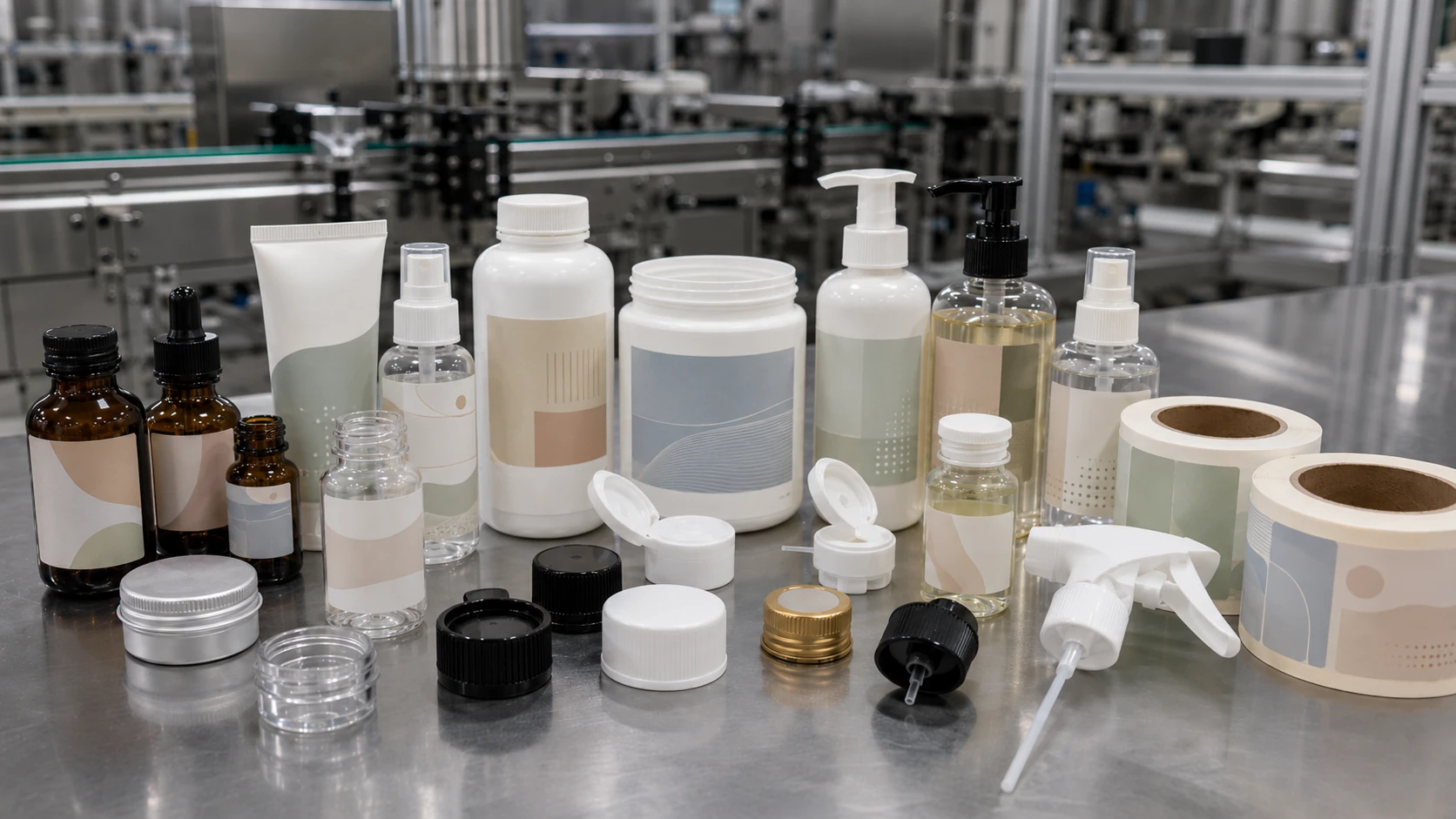
- Bottle drawings or specifications, including material, dimensions and neck finish.
- Cap drawings or specifications, including thread design, liner and tamper-evident features.
- Good and defective bottles, caps and filled samples when shipping is safe and permitted.
- Photos of cap position, thread damage, sealing surfaces and visible gaps.
- Videos showing cap delivery, placement, pre-seating, bottle restraint, tightening and release.
- Product and fill conditions, including residue near the bottle finish.
- Machine model, line speed, settings, change parts and recent maintenance history.
- Test instrument, fixture, calibration status, elapsed time, measured event, raw results and approved comparison range.
Unusual bottles, closures or new neck finishes require actual samples for LEKA engineering evaluation. A name, photograph or nominal diameter may not show the thread engagement, bottle rigidity, cap presentation or sealing behavior needed to select and test a configuration.
When to Escalate the Problem to QA or Stop Testing
Escalate the issue when there is leakage, possible contamination, damaged tamper evidence, cracked components, loss of traceability, repeatable results outside an approved specification, or uncertainty about package safety or compliance. Preserve affected samples and records for QA review.
Production hold, release, rework and safety decisions depend on the customer’s QA team, quality management system, product risk and local requirements. This article does not create universal stop-line or release criteria. If continued testing could compromise safety, evidence or product quality, follow the site’s approved procedure.
Frequently Asked Questions
Should I increase capping torque when caps feel loose?
Not first. Check seating, bottle movement, the measured opening event and leakage. Adjust the setting only after placement, handling, compatibility and measurement issues have been isolated.
Does low removal torque mean the machine applied too little torque?
No. It means opening resistance was low under the stated conditions. Additional evidence is needed to identify the original application torque.
How can I prove cap back-off?
Mark the cap and bottle immediately after application, document timing and process or storage conditions, then look for actual movement in the loosening direction.
Is a tilted cap always cross-threaded?
No. Tilt describes position; cross-threading describes incorrect thread engagement. Document the original position, then inspect the threads and placement process.
Can a tight cap still leak?
Yes. Opening resistance and seal integrity are different. Check the liner or sealing feature, sealing land, component fit, contamination and an appropriate integrity test.
Why are caps inconsistent at the same machine setting?
Placement, bottle grip, component dimensions, liner behavior, residue or the test method may vary even when the setting does not. Compare good and bad samples one variable at a time.
Is there a universal bottle-cap torque chart?
No chart applies to every bottle, finish, cap, liner and product. Use the closure supplier’s specification and validation of the actual package.
What should be tested before FAT?
Provide production-representative bottles, caps and product where practical. Agree on expected output, package checks, sampling, test methods and acceptance responsibility before FAT.
Request a Bottle and Cap Diagnosis Review
If loose, difficult-to-open, tilted or leaking caps are delaying a project, collect the bottle, cap, product, output target, layout and diagnostic evidence before requesting equipment changes.
LEKA can review actual samples and operating requirements to help assess a suitable bottle capping machine configuration or its role in a complete bottle packaging line solution. The review supports configuration and testing decisions; it does not replace the closure supplier’s specification or the package owner’s QA approval.
Sources
- ASTM D2063/D2063M-24 — Measurement of Torque Retention for Packages with Continuous Thread Closures
- ASTM D3474-23 — Calibration and Use of Torque Meters Used in Packaging Applications
- ASTM D5094/D5094M-24 — Gross Leakage of Liquids from Containers with Threaded or Lug-Style Closures
- Silgan Closures — Plastic Closure Quality Checks
- Silgan Closures — Closure Glossary
- Silgan Closures — Plastic Closure Pull-Up Check
- International Society of Beverage Technologists — Plastic Bottle & Closure Qualification Test Manual
- Frain Industries — Solving Common Capper Problems
- Closure Systems International — Series 900T Manual
- Sure Torque — Why Release and Application Torques Differ
- Checkline — Cap Torque Tester Technical Information
- Asia Pacific Food Industry — Bottle Capping: Analysing the Torque