Bleach Filling Machine Guide: How to Configure a Corrosion-Resistant Filling, Capping and Labeling Line
Bleach is one of the most widely filled household chemicals, yet it is also one of the most damaging to packaging equipment. Sodium hypochlorite corrodes stainless steel, foams easily under turbulence, and clings to nozzles long after the fill cycle ends. If you rely on a general liquid filling machine selection guide without accounting for bleach-specific modifications, you risk premature pump failure, inaccurate fills, contaminated labels and unsafe operator exposure.
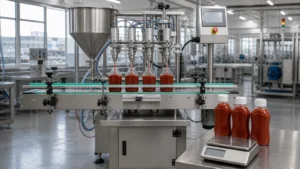
This guide explains how to configure a bleach filling machine line that actually lasts — covering corrosion-resistant wetted parts, anti-drip filling nozzles, HDPE bottle handling, capping, induction sealing, leak inspection and labeling. Whether you are setting up a new bleach bottling line or upgrading from manual filling, the goal is the same: match every contact surface, every seal and every nozzle to the chemistry of your product so the line runs reliably and safely.
What You Must Confirm Before Ordering a Bleach Filling Machine
Before comparing equipment models, collect the information that actually determines machine selection. A supplier cannot recommend the right configuration without knowing what your bleach product does to contact surfaces, how it flows and what container you are filling.
Bleach Concentration and Chemical Compatibility
Household bleach typically contains 3–8% sodium hypochlorite, with most retail products in the 5–8% range. Concentrated and industrial formulations can exceed 10–12%. The higher the concentration, the more aggressively it attacks unsuitable materials, and the more carefully wetted parts must be selected. Before choosing materials, obtain the product Safety Data Sheet (SDS) and confirm the active concentration, pH value and any added surfactants. Chemical compatibility between the bleach formula and every product-contact part — pump diaphragms, tubing, valve seats, nozzle tips and tank liners — must be verified at the operating concentration, not just at the diluted retail level.
Viscosity, Foaming and Bottle Format
Most bleach is thin and water-like, but formulas with added surfactants or thickeners behave differently. Thin bleach foams readily when it hits the bottom of an empty bottle. Thickened bleach flows slowly and clings to nozzle surfaces. Both affect filling accuracy and line speed. At the same time, your target filling volume, bottle shape, neck diameter and target bottles per hour decide how many filling heads you need and how long each fill cycle takes. Bring a sample bottle and cap to any machine discussion — dimensions on paper are rarely enough.
Why a Standard Liquid Filler Cannot Handle Bleach
A standard liquid filling machine is built around stainless steel: SUS304 or SUS316 frames, tanks, pumps, valves and nozzles. These materials are excellent for water, juice, oil and most cosmetic products. But sodium hypochlorite is an oxidizer. It attacks the passive layer that protects stainless steel, causing pitting corrosion that worsens with every production run. Over time — faster at higher concentration — pump seals leak, valve seats erode and nozzle tips develop rough surfaces that cause dripping.
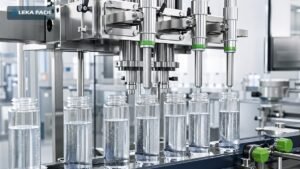
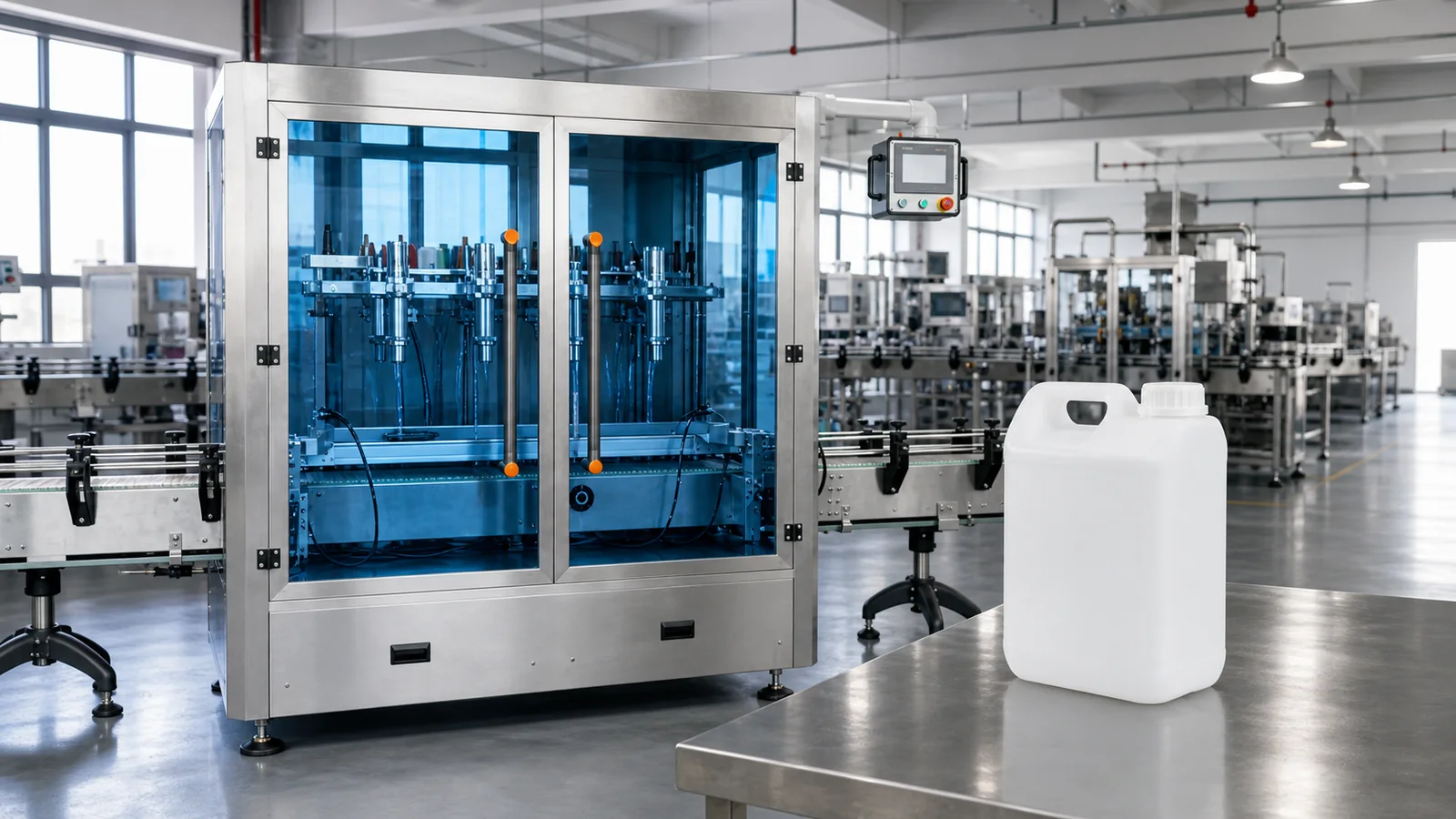
Beyond corrosion, standard machines lack the engineering details that bleach demands. They have no diving nozzles to control foam, no drip trays to contain spills, and no sealed product path to protect operators from fumes. An anti-corrosion filling machine addresses all of these by replacing every wetted surface with chemically resistant materials and adding spill containment around the filling zone.
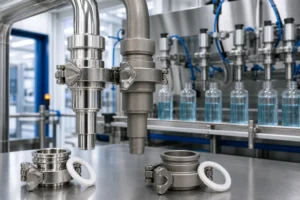
Choosing Corrosion-Resistant Wetted Parts: PP, PVDF and PTFE
The core of any bleach filling machine is its product-contact material selection. Three plastics dominate this space, each suited to a different zone of the machine.
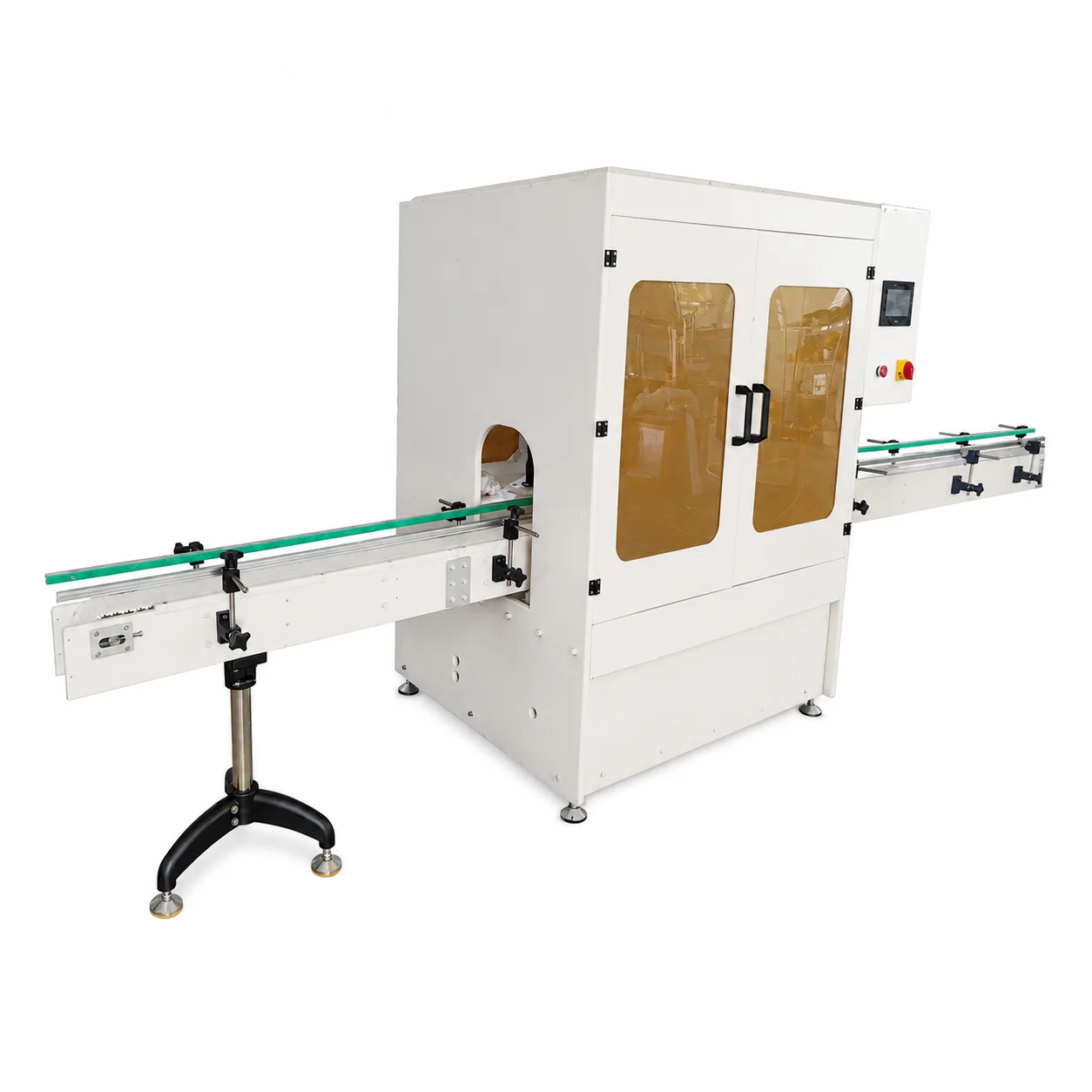
PP (polypropylene) is the workhorse. It resists sodium hypochlorite well across the full range of household-strength bleach and is easy to fabricate into tanks, frames, manifolds and conveyor guides at reasonable cost. Most bleach filling machines use PP as the primary construction material for everything that is not a precision seal or pressurized pump component.
PVDF (polyvinylidene fluoride) offers broader chemical resistance and better mechanical and temperature performance than PP. It is the preferred choice for pump heads, valve bodies and tubing — the parts where the product is pressurized, moving fast, or in prolonged contact. PVDF costs more than PP but lasts significantly longer in these high-duty zones, especially at higher bleach concentrations.
PTFE (polytetrafluoroethylene / Teflon) is chemically inert to virtually all substances. It is used for gaskets, O-rings, valve seats and diaphragm faces — anywhere a perfect seal and zero chemical reactivity are both critical. PTFE is rarely used for large structural parts because of cost and mechanical limits, but it is indispensable for sealing components.
In practice, a well-configured bleach filling machine uses all three: PP for structure, PVDF for pump and valve internals, and PTFE for seals. Stainless steel, by contrast, is not suitable for direct bleach contact. The table below maps common bleach product conditions to recommended materials and filling configurations.
| Bleach Product / Condition | Key Filling Challenge | Recommended Wetted Material | Suggested Filling Method |
|---|---|---|---|
| Household bleach, 5–8% sodium hypochlorite, water-thin | Corrosion of metal parts; foaming on impact; dripping after fill | PP tank and frame, PVDF pump, PTFE seals | Anti-corrosion overflow or gravity fill with diving nozzle |
| Concentrated bleach, 10–12%+ sodium hypochlorite | More aggressive corrosion; operator exposure to fumes | PVDF pump and valves, PTFE seals and diaphragms, PP frame | Anti-corrosion pump fill with sealed product path and good ventilation |
| Bleach with surfactant (foaming formula) | Heavy foam during fill; unreliable level detection; slow settling | PP structure, PVDF pump, PTFE seals | Diving nozzle with bottom-up fill and slow final top-off |
| Thickened bleach gel | Higher viscosity; product clings to nozzle; slower flow | PP structure, PVDF pump with larger bore, PTFE seals | Servo piston or positive-displacement pump fill with anti-drip cut-off |
| Acid toilet cleaner (HCl-based) — separate product path recommended | Different corrosion profile; must never contact bleach in the system | Dedicated product-contact circuit or separate equipment; materials verified against the formula | Do not share a product path without documented engineering and EHS approval |
Safety warning — never mix bleach and acid. Sodium hypochlorite and acid-based cleaners (such as HCl toilet cleaners) react to release toxic chlorine gas. Even residual acid left in shared tubing or tanks can trigger the reaction, and low concentrations of chlorine gas irritate the eyes, nose and throat. Use separate equipment or fully segregated product-contact circuits wherever possible. Any proposed shared-line process requires written engineering and EHS approval, documented changeover validation, proper ventilation, and the requirements in each product's Safety Data Sheet. Do not rely on routine flushing alone to control this hazard.
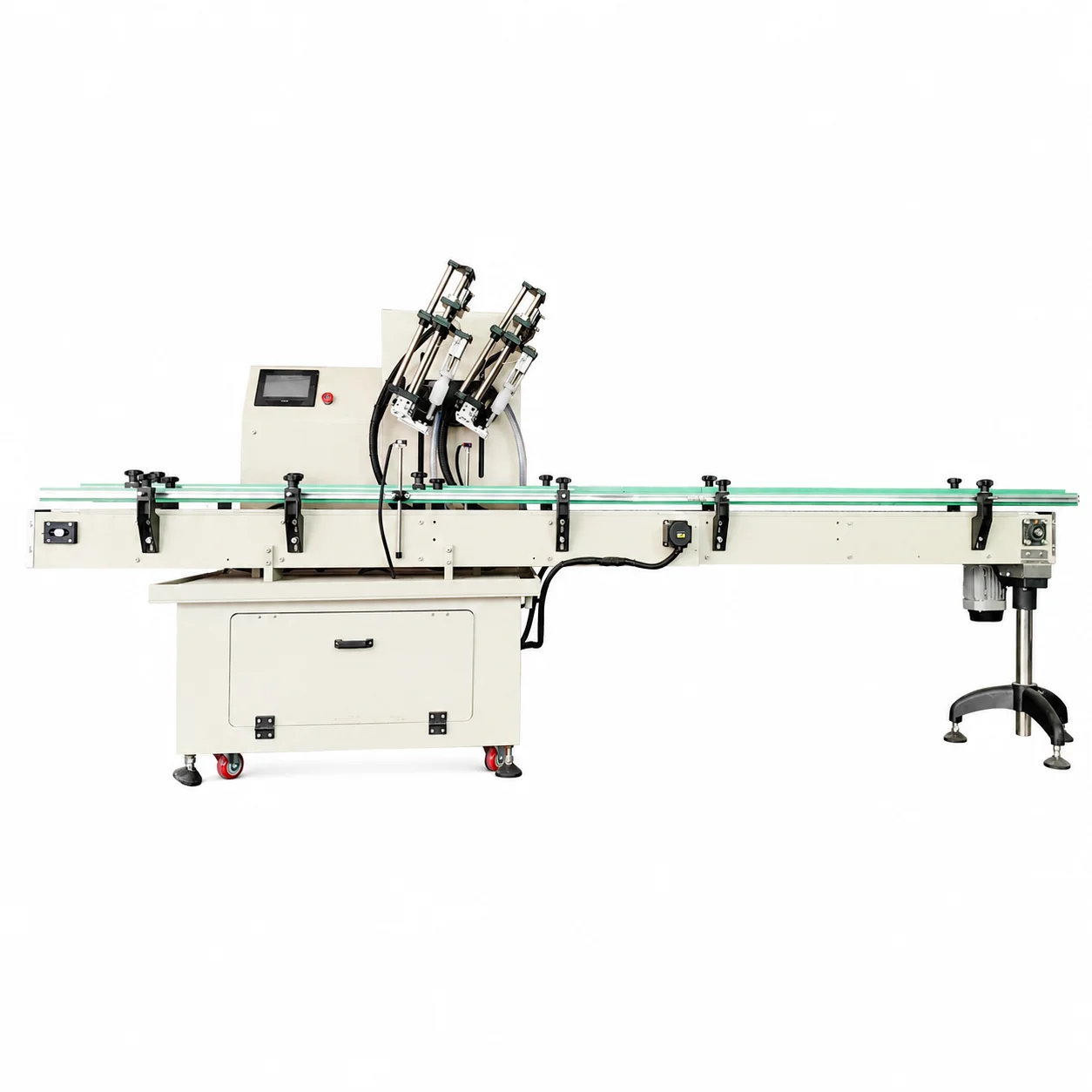
Anti-Drip Nozzles, Diving Fill Heads and Foam Control
Even with the right materials, the filling nozzle design decides whether your bleach bottles come out clean or covered in product residue. Two problems dominate: dripping and foaming.
Why Dripping Ruins Bleach Bottles and Labels
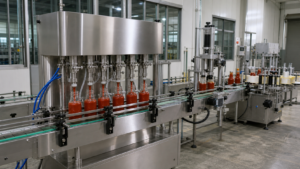
Bleach is a low-viscosity liquid that clings to nozzle surfaces. After each fill cycle, residual product on the nozzle tip can drip onto the bottle neck, the outer wall or the conveyor. On the bottle, this causes streaks that degrade label adhesive and bleach the printed graphics. On the conveyor and frame, accumulated drips create a corrosive puddle that damages equipment and creates a slip hazard. A properly designed anti-drip filling nozzle uses a positive shut-off at the nozzle tip combined with a brief suck-back stroke that pulls the liquid back inside the nozzle bore after each fill. Spill containment trays beneath the filling zone catch any residual drips and keep them off the conveyor.
Diving Nozzles to Reduce Foam and Splashing
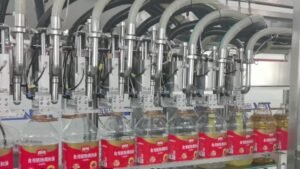
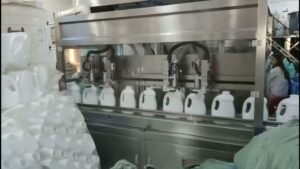
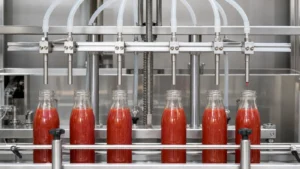
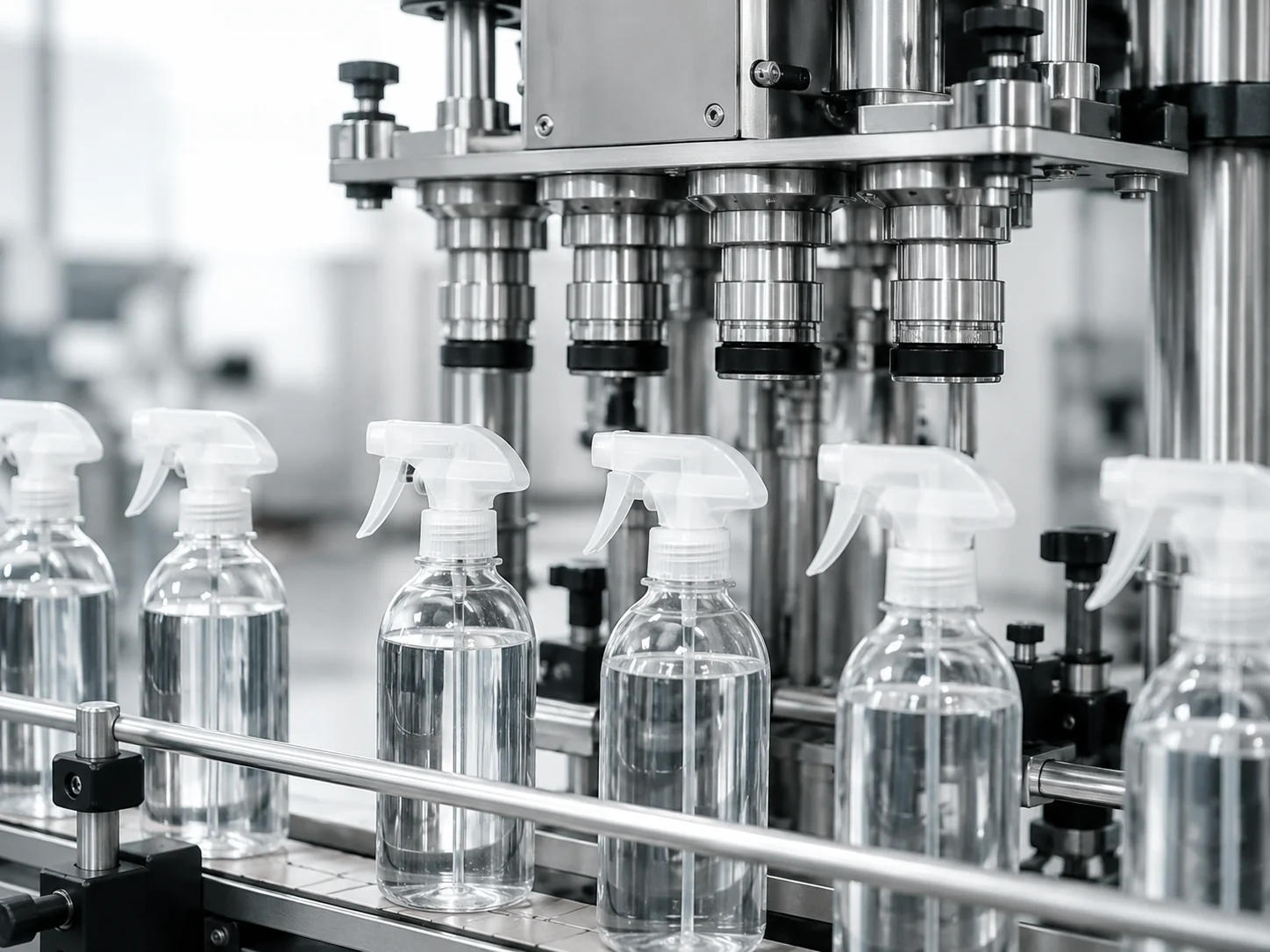
When thin bleach drops from a stationary nozzle into an empty bottle, it splashes and traps air, creating foam that can take a noticeable amount of time to collapse — longer for surfactant-heavy formulas. This slows the line, causes under-fills and makes level-based fill detection unreliable. A diving filling nozzle solves this by lowering into the bottle so the tip starts near the bottom. As the liquid rises, the nozzle retracts, keeping the tip just below the surface so the product is delivered beneath its own level. This virtually eliminates foam formation, and matters even more for bleach with surfactants, where foam is far more persistent.
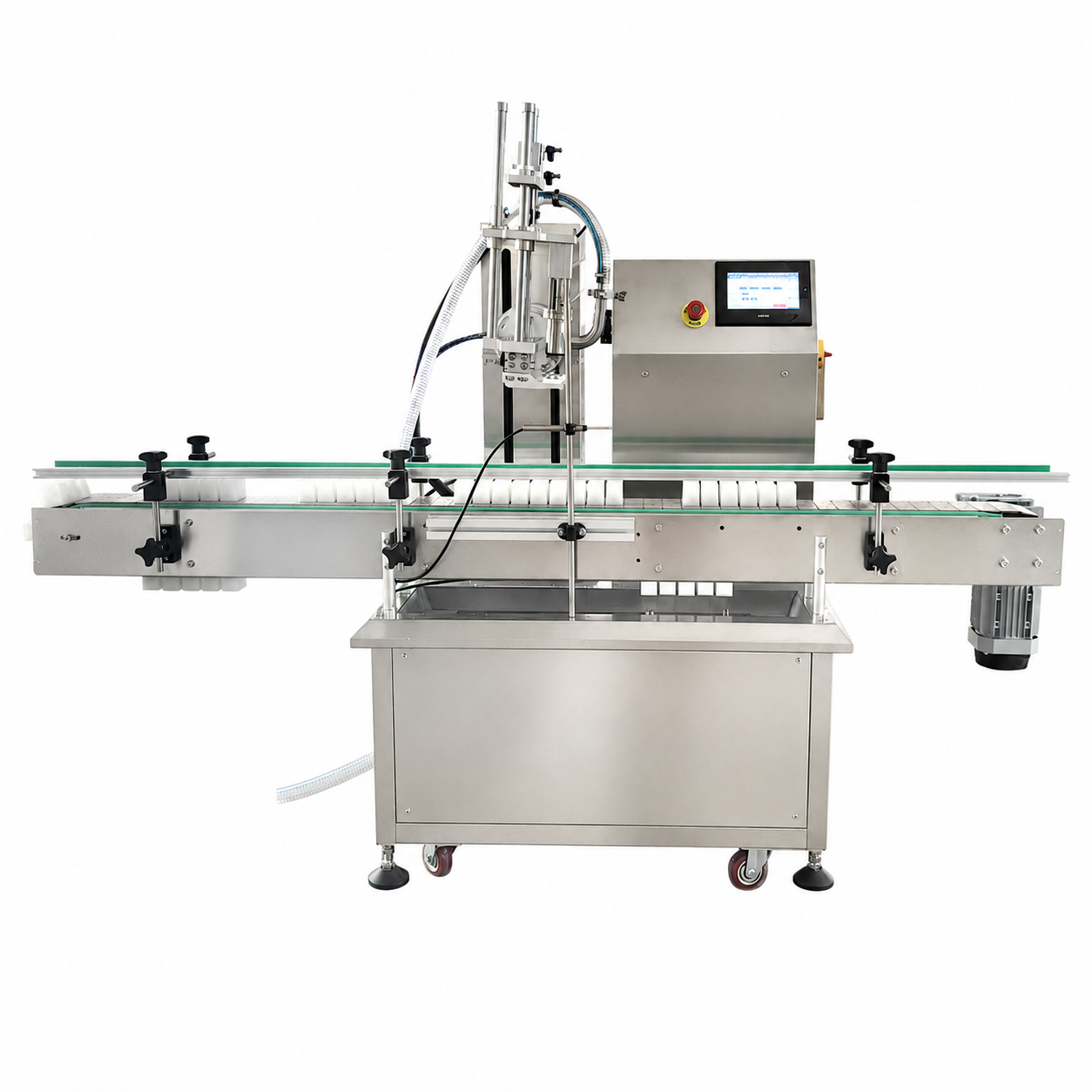
Bottle Handling: HDPE Bottles, Necks and Positioning
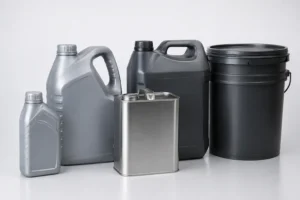
Most bleach is packaged in HDPE (high-density polyethylene) bottles because HDPE resists sodium hypochlorite and is economical for high-volume consumer products. These bottles come in many shapes — round, rectangular, handled jugs, angled-neck trigger bottles — and each shape creates different handling challenges on the line.
Round HDPE bottles can spin on the conveyor if the guide rails are not properly adjusted, causing misaligned fills and crooked labels. Handled jugs need wider conveyor spacing and sometimes a star-wheel or lug conveyor to maintain orientation. Angled-neck bottles for trigger sprayers sit unevenly and may require custom positioning fixtures to hold them upright during filling and capping.
Bottle Rinsing Before Filling
Before filling, bottles should be free of dust, debris and static-attracted particles — especially if they come from off-site suppliers rather than inline blow molding. An air-rinse or ionized-air blow station inverts each bottle, blows out loose contaminants, and returns it upright before the filling station. For bleach, this prevents visible particles from floating in the filled bottle, which customers can see through translucent HDPE and read as a quality defect.
| Bottle Type | Cap / Seal Type | Filling Consideration | Sealing & Leak Check |
|---|---|---|---|
| HDPE round bottle (500 ml – 1 L) | Screw cap with foil liner | Standard diving nozzle; straightforward guide-rail positioning | Servo capping for consistent torque; inline induction sealer; weight or visual leak check |
| HDPE round jug with handle (1 L – 4 L) | Screw cap with foil liner | Wider conveyor spacing; lug or side-belt transport; longer fill time due to volume | Higher capping torque for the larger cap; induction sealing; weight-based or visual inspection |
| HDPE angled-neck trigger bottle (500 ml – 1 L) | Trigger sprayer (press-on) | Custom fixture to hold the angled neck upright; narrower nozzle for the small neck opening | Press-on trigger capper (not screw); induction seal usually not applicable; weight check for fill verification |
| HDPE flat / rectangular bottle (250 ml – 1 L) | Flip-top or screw cap | Flat sides need orientation control; gentle guide rails for thin-wall bottles | Servo or pneumatic capping; induction seal if the cap has a foil liner; visual leak inspection |
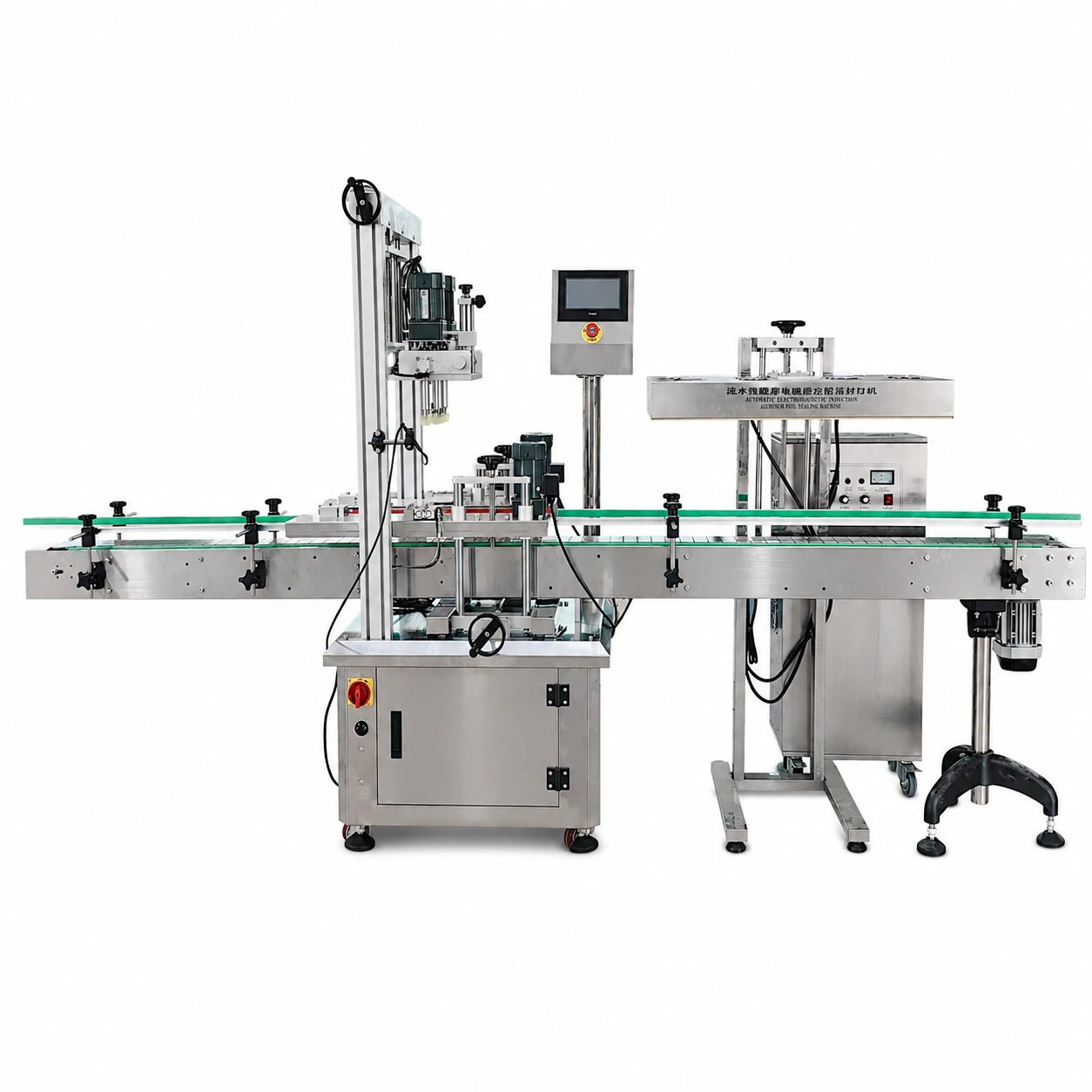
Capping, Induction Sealing, Leak Inspection and Warning Labels
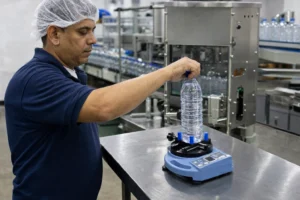
After filling, bleach bottles should be capped and sealed promptly. Sodium hypochlorite is chemically unstable and slowly decomposes — a process accelerated by heat, light, air and agitation — which can release low levels of chlorine. A tight cap and an inner foil seal keep the product contained, protect potency and keep fumes out of the workspace.
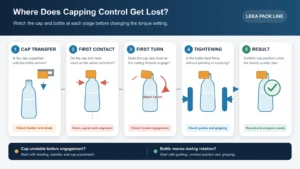
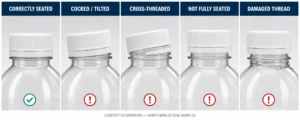
Capping: a servo-driven capping machine provides consistent, adjustable capping torque. This matters because HDPE necks are softer than glass or PET — over-torquing crushes the neck and causes leaks, while under-torquing lets the cap loosen in transit. For trigger sprayers, a press-on capper pushes the pump assembly into the bottle neck instead of screwing. Each cap style needs its own feeder and placement mechanism. The LEKA-CP-A-servo servo four-wheel capping machine is one example of a capper that holds torque steady across a production run.
Induction sealing: some HDPE bleach packages use foil-lined screw caps, while others require vented or specialized closures. Use induction sealing only when the bottle, cap liner and product specification are designed for it. Confirm chemical compatibility, sealing range and any venting requirement with the closure supplier. For compatible projects, the LEKA-GLF-4000 water-cooled foil sealer supports reference sealing ranges of 15–60 mm and 40–120 mm and can be integrated after capping.
Leak inspection: even with proper capping and sealing, bottles should be checked. Weight-based inspection confirms fill volume, and a simple reject station can push failed bottles off the conveyor into a spill-contained bin. For higher-value lines, pressure-decay testing detects micro-leaks by pressurizing the sealed bottle and measuring any pressure drop.
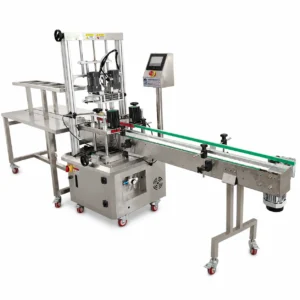
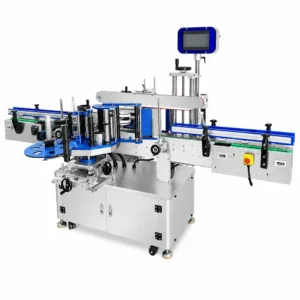
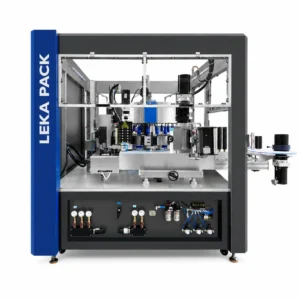
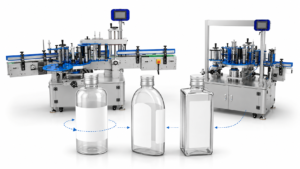
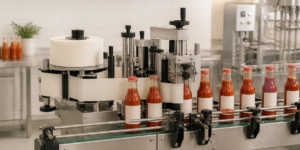
Warning labels: bleach is classified as a hazardous product. Depending on your market, labels must carry the required hazard symbols, signal words, hazard and precautionary statements and first-aid information — for example, GHS labeling internationally, or labeling under the Federal Hazardous Substances Act in the US. An automatic labeling machine applies wrap-around or front-and-back labels at line speed with consistent positioning, so the warning information stays visible and legible on every bottle. The LEKA-LB020 double-side labeling machine handles this kind of front-and-back application.
Semi-Automatic vs Fully Automatic Bleach Filling Line
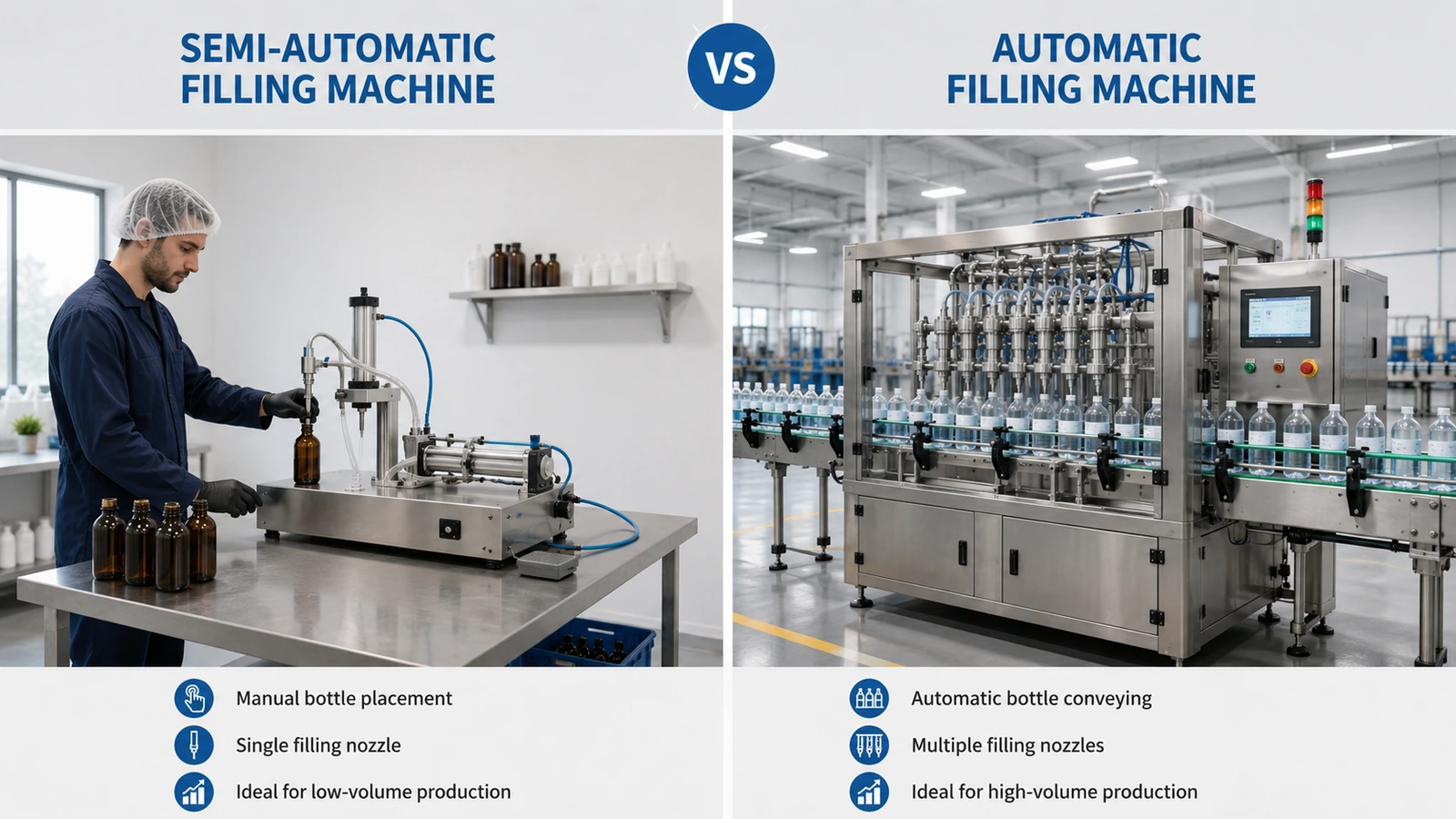
Not every bleach producer needs a fully automatic line on day one. The choice depends on production volume, labor cost, product variety and budget.
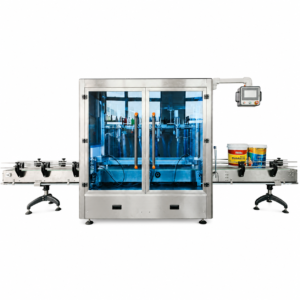
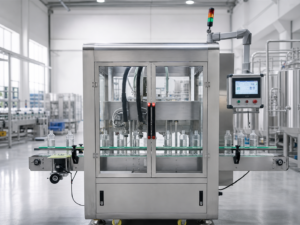
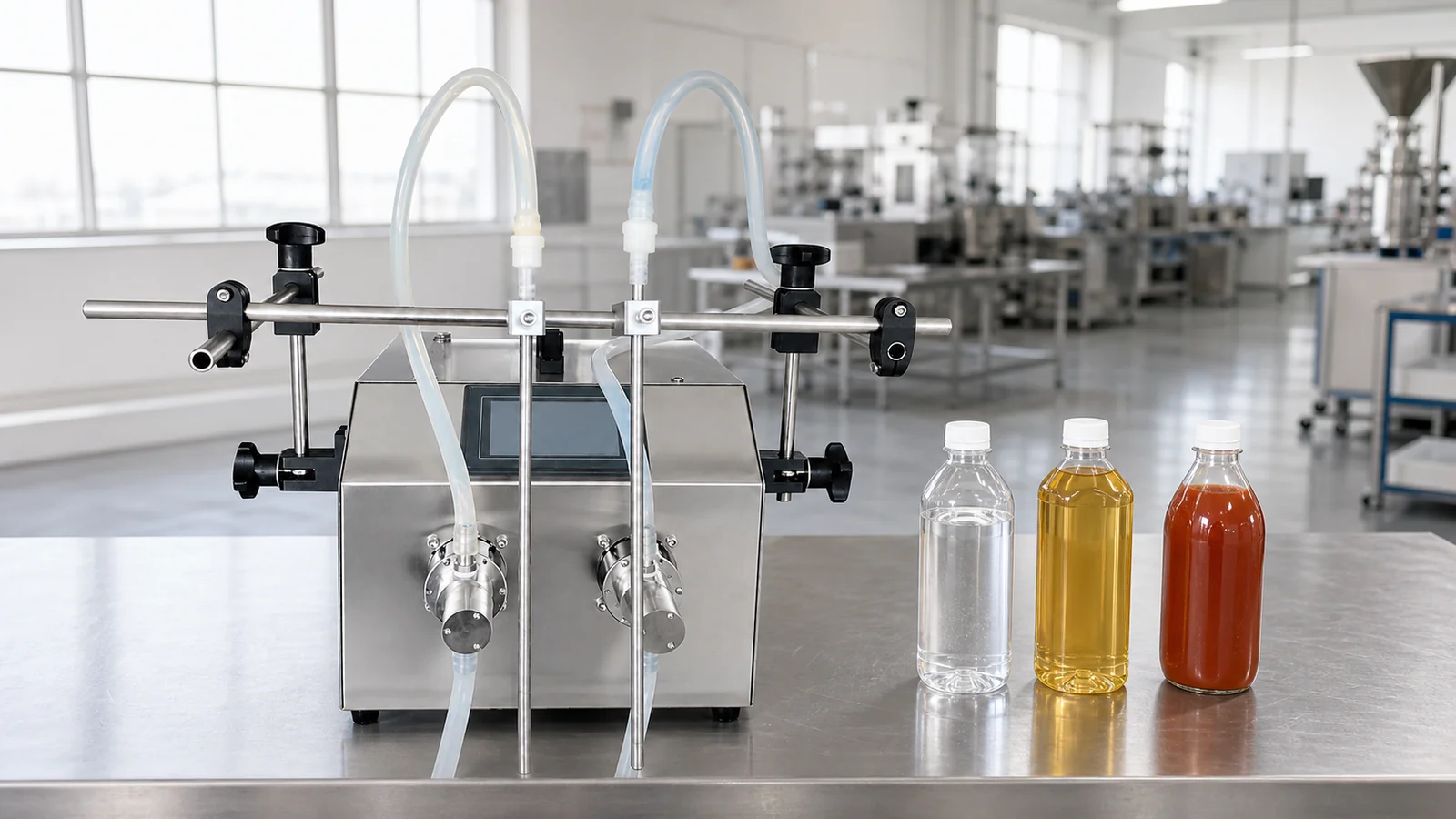
A lower-output anti-corrosion filler — such as a two-head machine like the LEKA-FLFF-02-A, or a compact unit like the LEKA-FLDT-XKJ01 — suits factories with modest volumes, startups testing a new bleach formula, or operations filling several low-volume products on shared equipment. The capital cost is lower and the footprint is small. For the lowest volumes or thicker formulas, a single-head or semi-automatic setup, where an operator places and removes bottles, can be enough to start.
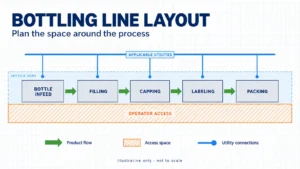
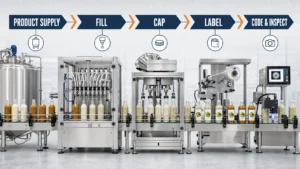
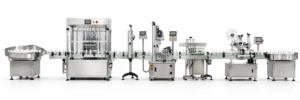
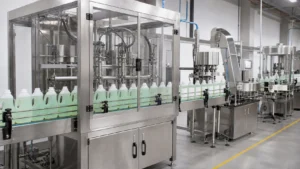
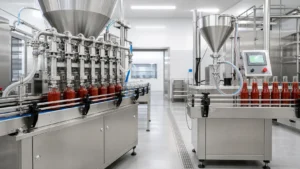
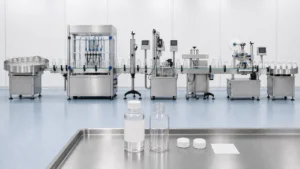
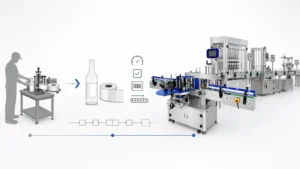
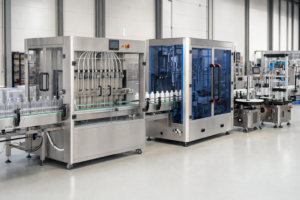
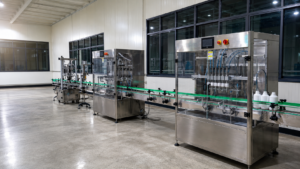
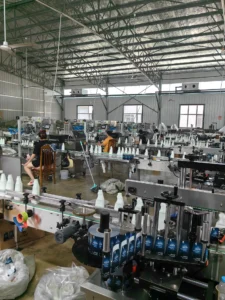
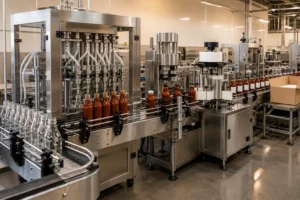
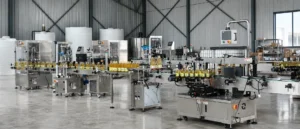
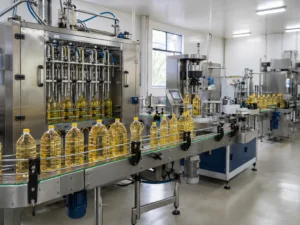
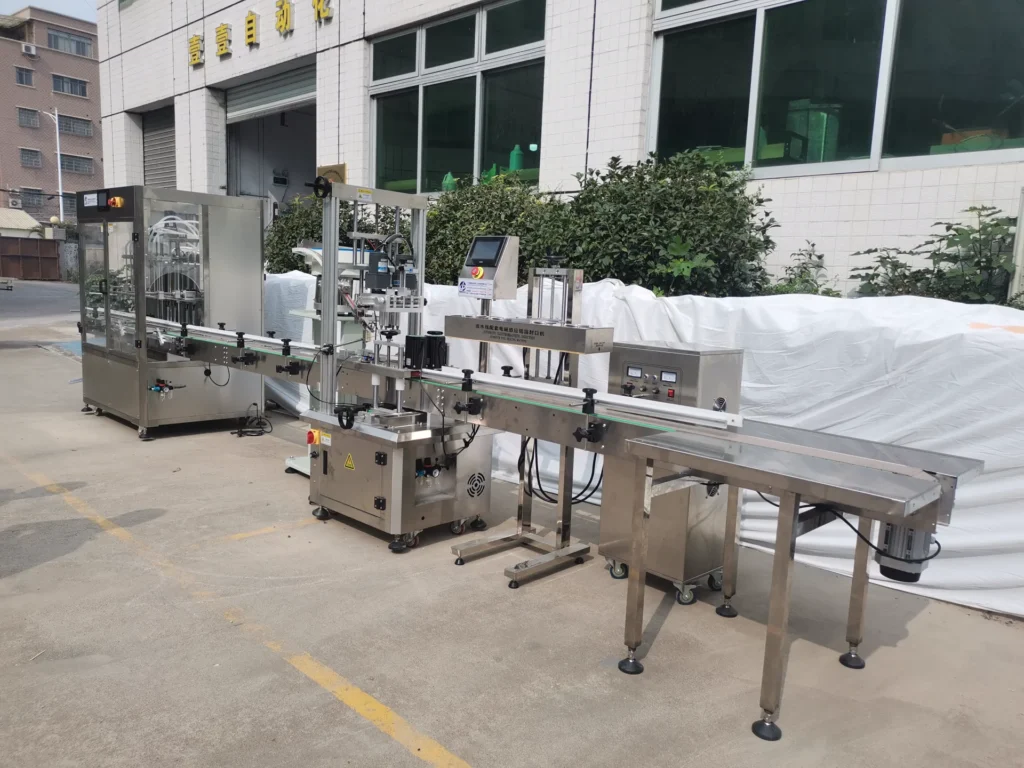
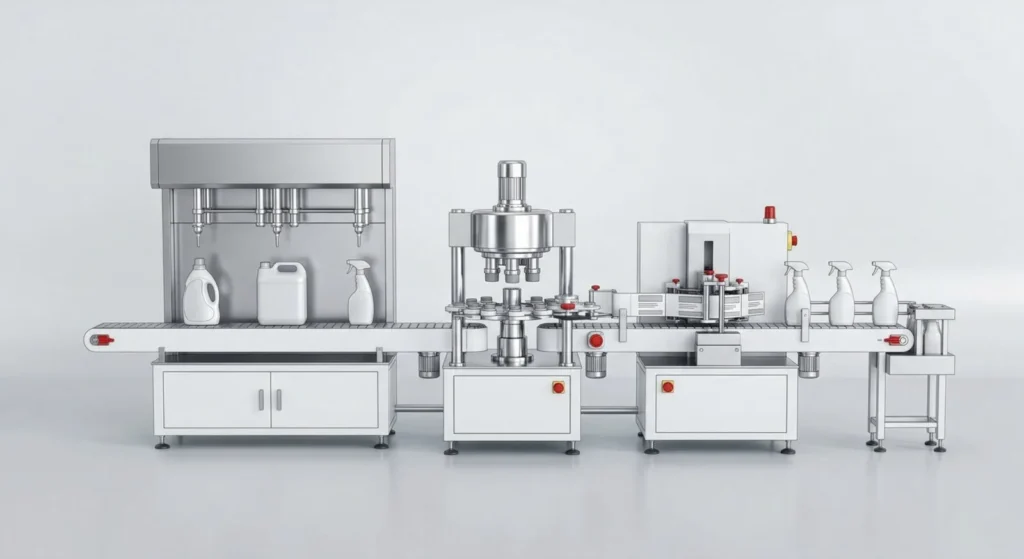
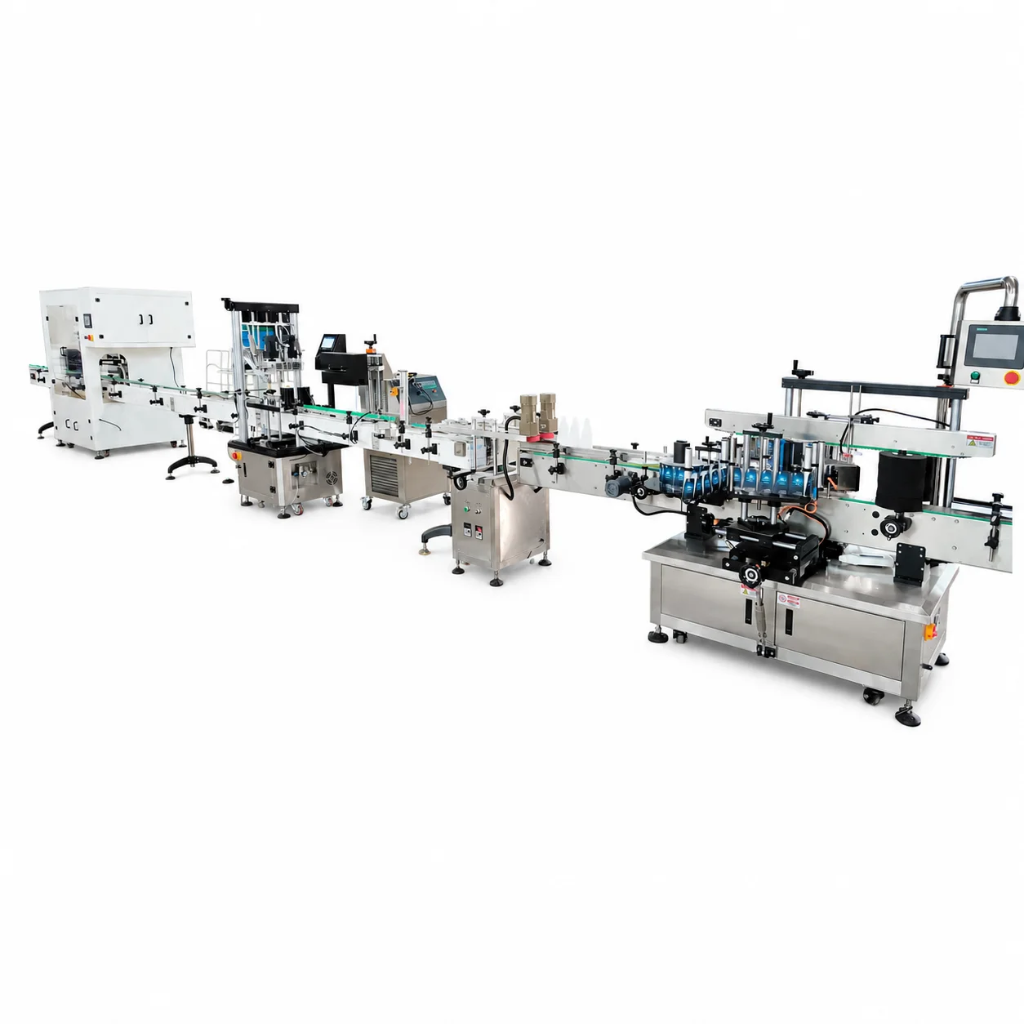
A fully automatic bleach filling line connects bottle feeding, filling, capping, induction sealing, labeling and coding into a continuous conveyor-linked system, so operators supervise rather than handle bottles. Higher output usually comes from more filling heads: multi-head options such as the LEKA-FLFF-10-B 10-head anti-corrosion filler or the LEKA-FLSF-06-C 6–12 head servo filler are built for this. As a general reference, a multi-head automatic line can reach roughly 1,600–3,000 bottles per hour for small bottles when viscosity allows; the real figure depends on bottle size, fill volume and the sample tested. A typical automatic bleach line pairs the filler with a servo capper (LEKA-CP-A-servo), a foil sealer (LEKA-GLF-4000), a labeling machine (LEKA-LB020) and a packing table or carton sealer at the end.
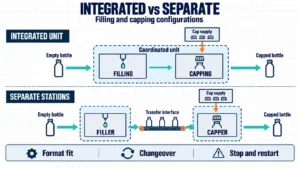
Many factories start small and add downstream automation module by module as production grows. When planning this path, choose a filler with a conveyor-compatible frame so it can be connected to capping and labeling later without replacing the machine. You can compare equipment options on the cleaning products filling machine page, review complete-line integration through our home care and cleaning products filling line solutions, or use the household chemical filling line setup guide for a step-by-step planning framework. For a non-corrosive surfactant product where foam, nozzle cut-off and cap handling drive the decision, compare the foam-control guide for dishwashing liquid filling.
Concentrated Bleach: A Trend That Affects Machine Selection
Many brands are shifting toward concentrated bleach — the same cleaning power in a smaller bottle with less water and less plastic. For machine configuration this matters in two ways. Higher concentration means a more aggressive environment for wetted parts, pushing material selection from standard PP toward PVDF for pump heads and valve bodies. And smaller bottles run faster through the same filling heads, which can raise the throughput demand on downstream capping and labeling. If your roadmap includes a concentrated variant, mention it at the quotation stage so the line can handle both diluted and concentrated formulas without a major rebuild.
What to Send Us for an Accurate Bleach Line Quote
A bleach bottling machine quotation is only accurate when the supplier knows exactly what you are filling, into what container, at what speed and in what factory environment. The more detail you provide upfront, the fewer rounds of revision the proposal needs. Here is what to prepare:
Product information: bleach formula name, active concentration, SDS document, viscosity if known, whether the formula foams, and whether you plan to run other corrosive products (toilet cleaner, acid cleaner) on the same line.
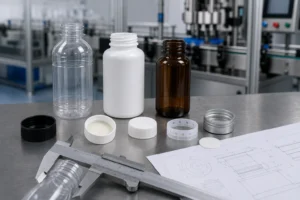
Bottle and cap: bottle material (HDPE, PET, PP), dimensions and volume, neck diameter, cap type (screw, flip-top, trigger sprayer, pump), and whether the cap has a foil liner for induction sealing. Send photos or drawings — or better, physical samples.
Production target: target bottles per hour, daily production hours, and whether you expect to scale up within one to two years.
Labeling and coding: label type (self-adhesive wrap, front-and-back, shrink sleeve), label dimensions, and whether you need date or lot coding.
Factory conditions: available floor space, ceiling height, power supply (voltage, phase, frequency), compressed air availability, room ventilation and ambient temperature range.
Ready to configure a bleach filling line? Send your product details, bottle and cap samples, target output and factory layout to our engineering team. We review real samples before recommending any machine configuration.
→ View LEKA anti-corrosion filling machines
→ Request a bleach line quotation
Frequently Asked Questions
Why can't a standard liquid filling machine fill bleach?
Bleach contains sodium hypochlorite, an oxidizer that attacks stainless steel and causes pitting corrosion over time. Standard machines use stainless steel pumps, valves and nozzles that will gradually fail. A bleach filling machine needs corrosion-resistant product-contact materials such as PP, PVDF and PTFE, plus anti-drip nozzles and spill containment around the filling zone.
What materials are corrosion-resistant for sodium hypochlorite?
Polypropylene (PP) resists bleach well and is the common choice for tanks, frames and structural parts. PVDF offers broader chemical resistance and is preferred for pump heads, valve bodies and tubing where the product is pressurized or in prolonged contact. PTFE is chemically inert and is used for seals, gaskets and valve seats. A well-built bleach line often combines all three. Stainless steel is not suitable for direct bleach contact because it pits and corrodes.
Semi-automatic or fully automatic bleach filling machine — which should I choose?
A semi-automatic or low-head anti-corrosion filler suits lower-volume production, new formulas, or factories filling several products in small batches. A fully automatic line with integrated capping, sealing and labeling makes sense at higher output or when labor cost and consistency matter most. Many factories start small and add downstream automation as production grows.
How many bottles per hour can a bleach filling line run?
Output depends on the number of filling heads, fill volume, bottle size, capping method and labeling speed. As a general reference, a multi-head automatic anti-corrosion line can reach roughly 1,600–3,000 bottles per hour for small bottles when viscosity allows; lower-head or compact machines run slower. The exact figure should always be confirmed against your bottle sample and target fill volume.
Can one line fill bleach, toilet cleaner and acid cleaner?
Not by default. Bleach and acid-based cleaners must never share an unverified product path. Use separate equipment or fully segregated product-contact circuits wherever possible. Any shared-line proposal requires written engineering and EHS approval, validated changeover procedures, proper ventilation, and compatibility checks against each Safety Data Sheet.
Do bleach bottles need induction sealing?
Not always. Use induction sealing only when the selected bottle, cap liner and bleach specification are designed for it. Some applications require vented or specialized closures instead. Confirm chemical compatibility and any venting requirement with the bottle and closure supplier before the line is configured.
Safety References
Conclusion
Configuring a bleach filling machine line is not about buying the most expensive equipment — it is about matching every contact surface, nozzle, seal and downstream station to the demands of sodium hypochlorite. Start with your product data and bottle samples, verify material compatibility, and build the line from filling to labeling with corrosion resistance at every step. If you are planning a bleach bottling project and need equipment engineered for corrosive liquids, explore LEKA's anti-corrosion filling machines or send us your project details for a line configuration review.