Salad Dressing Filling Machine Guide for Vinaigrettes, Creamy Dressings, and Particulates
A salad dressing filling machine should be selected from the dressing that reaches the filler—not from the product name alone. A pourable vinaigrette, a thick ranch-style dressing, and a recipe carrying herbs or vegetable pieces can place very different demands on the product supply, metering method, valves, nozzles, and cleaning procedure.
This guide is written for food factory owners, purchasing managers, production managers, engineers, co-packers, distributors, and packaging-line integrators. It explains how to classify the product, compare practical filling directions, define the rest of the bottling line, and turn a quotation into a testable project.
Scope note: This article covers filling and packaging equipment. The producer’s qualified team remains responsible for the recipe, process controls, heat treatment, shelf life, allergen programme, package validation, and compliance requirements in the destination market.
Key Takeaways
- Classify the dressing at its actual filling temperature and after its real holding time.
- Treat visible ingredient distribution as a separate requirement from net fill quantity.
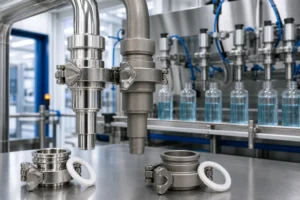
- Check the complete product path, including the feed system, pump, valves, hoses, and nozzles.
- Match the bottle opening, closure, and sealing area to the product before finalising the filler.
- Use representative dressing and production containers during the factory acceptance test.
What Is a Salad Dressing Filling Machine?
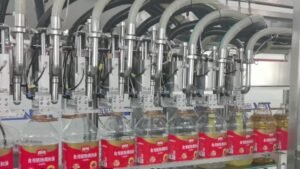
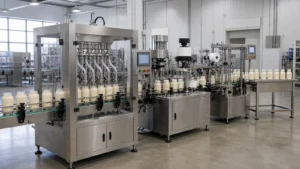
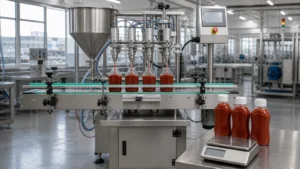
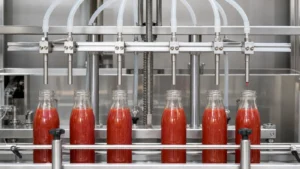
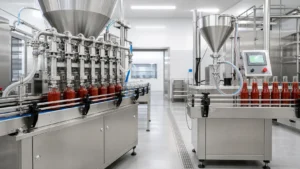
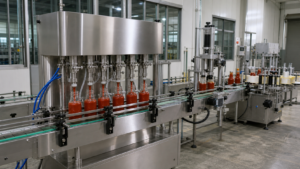
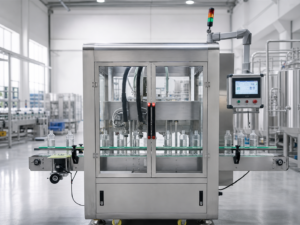
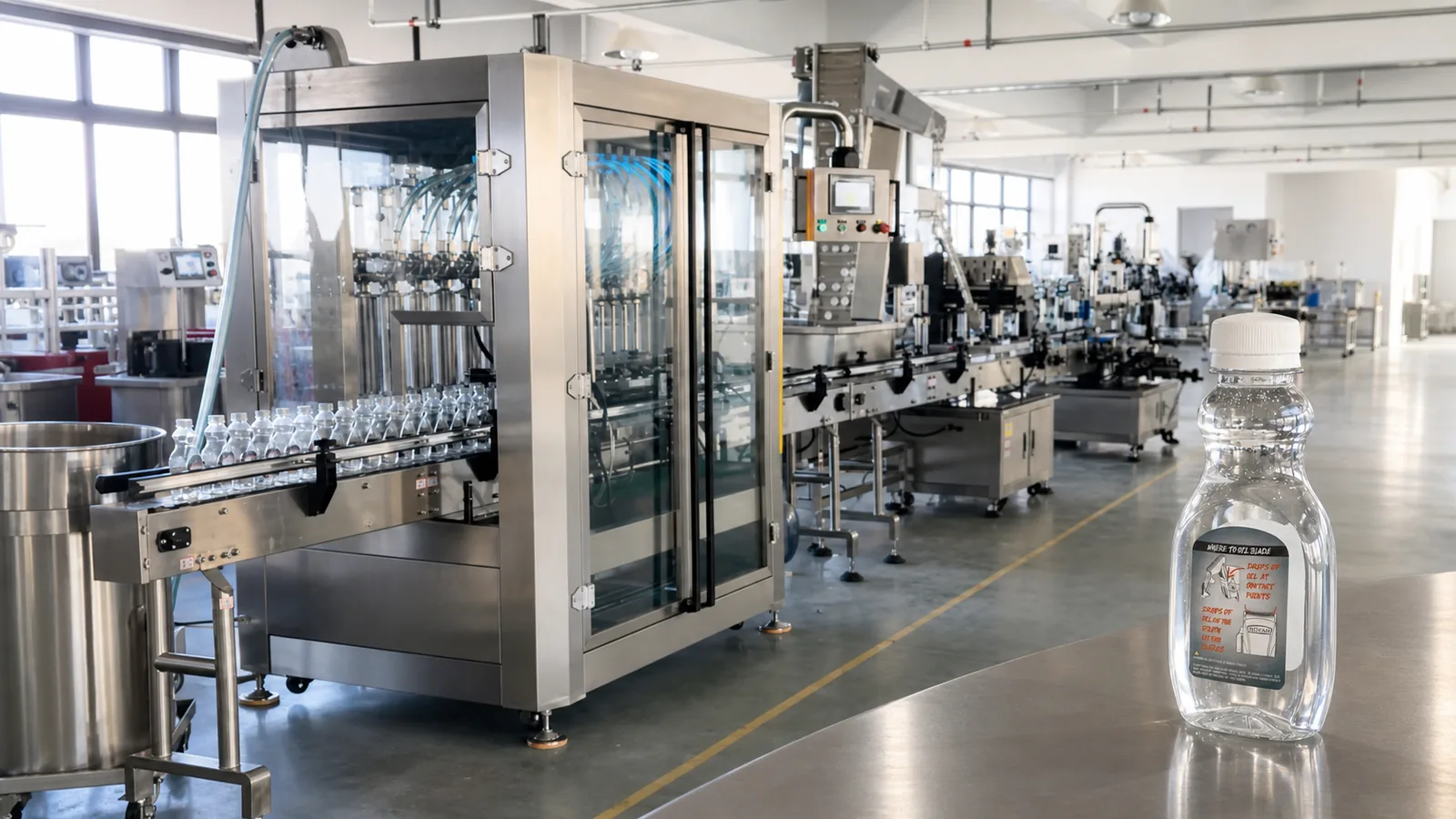
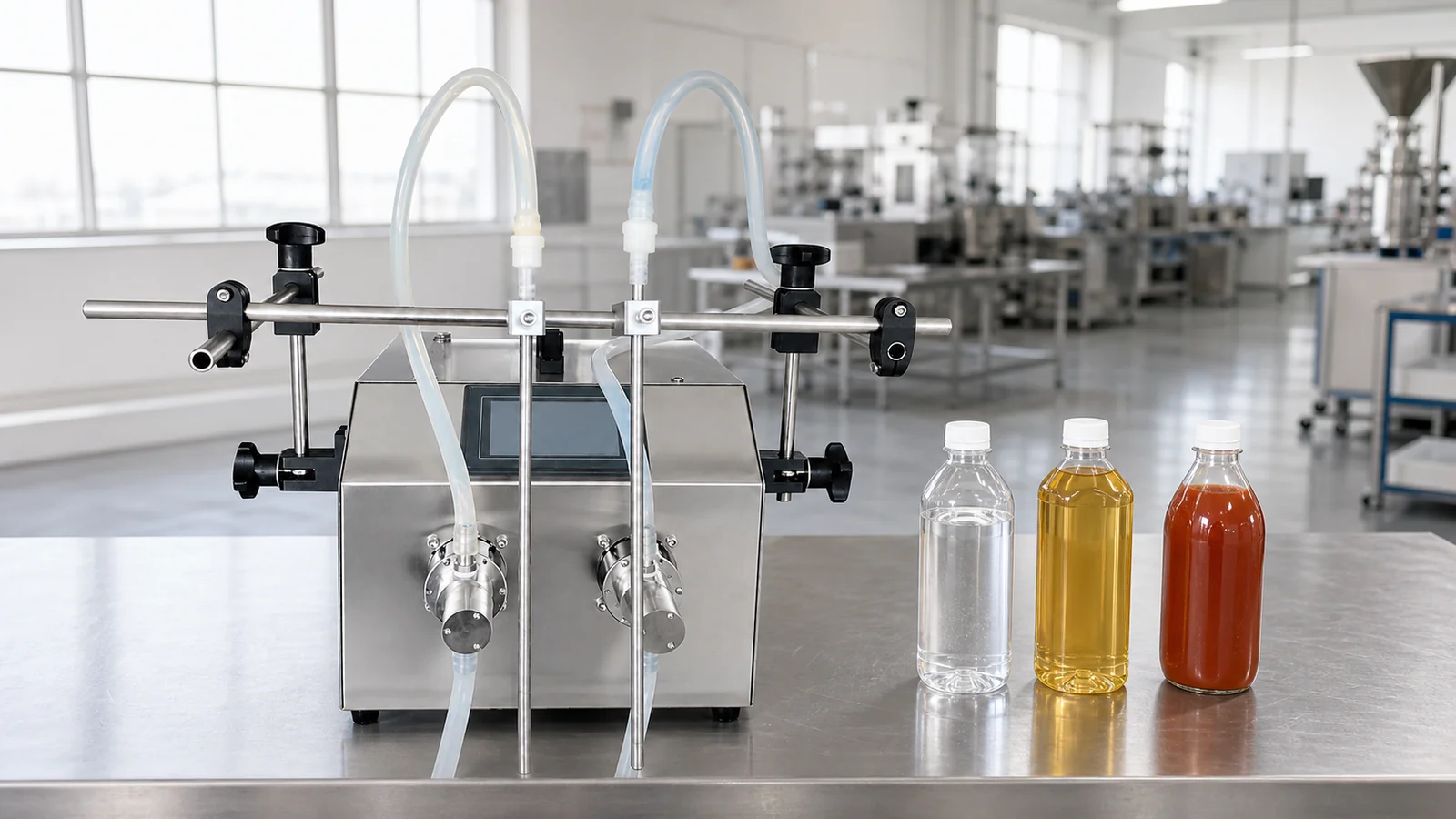
A salad dressing filling machine meters a defined quantity of dressing into a bottle, jar, tub, or other container. The suitable machine depends on the product’s flow, separation, particles, filling temperature, container opening, required output, and cleaning plan. It may operate as a standalone filler or as one section of an automatic bottling line.
Packaging scope: This guide focuses on preformed bottles, jars, tubs, and similar containers. Cups or pouches formed and sealed inside a form-fill-seal machine require a different packaging architecture and should be reviewed separately.
The definition sounds simple, but “salad dressing” covers a broad range of products. Some flow more like seasoned oil. Others behave closer to mayonnaise. A third group may carry pepper, herbs, cheese, fruit, or vegetable pieces. Before comparing quotations, establish which of those conditions the proposed machine is expected to handle.
Match the Salad Dressing Filling Machine to the Product
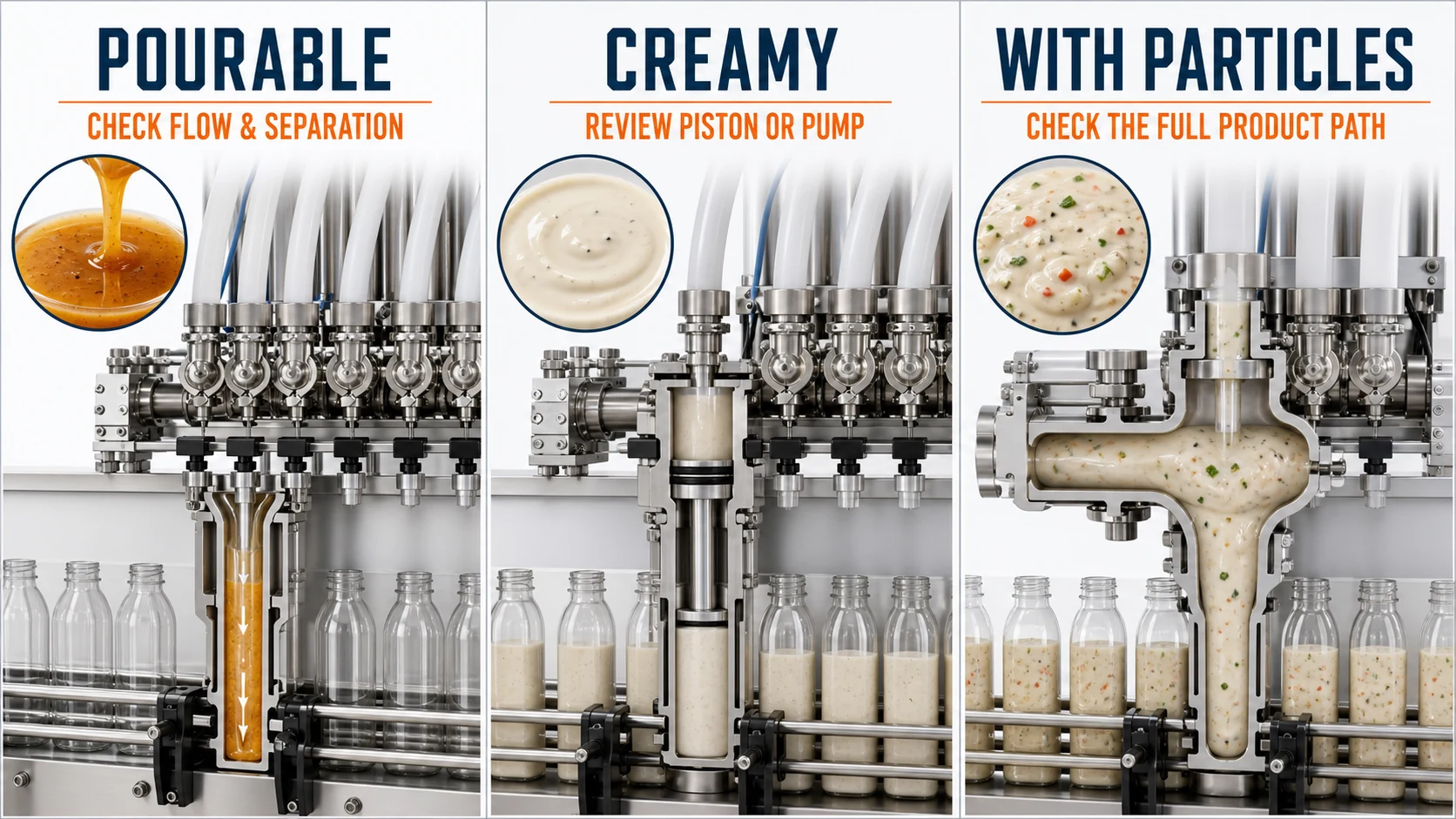
The quickest way to eliminate unsuitable proposals is to group the dressing by behaviour. This is more useful than choosing equipment from a product label or a catalogue photograph.
| Dressing Condition | What the Buyer Should Check | Practical Equipment Direction | Main Acceptance Concern |
|---|---|---|---|
| Pourable, smooth vinaigrette | Flow variation, splashing, oil separation, bottle-neck cleanliness | A suitable pump or other controlled liquid-metering system, confirmed by testing | Stable dose and clean cut-off |
| Creamy, smooth dressing | Viscosity, stringing, air pockets, feed pressure, nozzle cut-off | Piston or positive-displacement pump direction, selected for the real product | Repeatable filling without excessive residue at the neck |
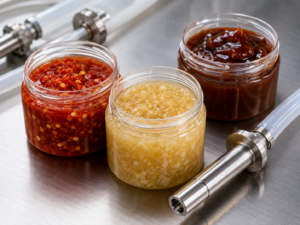
| Dressing with herbs or small pieces | Largest piece, concentration, settling, shear sensitivity, product-path restriction | Particle-friendly valves, pump, hoses, and nozzles with a suitable feed arrangement | Both net quantity and ingredient distribution |
| Visibly separating or multi-component dressing | Separation rate, holding time, agitation effect, ratio expectations, line speed | Single-phase feed with controlled mixing or a specially reviewed multi-phase approach | Consistent appearance and component ratio across the run |
These are starting directions, not universal prescriptions. Pacific Packaging Machinery also separates dressing applications by viscosity, particulates, and whether a two-phase arrangement is required, illustrating why the product condition must be defined before the machine.[1] A buyer who has not yet documented the product should begin with the broader sauce filling machine selection guide, then return to the dressing-specific checks below.
Confirm the Dressing at Its Real Filling Condition
A sample taken straight from a mixing tank may not behave like the same dressing after it has waited in a holding vessel. Temperature, separation time, particle settling, and exposure to pumping can all change what reaches the nozzles. That is why the project brief should state the operating condition rather than relying on the ingredient list.
Use the hardest production SKU
If one machine must run several recipes, identify the product most likely to expose a weakness. It may be the thickest dressing, the one with the largest herb pieces, the fastest-separating vinaigrette, or the SKU filled into the narrowest bottle opening. Testing only an easy product can leave the difficult changeover unresolved.
Record what the supplier can evaluate
A laboratory viscosity value is useful when available, but a buyer can still provide actionable information without one. Send a representative sample, a short pouring video at filling temperature, the largest visible piece beside a ruler, and a note showing how quickly the product separates or settles. State whether mixing changes the appearance or damages the product.
Separate filling capability from process responsibility
The filler moves a prepared product into a package. It does not replace the producer’s formulation, thermal process, microbiological controls, or shelf-life validation. If the project involves hot product or a specific hygienic regime, the temperature, exposure time, compatible materials, seals, and cleaning method must be reviewed as project conditions.
Piston Filler or Pump Filler for Salad Dressing?
Both directions can be valid, but neither wins on the machine name alone. The decision depends on the dressing, fill range, product feed, particles, cleaning method, changeover frequency, and output target.
When a piston direction may fit
A piston filler is a practical starting point for many smooth, viscous dressings that need repeatable volumetric dosing. The valve and nozzle still have to suit the product. If herbs or pieces are present, every restriction through the cylinder, valve, hose, and nozzle should be checked against the actual material. Pacific’s food-filling application page similarly presents piston-based filling for thick, viscous, and chunky food products while treating configuration as application-specific.[1]
When a pump direction may fit
A positive-displacement pump system can offer useful control across different flow conditions when the pump type is selected correctly. The supplier should explain how the pump handles the dressing, how the product supply remains stable, what happens during low-level operation, and how the wetted path will be cleaned.
Do not evaluate the filler without its feed system
An accurate metering device cannot correct an unstable product supply indefinitely. Hopper geometry, agitation, transfer pumping, pipe length, bends, level variation, and the distance from the preparation area can affect what reaches each filling head. Review the feed arrangement at the same time as the filler.
For a more detailed equipment comparison, see piston filler vs pump filler for sauce. Use that comparison after the dressing has been classified, not before.
How to Control Separation, Herbs, and Particle Distribution
Net quantity and ingredient distribution are different acceptance questions. A bottle can meet its target weight yet contain fewer visible herbs than the bottle beside it. If appearance or component ratio matters commercially, the FAT must check both.
Start with the separation pattern
Observe where the product changes. Does oil rise in the supply vessel? Do spices settle in a hopper corner? Do larger pieces accumulate at a valve? Does recirculation make the dressing uniform, or does it change its texture? The correct intervention depends on the location and cause of the separation.
Mixing is not automatically the answer
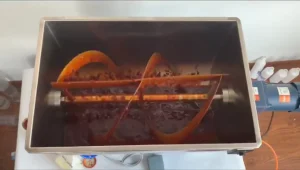
Agitation may help keep ingredients available to the filler, but excessive mixing can be unsuitable for a delicate emulsion or soft inclusion. Specify whether the product can tolerate continuous, intermittent, or gentle mixing. The supplier should then review agitator style, speed control, vessel shape, and the position of the outlet.
Use a particle-path check
Compare the largest representative piece with the narrowest opening in the complete wetted path. Include transfer connections, pump passages, valve ports, hose fittings, manifolds, and nozzle outlets. A wide nozzle cannot prevent a blockage that occurs earlier in the system. Pacific’s food-filling application page likewise describes pumping and manifold design as part of particulate handling.[1] The detailed guide to filling sauces with particles explains this check further.
When a special multi-phase review is justified
Some vinaigrettes present a genuine component-ratio problem rather than a simple mixing problem. Pacific Packaging Machinery describes a supplier-specific two-phase arrangement intended to manage oil and spice ratios for certain dressings. That example shows that a multi-phase approach can be engineered for a defined duty; it does not mean every vinaigrette requires it or that it is a standard filler feature.[1]
If a buyer needs separate phases or a defined visible ratio, say so before quotation. Request a project review, a representative product test, and written acceptance criteria for the finished bottles.
Match the Bottle, Neck, and Closure
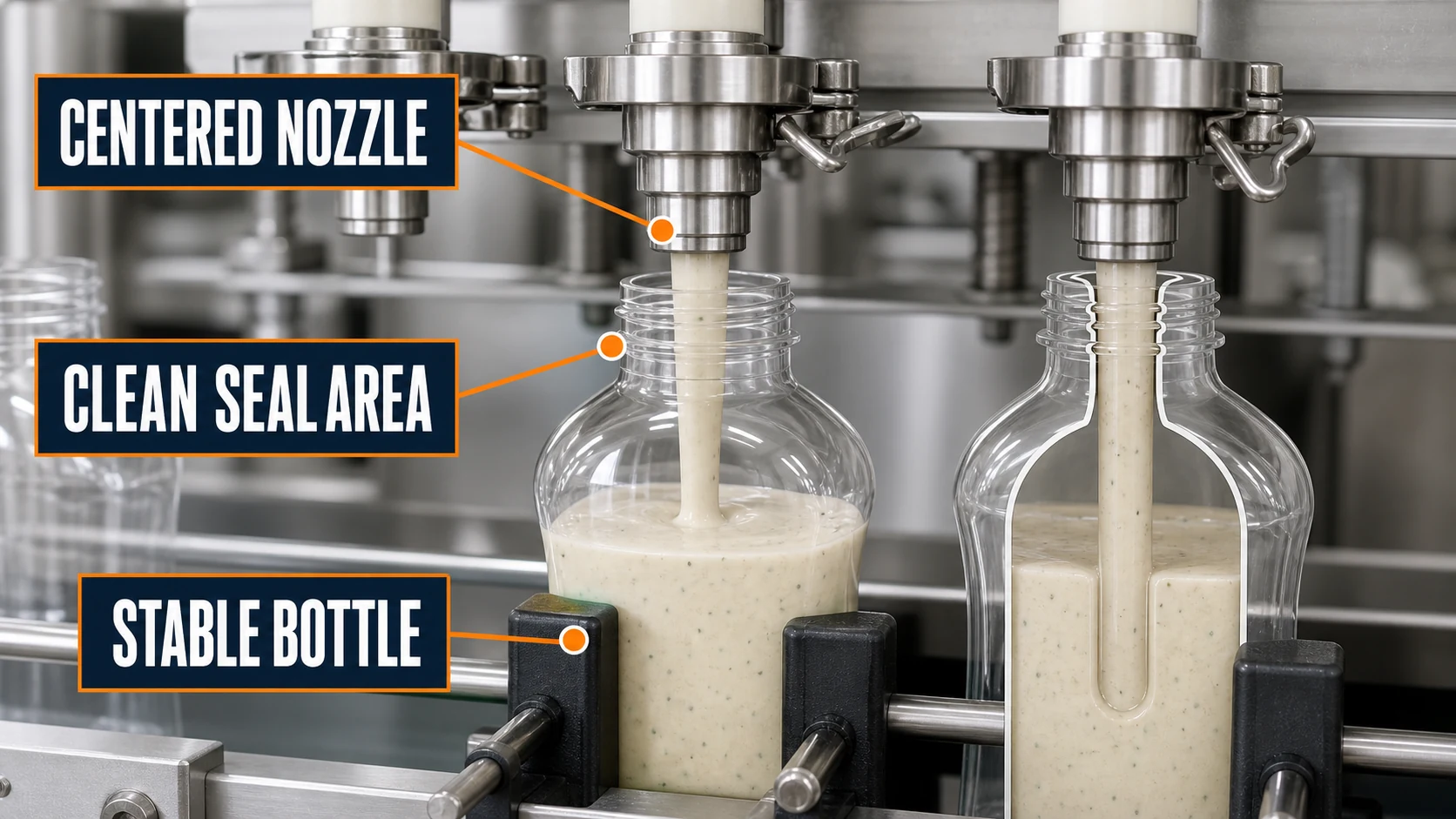
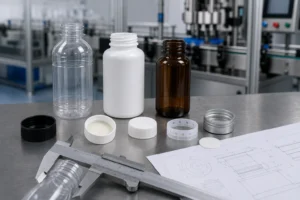
The container is part of the filling application. A bottle that works well for a smooth dressing may become unreliable when the recipe includes herbs or soft pieces. Send production samples rather than relying only on a drawing.
Bottle opening and fill position
The opening must provide enough clearance for the selected nozzle and product stream. The machine also needs repeatable bottle positioning so the nozzle does not touch the neck or deposit dressing on the sealing surface. For light bottles, guide rails and conveyor transitions should be tested at the intended line condition.
Squeeze bottles and dispensing closures
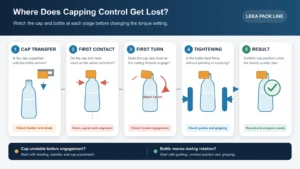
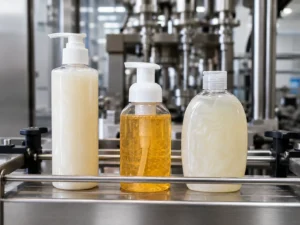
A squeeze bottle may use a flip-top cap, dispensing insert, liner, or induction seal. These parts affect the downstream equipment and the acceptable amount of residue around the neck. Confirm whether the line must feed an insert, orient a closure, control capping torque, or inspect a seal. For package-trial preparation, use the bottle and cap compatibility checklist.
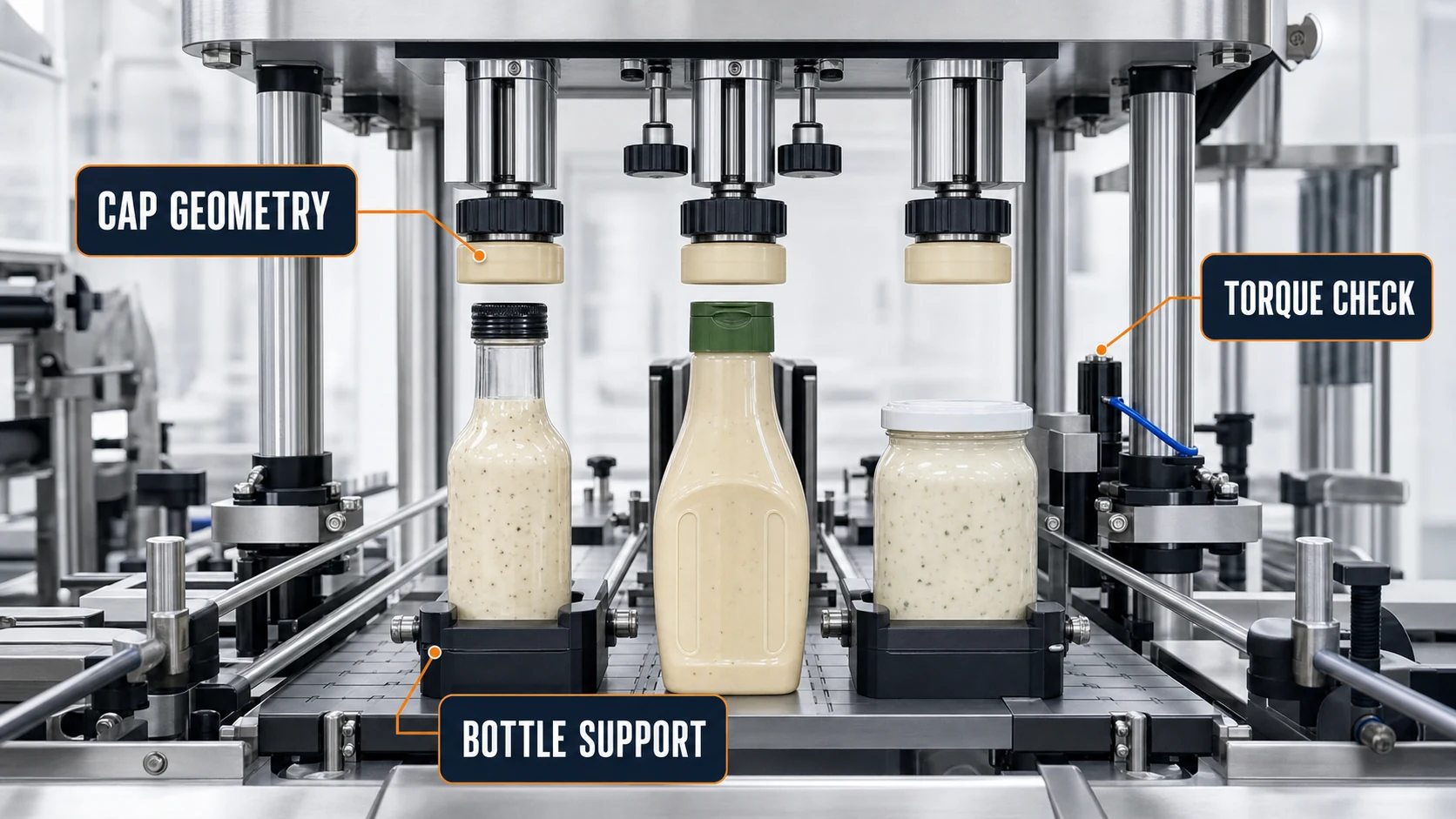
Glass bottles and jars
Glass containers may require different handling from lightweight plastic bottles. Check dimensional variation, accumulation, transfer points, and contact pressure. If the producer uses several bottle families, include the smallest opening and the least stable container in the line trial.
What Belongs in a Salad Dressing Filling Line?
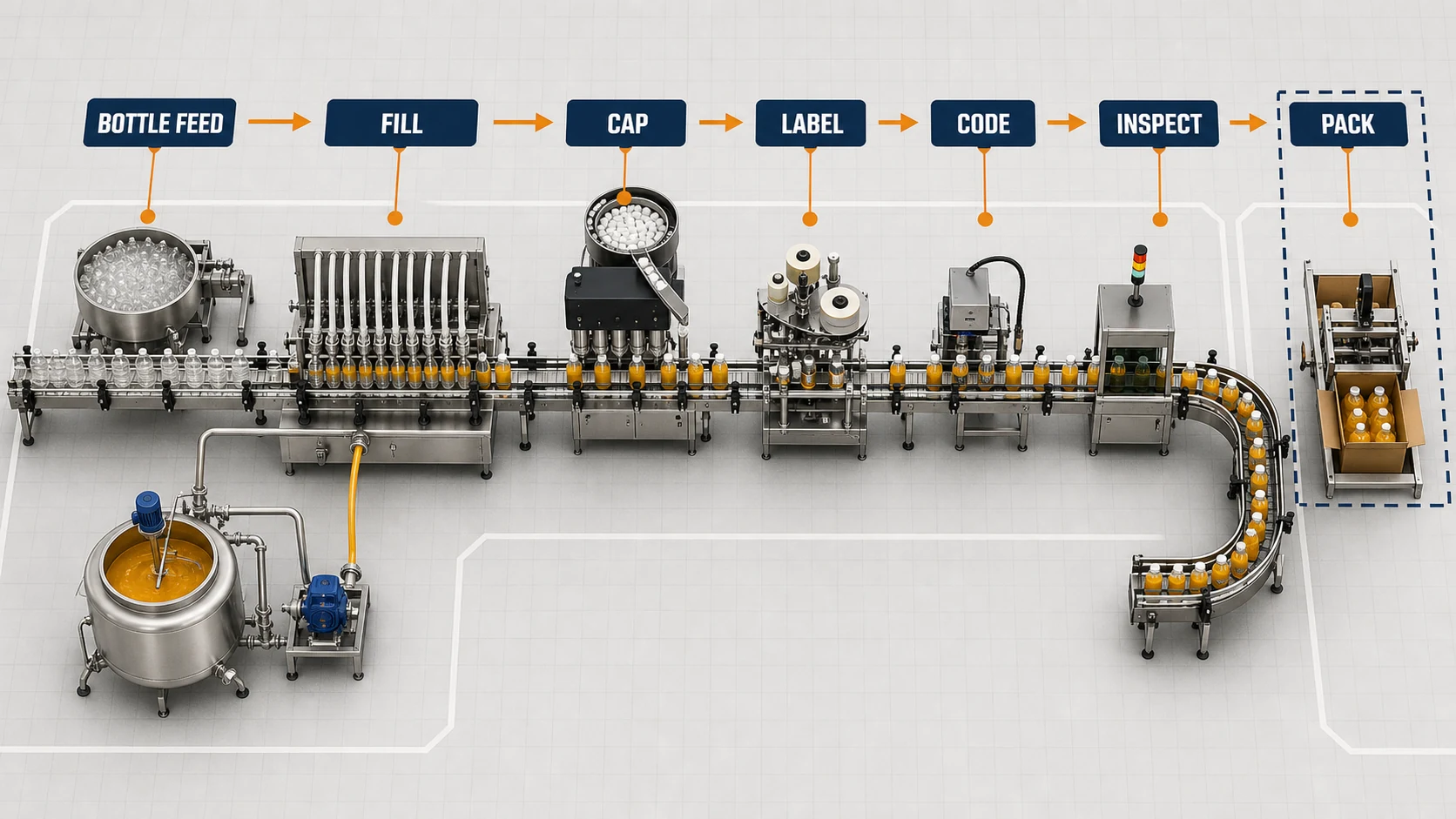
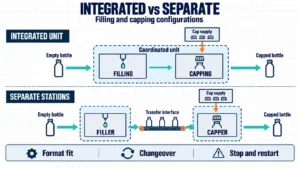
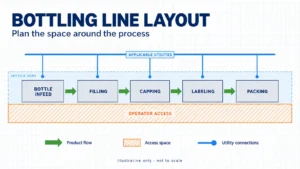
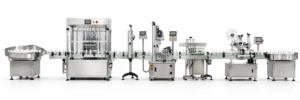
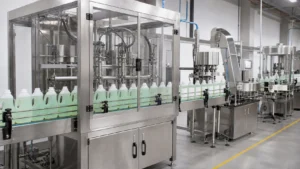
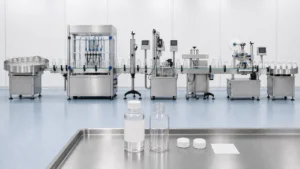
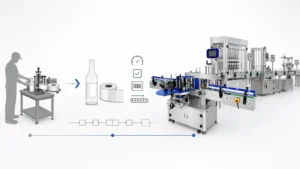
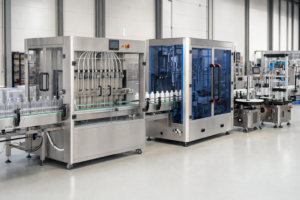
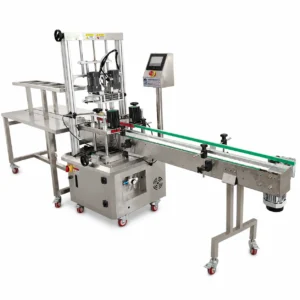
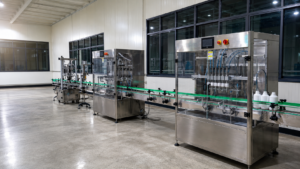
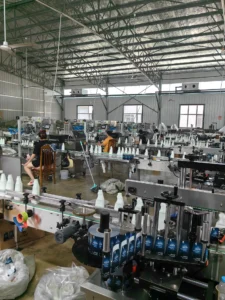
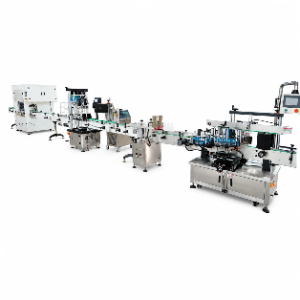
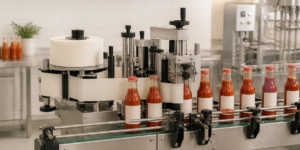
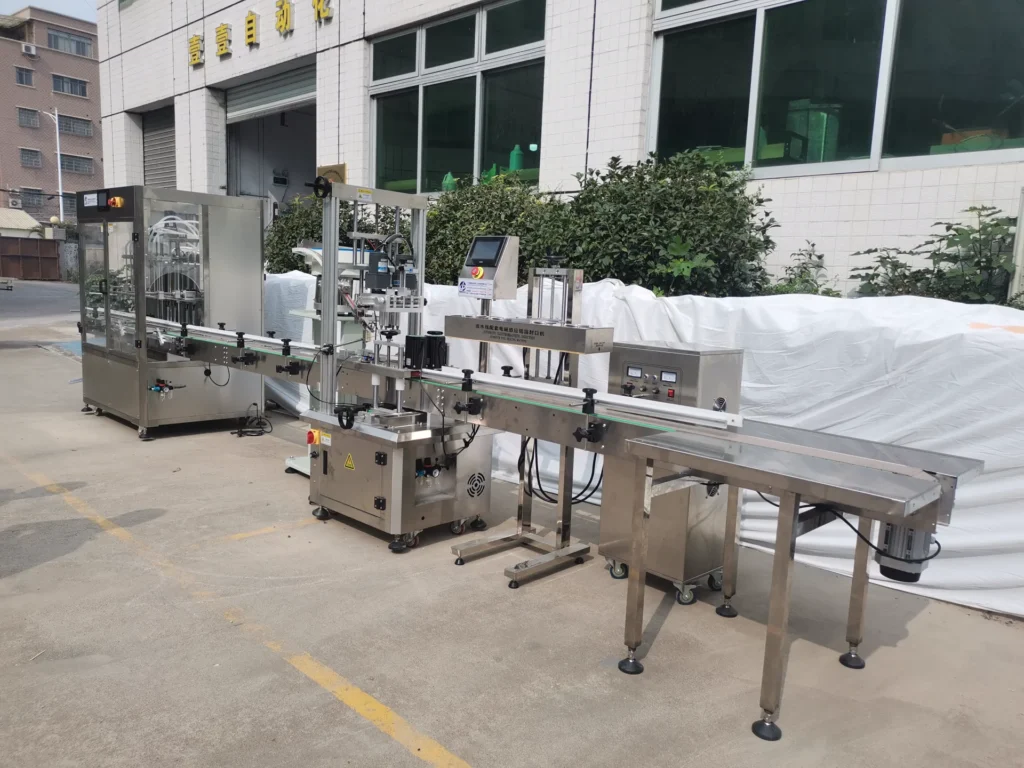
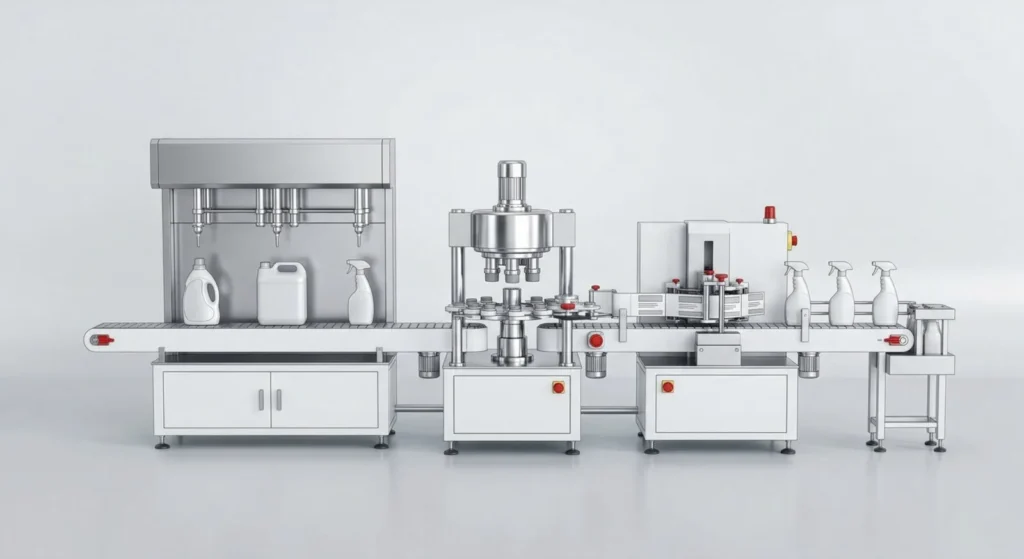
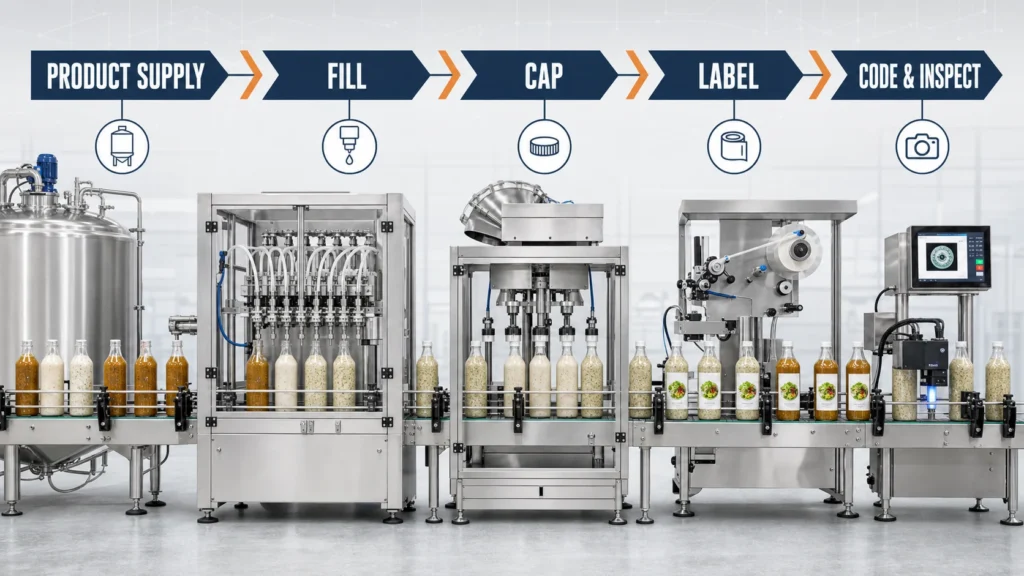
An automatic salad dressing filling machine is only one part of the production flow. A practical line may include empty-container feeding, rinsing or air cleaning where specified, product filling, cap or insert handling, capping, sealing, labeling, coding, inspection, conveying, accumulation, and packing support.
Choose the Automation Level From Sustained Line Output
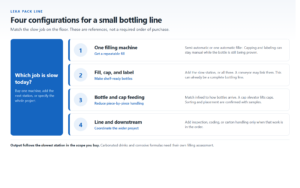
Choose manual loading, semi-automatic filling, or a fully automatic line from sustained output, labour availability, SKU frequency, and the slowest downstream operation. A semi-automatic setup may suit frequent small-batch changeovers, while an automatic line is more appropriate when filling, capping, labeling, inspection, and packing can operate at a balanced rate. The manual, semi-automatic, or automatic filling setup guide explains this comparison for smaller producers.
| Line Section | What to Confirm | Why It Affects the Project |
|---|---|---|
| Container feeding | Manual loading, turntable, or automatic unscrambling | Determines labour, accumulation, and entry speed |
| Filling | Product supply, metering, nozzles, dose range, and cleaning boundary | Controls the core dosing and product-handling duty |
| Closure handling | Cap, liner, insert, orientation, placement, and tightening method | Protects the package and affects line speed |
| Sealing | Whether an induction or other seal is required and who validates it | Adds package components and inspection requirements |
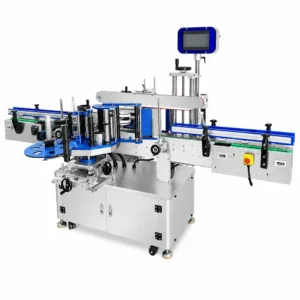
| Labeling and coding | Bottle shape, label panels, date or batch-code location | Determines labeler type and sensor arrangement |
| Inspection and packing | Fill check, cap presence, label check, accumulation, and case format | Defines the finished-pack acceptance and downstream balance |
The slowest or least stable operation can control sustained output. A quotation that lists only the filler rate does not establish the capacity of the complete salad dressing bottling machine. Ask for the assumed container, product, fill volume, operating pattern, and downstream scope behind every output statement.
Plan Cleaning, Allergen Control, and Changeover
Cleanability should be part of equipment selection, not an instruction added after installation. The Food and Agriculture Organization of the United Nations advises that food equipment should be designed and located to permit maintenance, cleaning, and disinfection, with suitable food-contact materials.[2]
Define the cleaning boundary
Mark every wetted component from the product supply to the nozzle. For each one, state whether it will be cleaned in place, removed for cleaning, or handled by another validated method. This component-level review follows the FAO principle that food equipment should permit effective maintenance, cleaning, and disinfection.[2] “CIP available” is not enough unless the quotation identifies the included circuits, flow paths, valves, spray devices, return route, utilities, and control sequence.
Plan for recipe changes
Changing from a thin vinaigrette to a creamy dressing can involve more than a recipe rinse. Operators may need to change nozzles, product settings, bottle guides, cap handling, label settings, and inspection limits. If the factory runs several SKUs per shift, changeover work should be demonstrated rather than estimated from a brochure.
Do not treat allergen cleaning as a visual check
Dressings may contain ingredients such as egg, milk, mustard, sesame, or nuts, depending on the recipe and market. The U.S. Food and Drug Administration notes that surface material, soil, and cleaning method can influence allergen removal.[3] The producer must define and validate its own allergen controls. The machine supplier should provide access, materials, documentation, and cleaning functions that support that programme.
How to Verify Output, Fill Results, and FAT
A useful factory acceptance test (FAT) reproduces the agreed duty closely enough to expose project risk. Water alone cannot demonstrate how a separating, viscous, or particulate dressing will move through the system.
Agree on the test material and package
Use representative dressing, bottles, closures, inserts, seals, and labels. Record the product condition before the run, including temperature and holding time. If the final recipe cannot be shipped, agree on a substitute and document what the substitute cannot prove.
Check more than the average fill
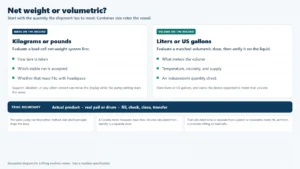
Sampling should identify head-to-head variation, changes during hopper-level movement, start-up behaviour, and drift over a sustained run. For visible ingredients, photograph or otherwise assess distribution separately from net quantity. The sauce filling machine accuracy guide provides a practical framework for net-weight checks.
Test the finished line condition
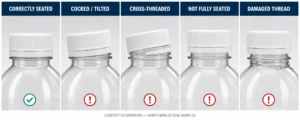
Observe bottle stability, neck cleanliness, cap placement, cap tightening, seal readiness, label position, coding, sensors, reject logic where included, and the transfer into packing. A filler can meet its dose target while the full line still loses output through dirty necks or unstable containers.
Write acceptance criteria before the test
The quotation and FAT document should define the product, package, duration, sampling method, acceptable result, and action if the result is missed. Do not rely on words such as “high accuracy,” “easy cleaning,” or “fast changeover” without a test method relevant to the project.
What to Send in a Request for Quotation (RFQ)
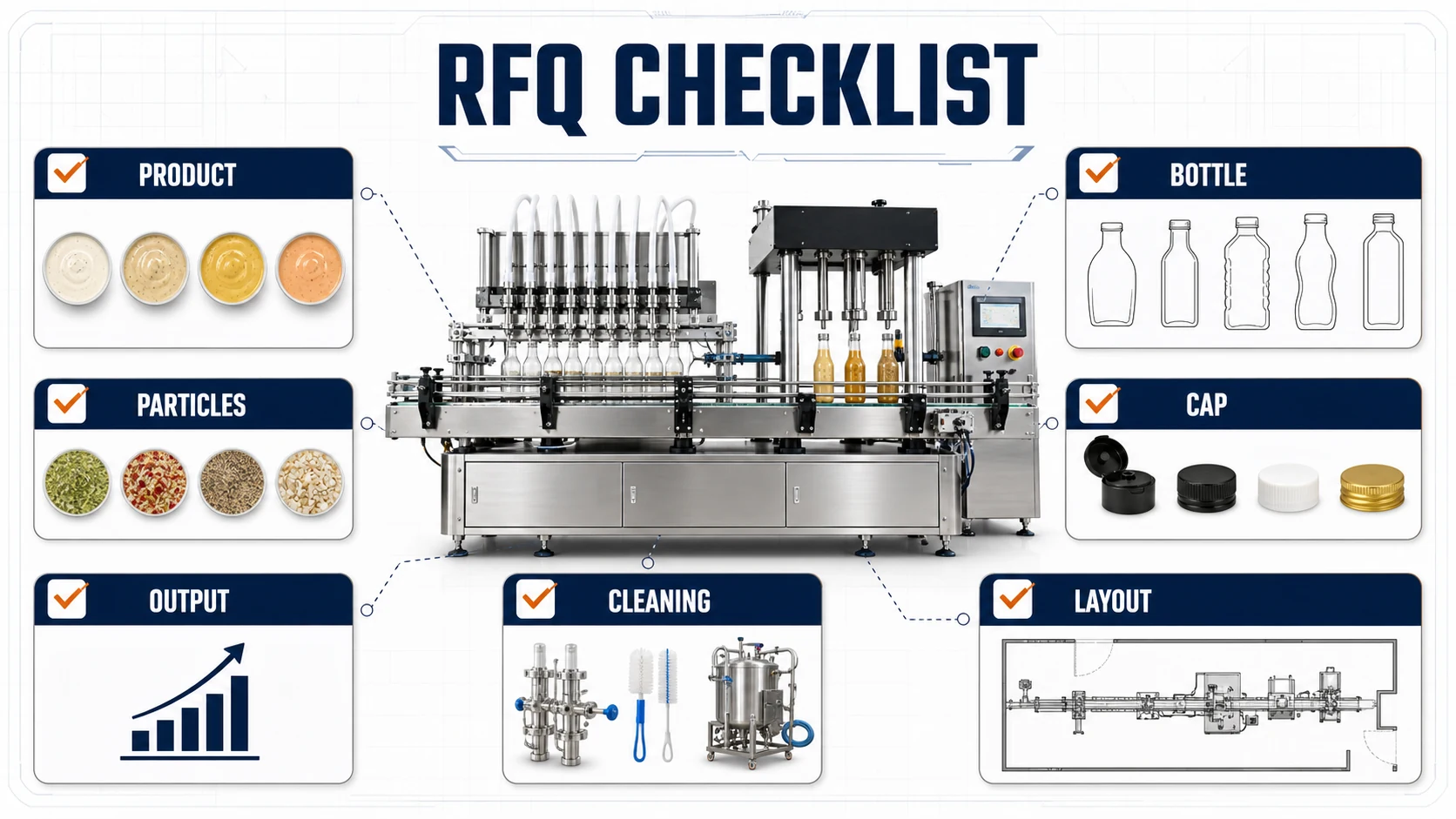
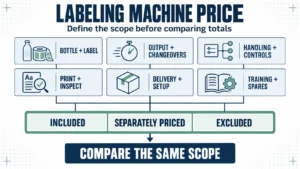
A complete inquiry reduces guesswork and makes supplier quotations easier to compare. For budget planning, review the sauce filling machine price factors and RFQ comparison guide before comparing suppliers. Send the following information:
- Dressing name and whether it is pourable, creamy, particulate, or visibly separating
- Actual filling temperature and expected holding time before filling
- Representative product sample or a clear flow video
- Largest herb, spice, cheese, fruit, or vegetable piece
- Whether agitation or recirculation is permitted
- Fill volumes and acceptable net-quantity method
- Production bottle, neck, cap, insert, seal, and label samples
- Target sustained bottles per hour and shift pattern
- Number of SKUs and expected changeover frequency
- Required cleaning method and allergen-control boundary
- Available floor space, product-supply location, voltage, frequency, compressed air, and other utilities
- Required line scope from container feeding through final packing
Illustrative Project Brief
This illustrative brief shows the level of detail a supplier can use: 500 mL PET bottle, 38 mm neck opening, and herbs up to 6 mm. The same brief states that product arrives at 22°C, the target is 2,400 bottles/hour, and 3 SKUs are planned per production day. These values are not a recommendation or performance promise; replace each one with the real project condition.
Common Buying Mistakes
- Requesting a quote with only the product name. “Salad dressing” does not define flow, separation, or particles.
- Testing an easy SKU. The most demanding recipe and container usually provide more useful evidence.
- Checking net quantity but ignoring ingredient distribution. These can fail independently.
- Assuming the filler determines line output. Closure handling, labeling, inspection, and accumulation can become the constraint.
- Assuming CIP is a complete specification. The included circuits, utilities, sequence, and validation responsibility still need definition.
- Buying before sending package samples. Bottle, neck, closure, insert, seal, and label details affect several machines at once.
Frequently Asked Questions
What type of filling machine is suitable for salad dressing?
The suitable filler depends on the dressing’s viscosity, separation, particles, filling temperature, dose range, and container opening. Smooth creamy dressings may suit a piston or positive-displacement pump direction, while pourable or separating dressings can require different metering and product-supply controls. A representative sample test should confirm the choice.
Can one machine fill vinaigrette and creamy dressing?
It may be possible, but the buyer should not assume it. The supplier must evaluate the full viscosity range, product feed, valves, nozzles, air-pocket risk, cleaning method, and change parts. FAT should include both the thinnest and thickest products in their actual containers.
How do you keep herbs evenly distributed during filling?
First identify where the herbs settle or accumulate. A suitable vessel, controlled agitation, product outlet, pump, manifold, valve, and nozzle path may be required. The correct arrangement depends on particle size, concentration, fragility, and the dressing’s response to mixing. Distribution should be checked separately from net fill quantity.
Can a salad dressing filler handle vegetable or cheese pieces?
Some filling systems can handle soft pieces, but capability depends on the largest piece and the narrowest point in the complete product path. Send representative material and the production container for testing. Do not approve the machine from nozzle diameter alone because restrictions may exist earlier in the system.
Is a piston filler suitable for creamy dressing?
A piston filler can be a practical option for many smooth, viscous dressings. Suitability still depends on the required fill range, seals, valve design, nozzle cut-off, product supply, cleaning method, and changeover plan. The final proposal should be tested with the real dressing rather than water alone.
Does a salad dressing filling machine include CIP?
Not automatically. CIP scope varies by machine and project. The quotation should identify which tanks, pumps, pipes, valves, manifolds, and nozzles are included; how cleaning solution circulates and returns; which utilities are required; and which components still need removal or separate cleaning.
What should be tested before ordering the machine?
Test the most demanding dressing and package combination. Check dose results, ingredient distribution, bottle-neck cleanliness, particle integrity where relevant, sustained running, product-level changes, capping, labeling, alarms, changeover, and cleaning access. Record the agreed method and acceptance criteria before FAT begins.
Plan the Filling Line Around the Actual Dressing
The right salad dressing filling machine is the one configured for the product, container, output, cleaning plan, and factory—not the one with the broadest catalogue description. Classify the dressing first, then turn every important production condition into a proposal requirement and FAT check.
Request a Salad Dressing Filling Line Review
Send LEKA Pack Line your dressing type, filling temperature, particle condition, fill volume, bottle and cap photos, target output, available layout, and required line scope. We can review a suitable sauce filling machine and bottling-line direction for the project. Send your project details to request a configuration review.
Sources
- Pacific Packaging Machinery. “Food Filling Equipment.” Accessed August 28, 2026. View source.
- Food and Agriculture Organization of the United Nations. “Establishment – design of facilities and equipment.” April 14, 2023. Accessed August 28, 2026. View source.
- U.S. Food and Drug Administration. “Allergen Removal and Transfer Using Wiping and Cleaning Methods in Retail Food Establishments.” Accessed August 28, 2026. View source.