
Sauce Filling Troubleshooting
Sauce Filling Machine Accuracy: Diagnose Overfilling, Underfilling, and Fill-Weight Variation
A practical method for checking net quantity, diagnosing inconsistent fill volume, and verifying dose adjustments during production, commissioning, and FAT.
Sauce filling machine accuracy is not confirmed by one bottle landing close to its target. When overfilling and underfilling appear, first determine whether every package is consistently high or low, whether one filling head differs from the others, or whether the line shows inconsistent fill volume after a refill, pause, temperature change, or cleaning cycle.
Those patterns point to different causes. A stable average offset may justify a controlled recipe adjustment. Wide fill-weight variation usually means that product, feed, air, timing, or measurement conditions are not stable enough for a meaningful dose adjustment yet.
This guide is for production troubleshooting, machine commissioning, and factory acceptance testing. It focuses on net-weight checks, tare control, temperature, viscosity, air, product feed, head-specific faults, and dose verification. It does not cover piston-versus-pump selection, nozzle-drip troubleshooting, or particle handling and distribution.
If you are choosing equipment rather than diagnosing an installed filler, start with our sauce filling equipment overview.
Contents
- Key takeaways
- How to check sauce filling machine accuracy
- How to diagnose inconsistent fill volume
- What causes fill-weight variation?
- A practical net-weight check
- Sauce filling machine calibration and dose adjustment
- FAT acceptance criteria
- What to send a supplier
- Frequently asked questions
Key takeaways
- Measure net product quantity, not only the gross weight of the filled package.
- Separate a consistent average offset from bottle-to-bottle fill-weight variation.
- Record results by filling head, sequence position, operating state, product temperature, and relevant refill events.
- Do not change a common dose setting until product, feed, air, and measurement conditions are stable.
- Use applicable law, the factory QA plan, customer requirements, and an agreed FAT protocol to define acceptance limits.
How to Check Sauce Filling Machine Accuracy
A filler that delivers one correct 500 g bottle has not necessarily proved that it is accurate. A useful check asks two separate questions:
- Is the average net quantity centered above, below, or close to the target?
- How tightly do individual packages group around that average?
The first question identifies average bias. The second identifies variation. A process can repeat tightly but consistently overfill. It can also average near target while producing an uncomfortable mix of high and low packages.
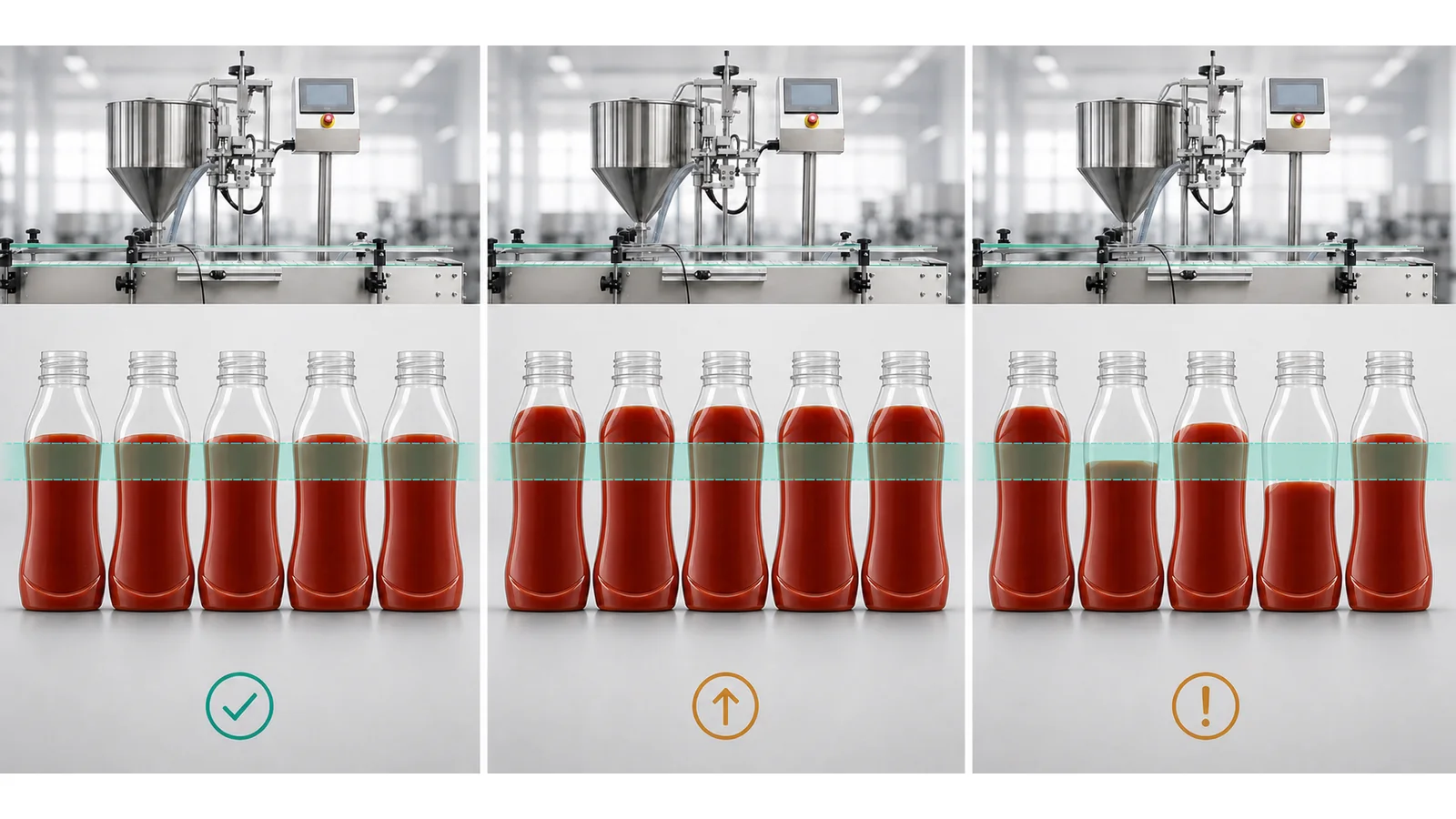
| Measure | What it shows | Typical diagnosis question |
|---|---|---|
| Target quantity | The intended net amount for the product and package | What should this package contain? |
| Average bias | Whether the fill series is centered above or below target | Is there a shared target, tare, recipe, dose, or conversion issue? |
| Fill-weight variation | How widely individual packages differ | Is the filling process stable enough for dose adjustment? |
| Head-to-head difference | Whether one lane or filling head behaves differently | Is the fault local or shared across the machine? |
For packaged-goods compliance, the factory average is not always enough. In the United States, NIST net-contents guidance explains that package evaluation can involve both average and individual-package requirements. The applicable approach depends on the product, label declaration, package type, jurisdiction, and test procedure.
Measure net quantity before judging the filler
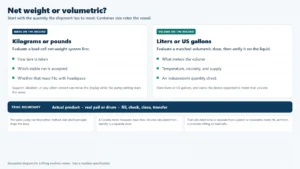
Teams often say they are checking “fill volume” when the actual production control point is mass. Before comparing a scale reading with a machine setting, define the target and its unit: grams, kilograms, milliliters, fluid ounces, or another approved declaration.
For many viscous or semisolid foods, net quantity is controlled by weight. The FDA Food Labeling Guide summarizes U.S. conventions for weight and fluid-measure declarations. Requirements may differ by market, so confirm the applicable rule for the product being packed.
For example, a package with a gross mass of 532.0 g and a tare of 32.0 g contains 500.0 g net product. The subtraction is simple; the important point is using a tare method approved by QA for the actual bottle, cap, pouch, lid, or other relevant packaging components.
If a volume declaration is checked by weight, use density data valid for the actual product and the defined temperature range. Do not assume one density value remains accurate when a sauce changes materially with temperature, shear, mixing, or batch condition.
How to Diagnose Inconsistent Fill Volume
Inconsistent fill volume is easier to solve when data are separated by filling head and operating state. A production team may see “some bottles are light,” but the actual pattern may be one high head, startup-only underfills, or a shared instability after hopper refill.
| Observed pattern | Where to look first | First practical checks |
|---|---|---|
| Nearly every package is consistently high or low | Shared target, tare, recipe, dose, timing, or density conversion | Confirm units, target, tare method, saved recipe, and the designated dose parameter |
| All heads show a wide, irregular spread | Shared product, feed, air, utility, or timing condition | Check product temperature, visible air, hopper level or feed condition, inlet continuity, refill events, and common timing |
| One head differs while the others remain stable | Local product path or head-specific setup | Inspect its valve, seals, O-rings, tube, clamp, obstruction, and approved head offset |
| Only startup or post-pause packages vary | Priming, trapped air, temperature change, or stop-start sequence | Follow the priming procedure and record startup fills separately from steady-running fills |
| Results drift through the batch | Changing product or supply condition | Trend product temperature, hopper level or feed condition, aeration, inlet continuity, refill events, and—where the system uses controlled product pressure—supply pressure |
| Variation begins after cleaning or changeover | Assembly, seal seating, hose routing, or recipe selection | Review reassembly, valve orientation, clamps, seals, trapped air, and the loaded recipe |
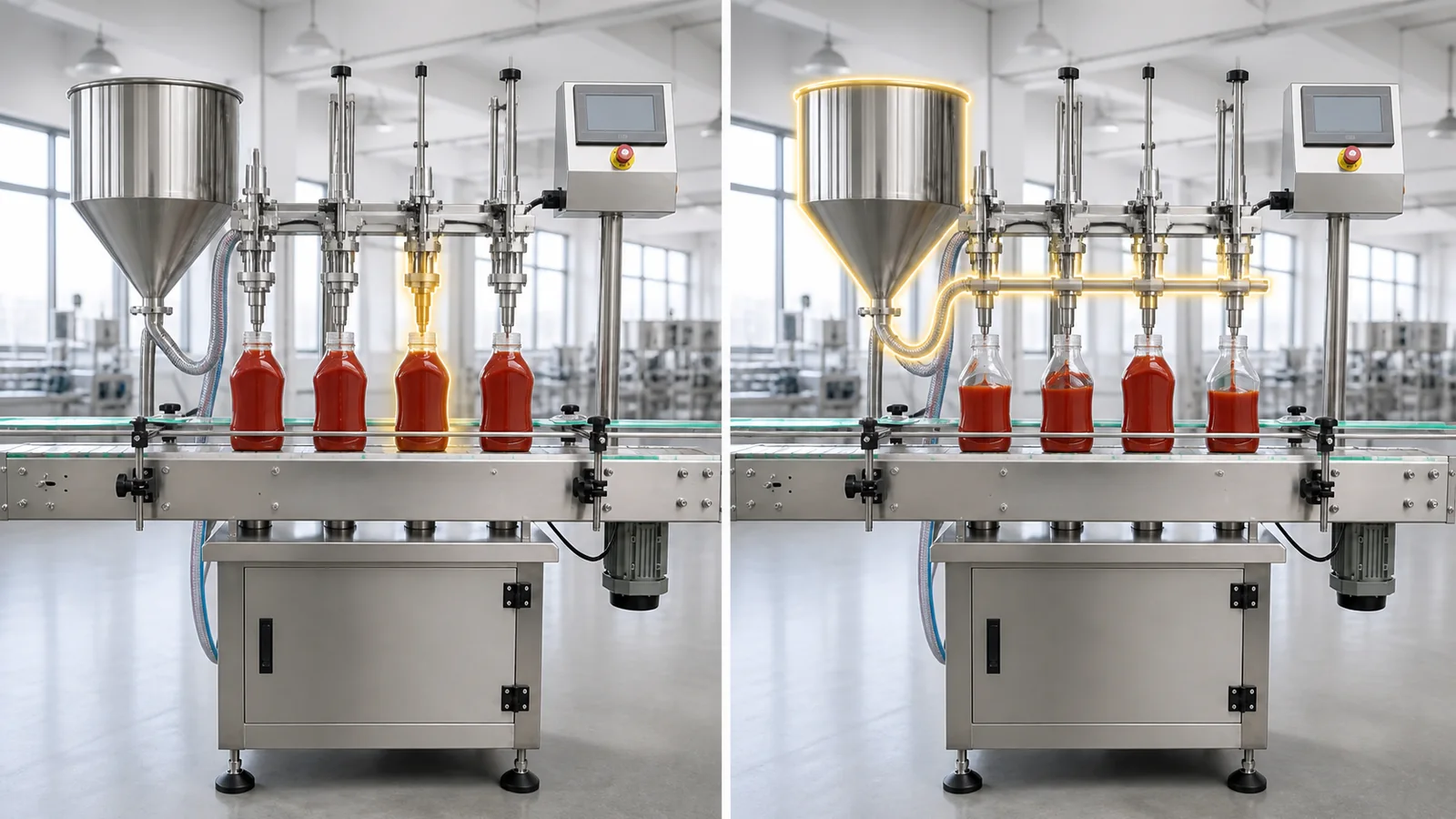
Example: one head is consistently high
Consider a three-head sauce filler set for 500 g. Under steady-running conditions, Heads A and B produce fills between 499 g and 501 g. Head C repeatedly produces fills from 503 g to 505 g. The product temperature, tare method, feed arrangement, and line speed remain unchanged.
Do not lower the common dose setting first. Heads A and B are already close to target, so the evidence points to Head C rather than a global recipe issue. Inspect the permitted head-specific correction, valve seating, seal condition, tube condition, local restriction, and assembly history.
After correcting the local cause, collect a fresh series under the same conditions. Only then decide whether the shared setting requires a controlled adjustment.
What Causes Fill-Weight Variation?
Fill-weight variation does not have one universal cause. It can result from changing product condition, unstable product supply, trapped air, timing or utility instability, incorrect assembly, or a local component problem at one filling head.
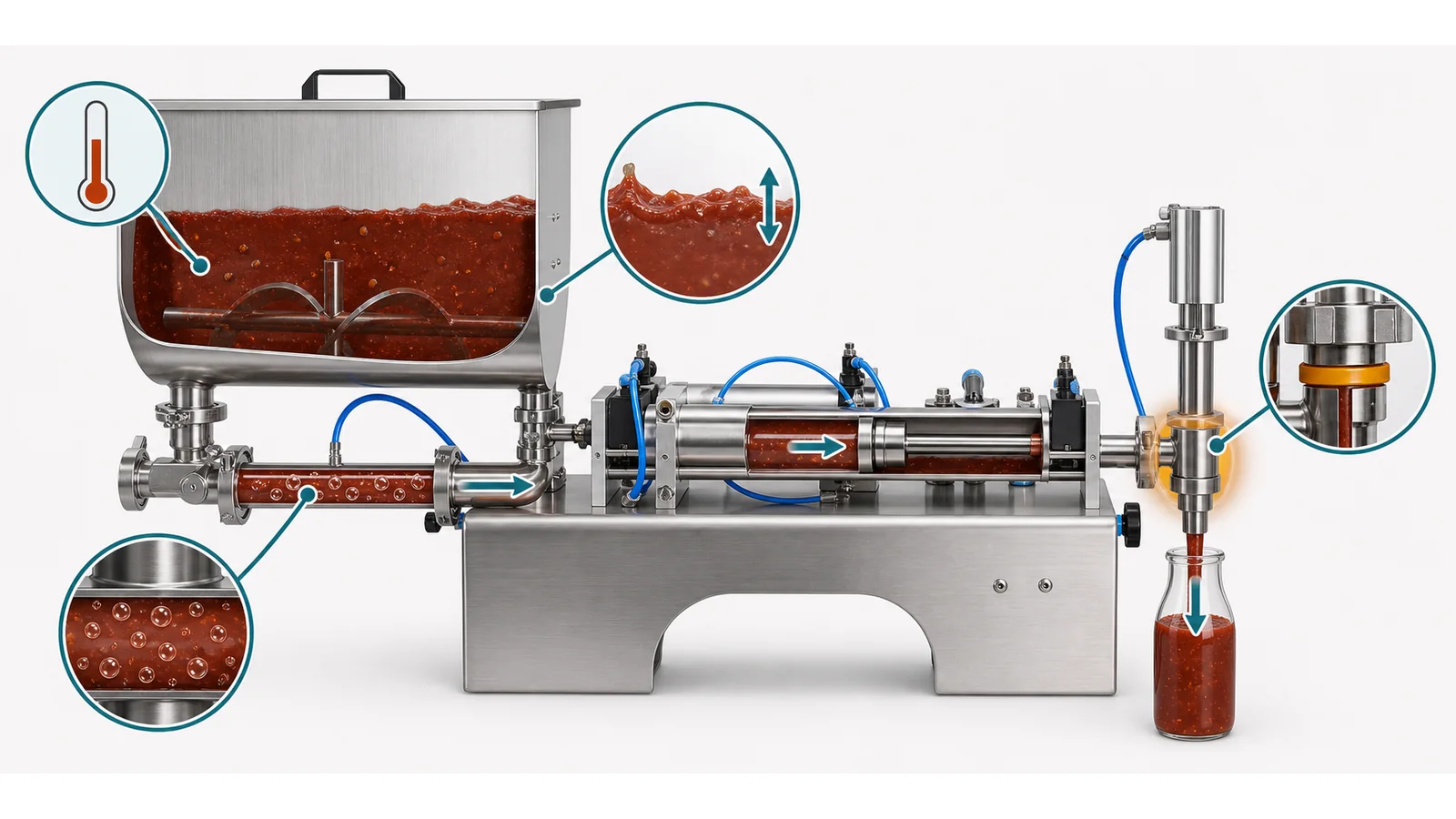
Product temperature and viscosity
Sauce can behave differently as it heats, cools, shears, or sits in a hopper. These changes can affect suction, refill, valve flow, cutoff behavior, and the amount delivered during each cycle.
Record product temperature at the filler, not only at the cooking tank or batch-release point. A warmer sample may appear easier to fill than the same sauce later in the shift. If temperature affects flow behavior, define the permitted operating range before accepting a dose setting.
Air, priming, and product supply
Air in the product path is a frequent cause of unstable filling, particularly after priming, cleaning, sauce bottling line changeover, or hopper refill. Possible entry points include loose clamps, damaged seals, poorly seated O-rings, incomplete priming, exposed inlets, or unstable product feed.
If every head begins to vary after a hopper refill, inspect the shared feed and priming condition before adjusting individual heads. If only one head varies, inspect that head’s local product path first.
For model-specific examples of inconsistent-fill checks, see Neostarpack’s first-party guidance on inconsistent fills. Use it as a list of possible checks, then follow the manual and approved maintenance procedure for the installed machine.
Feed condition, timing, and recovery
The relevant feed condition depends on the dosing design. A pressure-fed system may require stable product supply pressure. A gravity-fed or hopper-fed system may depend more on product level, inlet continuity, refill behavior, and the ability of the dosing chamber to refill completely.
For a pneumatic system, unstable air pressure, limited air storage, trapped air, or incomplete valve movement can affect repeatability. For electric, servo-driven, or weight-based equipment, the failure mode may differ, but the product path must still refill, dispense, stop, and recover consistently during every cycle.
If results worsen after a pause or at higher speed, compare the complete cycle. A dose setting that works during a slow trial may not remain stable when refill time, cutoff behavior, product supply, or machine timing changes.
For the capacity side of this check, review how filling-head count and line speed affect bottle filling machine output.
Head-specific seals, valves, and settings
When only one head shifts, inspect the local product path before changing a shared recipe. Depending on the installed filler, this may include valve movement, seals, O-rings, tube wear, local restrictions, or an approved head-specific offset.
If the maintenance procedure allows a controlled component swap, record whether the fault follows the component or stays with the station. That comparison can help distinguish a local mechanical issue from a setup or control issue.
If net quantity remains stable but product continues to collect on the bottle neck after cutoff, the primary issue may be sauce filling nozzle dripping rather than dosing accuracy.
A Practical Net-Weight Check
A useful check produces data that support a decision. Avoid taking a few random weights, calculating one average, and declaring the filler accurate or inaccurate.
- Define the test condition. Record product, batch, target quantity, unit, package, tare method, active heads, line speed, recipe, feed arrangement, and product temperature.
- Confirm the measurement method. Use suitable, in-calibration equipment. Repeat-weigh one unchanged package to identify obvious scale or weighing-environment noise before interpreting filling results.
- Prime the installed machine correctly. Follow the startup and priming sequence specified for the installed filler. The correct sequence depends on its dosing design and product path.
- Sample by head and operating state. Identify the head or lane for each package. Separate startup, steady running, normal pause/restart, refill recovery, and post-cleaning checks where those states represent production.
- Keep raw values. Record gross mass, tare, net mass, head, sequence position, temperature, operating state, and observations such as visible air, leakage, valve motion, or hopper refill.
- Read the pattern before adjusting. Investigate broad variation or one abnormal head before changing a common dose parameter.
- Change one variable and repeat. Save the baseline, make one approved adjustment, and collect a new series under comparable conditions.
Illustrative fill-check record
The table below shows a useful data structure. It is not a universal sample size or legal acceptance plan. QA should define the number of samples, head coverage, operating states, and acceptance criteria for the product and intended purpose.
| Sequence | Head | Gross mass | Tare | Net mass | Deviation from 500.0 g | Operating state |
|---|---|---|---|---|---|---|
| 1 | A | 532.0 g | 32.0 g | 500.0 g | 0.0 g | Steady running |
| 2 | B | 533.1 g | 32.1 g | 501.0 g | +1.0 g | Steady running |
| 3 | C | 535.9 g | 31.9 g | 504.0 g | +4.0 g | Steady running |
| 4 | A | 530.8 g | 31.8 g | 499.0 g | −1.0 g | Steady running |
| 5 | B | 532.2 g | 32.2 g | 500.0 g | 0.0 g | Steady running |
| 6 | C | 535.0 g | 32.0 g | 503.0 g | +3.0 g | Steady running |
The average is slightly high, but the more useful finding is that both Head C fills are above the results from Heads A and B. The next investigation should focus on Head C. More controlled samples are still needed before concluding whether the cause is a local setting, valve behavior, measurement issue, or another factor.
For an initial troubleshooting check, minimum, maximum, and head-by-head comparison may be enough to identify an obvious pattern. For FAT release or ongoing process control, use the variability, control-chart, or capability method approved by QA.
Sauce Filling Machine Calibration and Dose Adjustment
Operators often search for “sauce filling machine calibration” when a sauce filler begins to overfill, underfill, or show inconsistent fill volume. In practice, two different activities may be involved:
- Measurement-system calibration: confirming that the scale, checkweigher, load cell, or other verification equipment provides valid measurements under the defined test conditions.
- Filler dose adjustment: changing an approved recipe parameter—such as stroke, pulse count, filling time, target weight, speed profile, or permitted head-specific offset—to move a stable average toward the target.
Do not treat these activities as interchangeable. A valid dose adjustment depends on trustworthy measurement data, while a calibrated scale cannot correct a filler with trapped air, changing product viscosity, unstable supply, worn seals, incomplete valve movement, or a head-specific mechanical fault.
How to verify and adjust a stable dose setting
- Save the baseline. Record the recipe, parameter values, product condition, speed, active heads, tare method, and raw fill results before changing anything.
- Confirm the approved adjustment point. The correct parameter may be stroke, pulse count, filling time, target weight, speed profile, cutoff timing, or a head-specific correction.
- Adjust one controlled variable. Do not alter pressure, product temperature, head offsets, valve timing, and the common dose in the same trial.
- Reach the defined operating state. Keep priming and stabilization separate from the measured series according to the approved procedure.
- Repeat comparable sampling. Test the same heads, speed, product condition, and operating states used in the baseline.
- Document the accepted recipe. Record the product, package, target, operating condition, approval date, responsible person, and re-verification triggers.
Practical rule: Dose adjustment should move the center of a stable fill pattern. Troubleshooting should reduce unexplained spread or remove a head-specific pattern. Do not expect one adjustment to solve both problems.
FAT Acceptance Criteria for Sauce Filling Accuracy
“High accuracy” is not an acceptance test. For an effective factory acceptance test, buyer and supplier should agree the product condition, package, test method, sample plan, and pass/fail criteria before testing begins.
For the wider procurement test plan, use a structured bottle filling machine RFQ and FAT checklist, then add the product-specific accuracy criteria defined here.
A useful FAT protocol should define:
- The production-representative sauce and agreed temperature or condition range
- The nominal quantity and unit, plus density and reference-temperature method when mass verifies a volume declaration
- The actual package components and approved tare procedure
- The line speed, active heads, product-feed arrangement, refill method, and operating states to be tested
- The sample plan and agreed criteria for average quantity, individual-package results, head-to-head consistency, and process stability
- The raw-data record, recipe settings, observations, and sign-off responsibilities
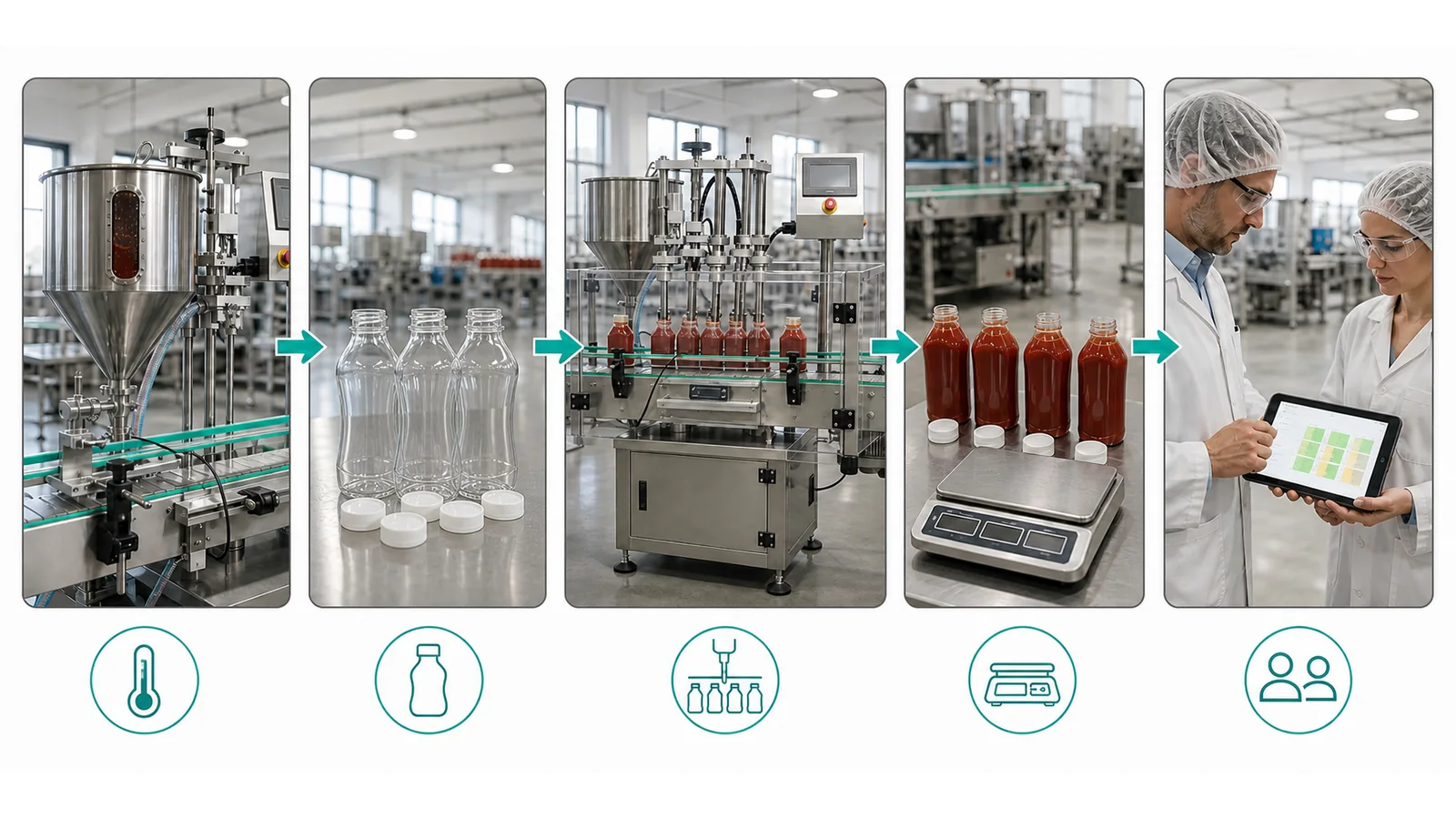
Agree responsibilities before FAT
- Buyer or QA team: approves the target quantity, acceptance criteria, applicable market requirements, product-condition range, package components, tare method, and sampling plan.
- Supplier: identifies the installed dosing principle, approved adjustment points, expected operating limits, required utilities, and machine data available during the test.
- Both parties: agree whether FAT uses representative product, actual production containers, steady-running conditions only, or additional states such as startup, refill recovery, and pause/restart.
FAT wording template: “Using [agreed product] at [agreed condition range] in [actual container], the filler will be evaluated at [operating condition] for a nominal quantity of [value and unit]. Samples will be identified by head and sequence under [agreed sampling plan]. Acceptance will follow [buyer-approved criteria and applicable standard].”
The buyer should approve limits that reflect applicable law, customer requirements, plant QA rules, and the commercial cost of overfill. Do not invent the acceptance rule after seeing the test result.
For U.S. net-content context, NIST Handbook 133, current 2026 edition provides procedures for checking packages labeled by weight, volume, and other quantity declarations. Its regulatory inspection procedures should not be copied automatically as a factory process-control or FAT sample plan.
What to Send a Supplier for Review
“The machine is inaccurate” does not give a supplier enough information to identify a likely cause. Send raw figures and operating context, not only a screenshot showing one average value.
- Target quantity, unit, product, batch, and product-temperature trend
- Scale identification, resolution, calibration status, and approved tare method
- Filler model, dosing principle, active heads, speed, recipe, and relevant settings
- Gross mass, tare, and net results identified by head and sequence position
- When variation appears: startup, steady running, pause, restart, refill recovery, or after cleaning
- Photos or a cycle video when visible air, leakage, supply behavior, or valve movement may be relevant
With this information, a service engineer can usually decide whether to investigate the common recipe, product supply, measurement method, or one local filling head first.
Need an initial fill-accuracy review? Send LEKA Pack Line the raw fill record, product details, operating conditions, and head-by-head results. We can help narrow the diagnostic path and discuss how the filler should fit into a complete sauce filling line.
Frequently Asked Questions
What causes inconsistent fill volume in a sauce filling machine?
Inconsistent fill volume can result from trapped air, incomplete priming, changing product temperature or viscosity, unstable hopper level or feed condition, worn seals, incomplete valve movement, incorrect recipe settings, or one filling head behaving differently from the others. First determine whether the pattern is shared across all heads or isolated to one head.
How do you diagnose overfilling and underfilling?
Measure net quantity using an approved tare method, then compare results by filling head, sequence position, product temperature, and operating state. Consistent overfilling or underfilling across all heads suggests a shared target, recipe, dose, or timing issue. Wide variation or a single abnormal head points first to product, feed, air, or local mechanical causes.
When should sauce filling machine calibration be verified?
First verify that the measurement system remains suitable and in calibration. Then verify the saved filler recipe or dose setting after a product change, meaningful temperature or viscosity change, new package or tare profile, cleaning and reassembly, maintenance on the product path, replacement of critical components, or an approved parameter change.
What is the difference between fill-weight variation and a wrong dose setting?
A wrong dose setting usually shifts the average net quantity consistently above or below target. Fill-weight variation describes how widely individual packages scatter around that average. Correct the dose after the variation is controlled enough to make the adjustment meaningful.
How many packages should be checked during a fill-accuracy test?
There is no universal number for every product, filler, or purpose. A production verification plan should cover the relevant heads and operating states. A legal inspection follows jurisdiction-specific procedures. Use the sample plan approved by QA and agreed for FAT rather than copying a generic bottle count.
Technical Sources
- NIST Handbook 133, current 2026 edition — U.S. procedures for checking packages labeled by weight, volume, and other quantity declarations.
- NIST Net Contents of Packaged Goods FAQs — U.S. context for average and individual-package requirements.
- OIML R 87:2016, Quantity of product in prepackages — international guidance concerning quantity of product in prepackages and tare procedures.
- FDA Food Labeling Guide — U.S. guidance on net quantity declarations and weight versus fluid measure.
- International Vocabulary of Metrology (VIM): calibration — terminology for calibration of measurement systems.
- International Vocabulary of Metrology (VIM): adjustment of a measuring system — terminology distinguishing adjustment from calibration.
- Neostarpack inconsistent-fill troubleshooting guidance — first-party reference covering priming, air, seals, connections, hopper supply, and refill practices.
Editorial note: This article provides technical troubleshooting context, not legal or regulatory advice. Confirm the applicable labeling, net-content, measurement, inspection, and acceptance requirements for each market where the finished product will be sold.