Wetted-Part Materials for Liquid Filling Lines: A Specification Reference
Most filling and dosing lines are correctly built in 316L stainless steel. This reference covers the minority of cases where that is not true, and what a buyer or specifier should put on paper when it happens.
It is written from the material supply side. Grade selection detail sits with the material supplier; what follows is the specification work that has to happen on the equipment side first.
1. Which components count as wetted parts
Scope the specification by listing product-contact items, then stop. Anything a liquid never touches stays in standard construction.
| Component | In the wetted circuit | Notes |
|---|---|---|
| Supply tank or hopper, liner, wetted agitator shaft and impeller | Yes, where product-contact | Excludes the agitator drive, motor and external supports |
| Product tubing or piping, hoses, manifolds, ferrules, fittings and product-side gasket surfaces | Yes | External clamp rings are not normally wetted; the ferrule and gasket form the product-contact joint |
| Pump chamber, rotor or impeller, or piston and cylinder | Yes, according to pump design | Include only seals and rod surfaces exposed to product or CIP liquid |
| Valve body, seat, plug or diaphragm, and any product-contact stem | Yes | Confirm the actual wetted boundary from the valve drawing |
| Filling nozzle, shut-off tip and dive tube | Yes | Product and CIP chemistry contact these surfaces directly |
| Filter housing and element, check valve, flowmeter body and sight glass | Yes, where fitted | Commonly omitted from abbreviated wetted-part lists |
| Intrusive level and temperature probes or thermowells | Yes, where fitted | Non-contact sensors are outside the wetted circuit |
| External clamp rings, non-contact sensors, frame, drive, guarding, conveyor and cabinet | No | No titanium change is required unless the project identifies a separate exposure |
A machine with titanium wetted parts is usually a stainless machine with selected product-contact components changed. It is not a titanium machine.
2. Service conditions that move the answer
State each of the following in the enquiry. A builder can price against them; nobody can price against the phrase “titanium wetted parts”.
| Condition to state | Value to give | Why it changes the material |
|---|---|---|
| Product chemistry | Species, concentration, pH | Decides whether 316L is in question at all |
| CIP or sanitiser chemistry | Species, concentration, contact time | On many lines the cleaning cycle is more aggressive than the product |
| Maximum surface temperature | °C at the wetted surface, not ambient | Localised attack thresholds are temperature-driven |
| Longest idle period with liquid in the machine | Hours, including weekends and shutdowns | Stagnation changes local chemistry at gaps and low points |
| Gasket, clamp and dead-leg locations | Marked on the P&ID | Tight oxygen-starved gaps behave differently from open surfaces |
| Inspection document requirement | By material item and order scope | Specify EN 10204 type 3.1 inspection documents and heat-number traceability on the order; map the resulting material documents to installed parts during acceptance |
Three service groups commonly prompt a review of 316L:
- Hypochlorite, wet chlorine and chlorine dioxide. Bleach dosing lines and chlorinated sanitiser circuits are the most common trigger. Damage on 316L shows up first at the components a filler can least afford to lose: nozzle tips and valve seats.
- Chloride brines. Concentration, temperature and geometry act together. A deposit under a clamp can matter more than the bulk concentration.
- Acidic cleaning cycles. Where a descaler or acid CIP step exists, its chemistry belongs in the specification alongside the product, and on some lines it is the step that ends up selecting the material.
Temperature is often left vague, even though it can change the grade decision alongside chemistry and crevice geometry. As an order of magnitude for unalloyed titanium in near-neutral saturated brine, the threshold sits in the low nineties Celsius, drops with pH, and drops again where calcium or magnesium is concentrated. Give the builder a figure rather than a description. The medium-by-grade detail behind that threshold is set out in this titanium corrosion resistance grade guide.
3. The wetted-parts schedule
Ask for one document, drawn against the P&ID, with these columns:
| Item | Component | Product form | Material and standard | Inspection document requirement |
|---|---|---|---|---|
| 1 | Filling nozzle | Machined from bar | Grade 2 to ASTM B348 | EN 10204 3.1, if specified on the order |
| 2 | Product line, where tubing is specified | Tube to the project drawing | Grade 2 to ASTM B338; state dimensions, internal surface finish and end connections separately | EN 10204 3.1, if specified on the order |
| 3 | Valve body | Machined from bar | Grade 2 to ASTM B348 | EN 10204 3.1, if specified on the order |
| 4 | Tank liner | Plate | Grade 2 to ASTM B265 | EN 10204 3.1, if specified on the order |
ASTM B338 is a tube material specification intended for condenser, evaporator and heat-exchanger tubing; it does not by itself define the hygienic dimensions, internal finish or end connections of a filling-line assembly.
Two points about that fourth column. Grade alone is not sufficient, because acceptance requirements differ between material specifications covering the same grade; grade and standard travel together. And the product forms have their own specifications, which is why titanium tube and pipe for the product line is ordered against a different standard from the bar that nozzles are machined from.
Without this schedule, two quotations are not comparable. One builder’s “titanium wetted parts” may be four nozzles; another’s may include the product line and tank.
4. Mixed titanium and stainless circuits
Retrofits and staged upgrades can leave titanium and stainless electrically connected while exposed to the same conductive liquid. That is the condition that creates a galvanic couple. Three rules apply.
- Direction. In the oxidising chloride duties above, passive titanium is normally the cathodic member. If the stainless loses passivity and acts as the anode, coupling can increase its attack; the magnitude depends on the electrolyte, surface state and exposed-area ratio.
- Area ratio. Ask for the exposed-area ratio at each electrically continuous connection and for the complete isolation detail. The unfavourable case is a large exposed titanium cathode coupled to a small exposed stainless anode. An insulating gasket alone is insufficient if bolts or another metallic path bridge the joint.
- Joining. A direct fusion weld between titanium and stainless should not appear on the drawing, because the two form brittle intermetallic compounds. Use a mechanically isolated connection, or a transition joint qualified for the operating conditions.
5. Documents and acceptance
Require the document pack to map each material inspection document to the installed component. A folder of material documents that cannot be traced to specific parts proves titanium was purchased; it does not prove the nozzle in front of you is made of it.
Three checks close the loop:
| When | Check |
|---|---|
| Factory acceptance | Walk the wetted-parts schedule against the assembled machine, item by item |
| Before insulation and guarding | Photograph insulating gaskets, sleeves and transition joints while they are still visible |
| After the first full CIP cycle on site | Re-inspect the same components, under gaskets and clamps in particular, as a documented starting condition |
6. Where titanium is the wrong answer
Fluoride is the limit worth knowing. Titanium is rapidly attacked by even very dilute hydrofluoric acid and is generally not recommended for fluoride-containing solutions below pH 7. Corrosion depends on fluoride speciation, pH and concentration. Certain complexing metal ions may inhibit attack in dilute fluoride solutions, but that exception has to be demonstrated for the actual chemistry rather than assumed.
The other limit is commercial. For ordinary food, beverage and personal-care duty, 316L is usually the material baseline. Food-contact compliance remains the equipment builder’s responsibility under the applicable regional rules; neither an ASTM grade designation nor an EN 10204 3.1 inspection document establishes compliance of the finished machine.
That leaves a narrow review list: hypochlorite, warm concentrated chloride, reducing acid and acidic free fluoride. The last is normally a reason to rule titanium out, not a reason to select it. If none appears in the product or cleaning cycle, the standard build is usually the correct starting point. If one does, material selection and joint design belong on the drawing before approval.
Planning a Filling Line with Special Wetted-Part Requirements?
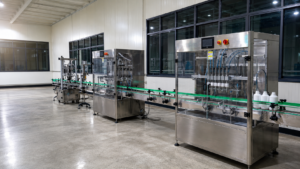
Share the product chemistry, cleaning method, operating temperature, container, target output and factory layout with LEKA Pack Line. Our team can help define a practical filling-line configuration for further technical review.
About the author
Penn Ma has spent fifteen years exporting titanium mill products and is the co-founder of Beiyu Titanium (beiyutitanium.com), a titanium supplier and exporter working with mills in Baoji, China. He reviews titanium grade selection, standards and certificate scope for chemical, marine and industrial equipment projects.