Bottle Labelling Machine Types: Choose by Bottle, Label and Line
Choosing between bottle labelling machine types starts with matching the container, label and production line—not by selecting one isolated machine category. A round cylindrical bottle with one self-adhesive label commonly uses wrap-around labelling. An oval or flat-sided bottle may need separate front-and-back labels, while a bottle that must present its label in a fixed position needs orientation control. Linear and rotary describe how containers move through the machine, not the label style itself.
For Australian factory owners, production managers and line integrators, the practical choice depends on bottle shape and stability, label position and material, required output, product changeovers, available floor space, and integration with filling and capping equipment.
Key Takeaways
| Machine Configuration | Suitable Container | Label Application | Typical Production Use | Key Selection Checks |
|---|---|---|---|---|
| Round-bottle wrap-around | Cylindrical bottles, jars and cans | Full or partial wrap | Standalone or inline lines | Diameter, stability, overlap and orientation |
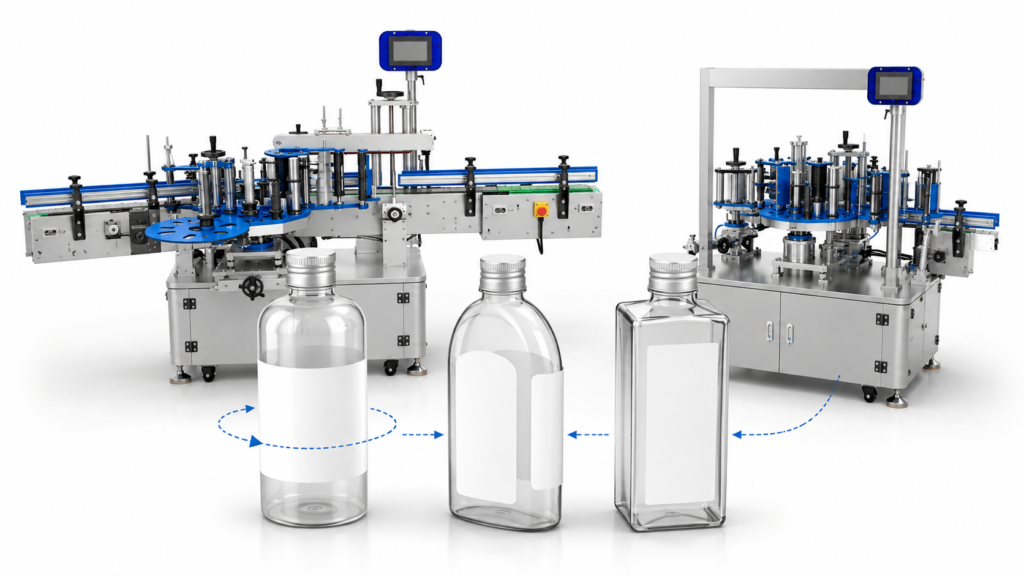
| Front-and-back labeller | Oval or flat-sided bottles | Two opposing labels | Multi-product lines | Panel shape, alignment and label reels |
| Orientation-sensitive labeller | Bottles with a detectable reference | Fixed-position label | Consistent presentation | Reference feature, sensor and rotation |
| Top labeller | Flat containers, lids or defined panels | Top or flat-surface label | Trays, tubs and selected bottles | Flatness, guidance and label contact |
| Linear labeller | Many common bottle shapes | Depends on fitted stations | Flexible inline production | Changeover, conveyor flow and line length |
| Rotary labeller | Bottles suited to positive rotary control | One or multiple labels | Integrated line projects | Bottle handling, stations and line balance |
| Semi-automatic labeller | Operator-fed bottles | One defined application | Short runs and trials | Labour, SKU variety and repeatability |
| Integrated automatic system | Conveyor-fed bottles | Project-specific application | Filling and capping lines | Synchronisation, inspection and rejection |
What Is a Bottle Labelling Machine?
A bottle labelling machine dispenses and applies a label to a controlled position on a container. The system may include bottle spacing, sensing, stabilising, rotation, label dispensing and pressing components. In US documentation, labelling is commonly written as “labeling”, but both spellings refer to the same process.
In This Guide
- Container shape and label position
- Linear and rotary layouts
- Semi-automatic and automatic systems
- Label technologies
- Selection checks, applications and FAQs
Bottle Labelling Machine Types by Container Shape
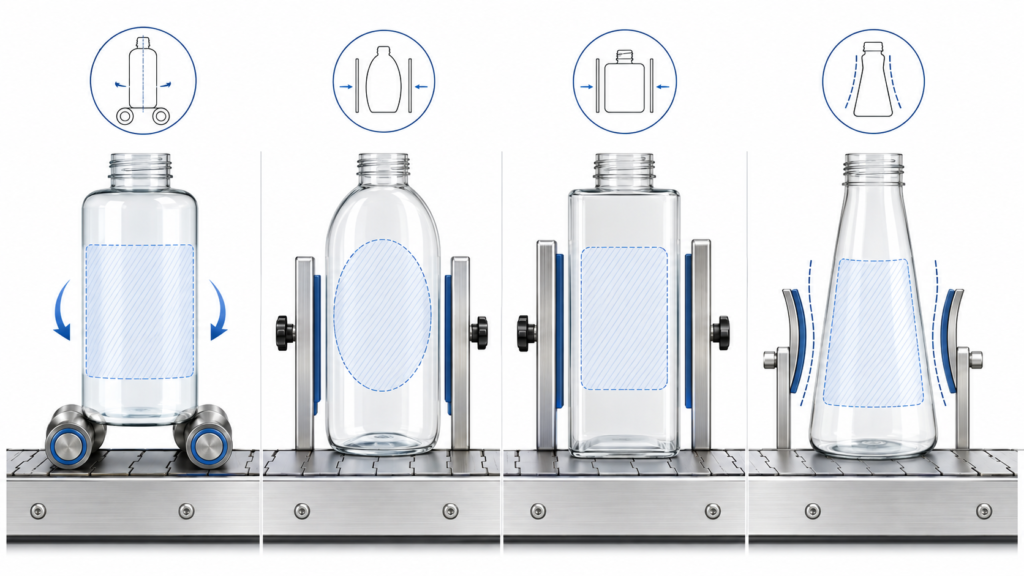
Container geometry affects how a bottle travels, where it can be supported and how evenly the label contacts the surface. Bottle shape should therefore be established before the application method or machine layout is selected.
Round bottles
Cylindrical bottles are natural candidates for wrap-around labelling because the container can rotate while the label is dispensed. Nexus Australia likewise associates wrap-around applicators with round bottles, jars and cans in its guide to label applicator types.
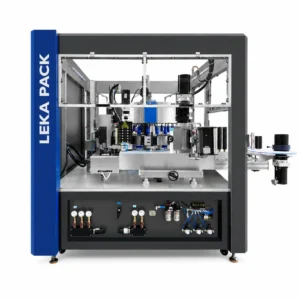
Round does not automatically mean simple. The supplier still needs the bottle diameter and height, label dimensions, surface material, stability and any required relationship between the label and a cap, seam or printed mark. LEKA’s round-bottle labelling systems show configurations available for cylindrical-container applications.
Square, rectangular and flat-sided bottles
These containers usually present distinct panels rather than one continuous cylindrical surface. A front label, back label or two labels on opposing faces may therefore be more suitable than a complete wrap. Guides, side belts or top stabilisation may be needed to stop the container turning before application.
Some rectangular containers can carry a wrap label, but corners, recessed panels and changing surface angles should be tested with the intended label material.
Flat containers
A flat container, lid or defined horizontal face may use top labelling. Check whether the application surface remains level and whether the label must avoid moulded edges, closures or recessed areas. A bottle with one flat panel must still be assessed for conveyor stability.
Oval, irregular, tapered or unstable containers
Oval and irregular bottles often need positive control because they can rotate or present changing surface angles. Front-and-back labels must meet the intended panels consistently, while orientation-sensitive work may require a physical or visual reference.
For tapered containers, test actual samples to determine how the surface geometry affects label contact. Lightweight or top-heavy bottles may also need stabilisation. Nexus Australia notes that container control, sensor timing and label-web tension affect placement, supporting the need to assess handling and application together.
Types by Label Position and Application Method
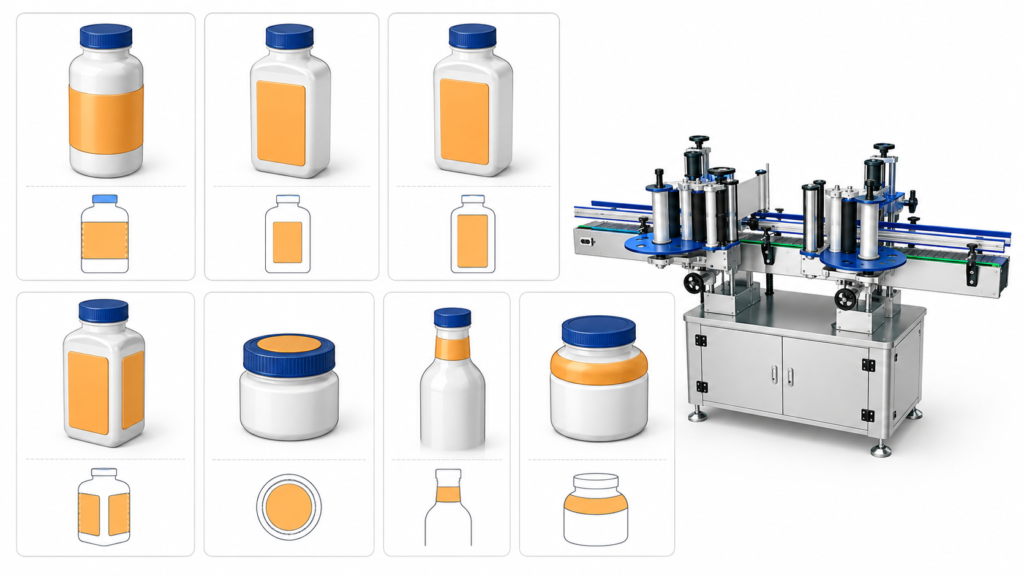
The required position should be defined before selecting the machine. One bottle can be round, require orientation, carry front-and-back labels and run through either a linear or rotary system.
Wrap-around labelling
Wrap-around labelling applies one label around a cylindrical surface. It can be a full or partial wrap, with the bottle rotated during application. Check the required overlap or gap, label straightness, bottle surface and whether the finished label must face a particular direction.
Front, back and double-side labelling
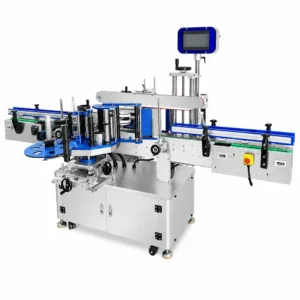
Front labelling applies one label to the main presentation panel; back labelling places another on the opposite panel. Front-and-back, sometimes called double-side labelling, applies both during one production pass.
The labels may differ in size or content, so their positions and reel specifications must be defined separately. A multifunction system can combine front, back and wrap-around applications if it supports the actual SKUs. See LEKA’s front-and-back and multifunction labelling systems.
Top, neck and shoulder labelling
Top labels suit flat upper surfaces, lids or selected bottle panels. Neck and shoulder labels sit closer to the closure or on the transition between the body and neck. Ekam Global lists front, shoulder, back, neck and orientation applications across its linear and rotary labelling equipment.
These positions require drawings or labelled samples. Curvature, moulded features and distance from the closure can change the required applicator and container-control arrangement.
Partial-wrap and orientation-sensitive labelling
A partial-wrap label covers only part of a curved bottle. If it must align with a handle, seam, closure, embossing or printed mark, the system needs an orientation method. “Positioning labeller” is therefore incomplete as a specification: identify the reference feature, detection method and permitted final position.
Linear Versus Rotary Labellers
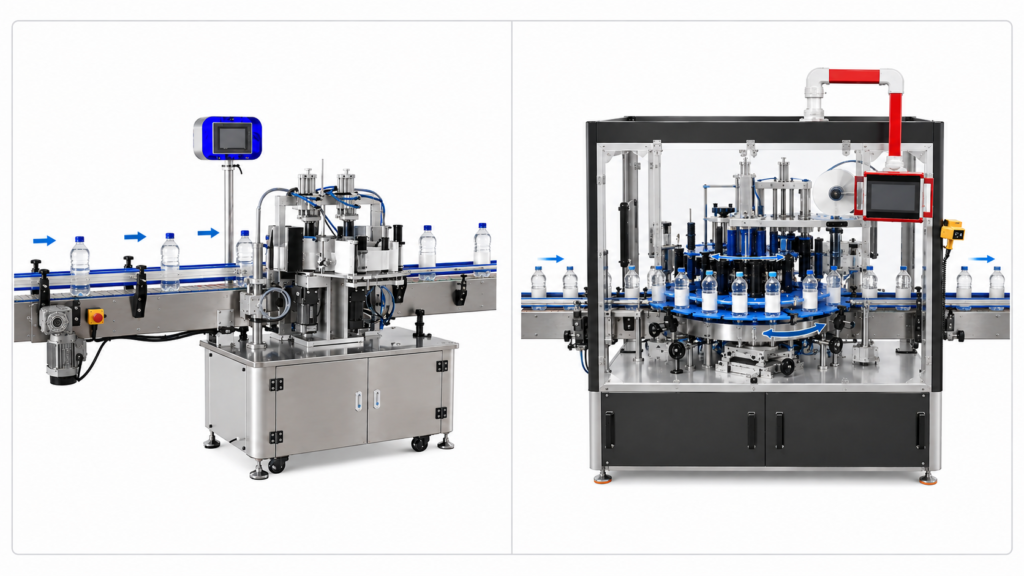
A linear or inline labeller moves containers along a conveyor through application stations. A rotary labeller transfers them around a rotating platform, normally using dedicated positions or handling parts. Australian supplier Splatt Engineering lists both layouts and several application technologies in its labelling-machine range.
When comparing the layouts, assess whether the project needs a straight conveyor arrangement, accessible stations, frequent product changes or more positively controlled movement through several application steps. Neither layout should be selected from output alone.
Compare:
- How bottles are spaced, transferred, held and released
- The number and shape of containers in the production range
- Change parts and adjustment points for each SKU
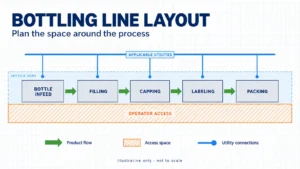
- Available line length, width and operator access
- Filling and capping flow upstream
- Coding, inspection, rejection and accumulation downstream
- Required output under normal operating conditions
LEKA’s rotary labelling systems show available rotary configurations, but the final layout should be confirmed with bottle samples and complete line requirements.
Semi-Automatic Versus Automatic Systems
A semi-automatic labeller requires an operator to load, position or remove each container. It can suit short runs, trials or a defined labelling task without a continuous conveyor. Assess operator involvement, repeatability, available labour and changeover frequency.
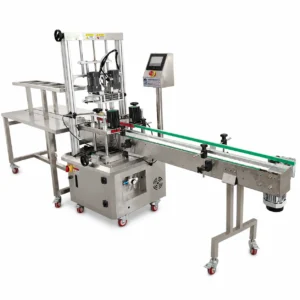
An automatic inline labeller receives bottles from a conveyor and applies labels continuously. It must be balanced with equipment before and after it; otherwise, transfers or accumulation may disrupt the line.
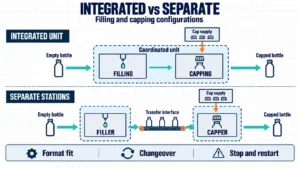
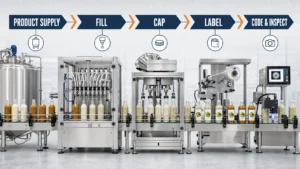
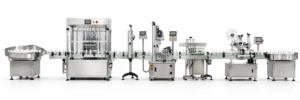
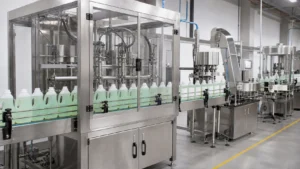
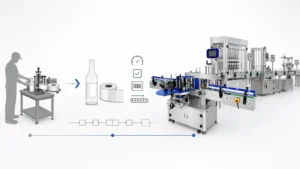
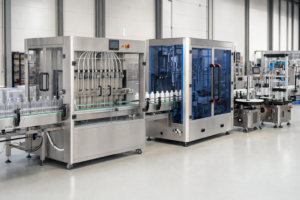
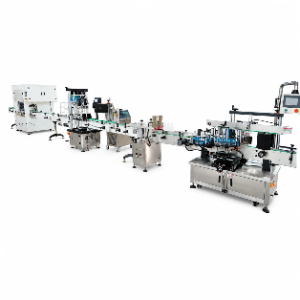
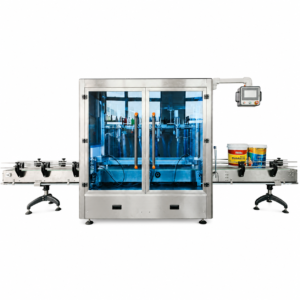
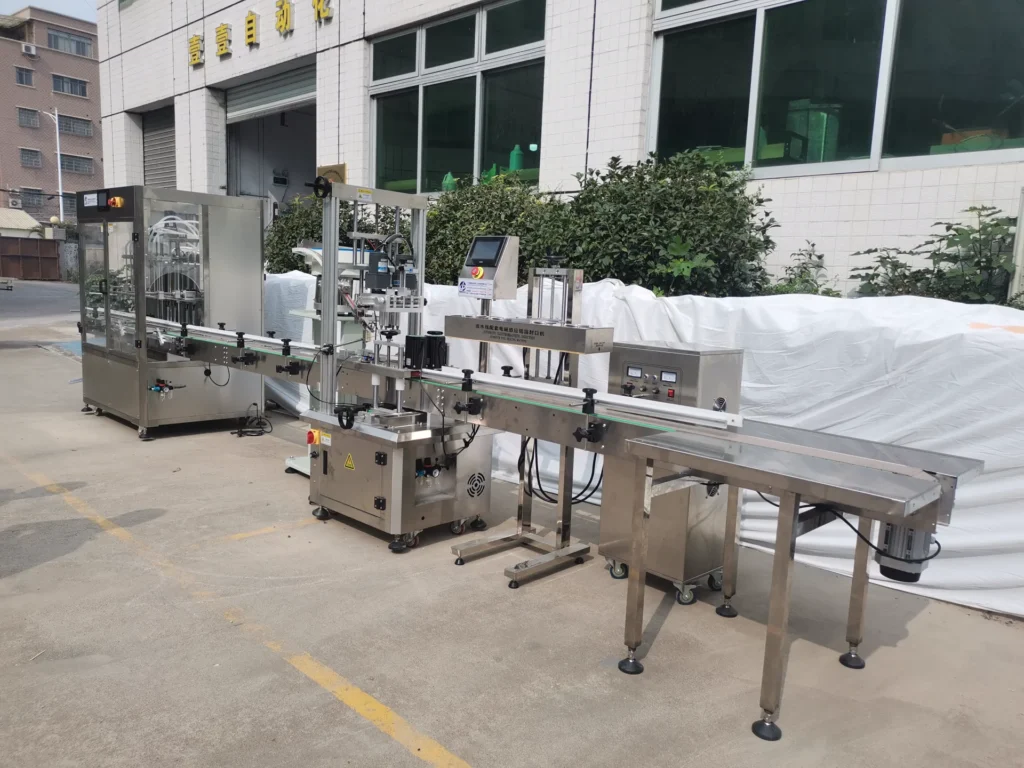
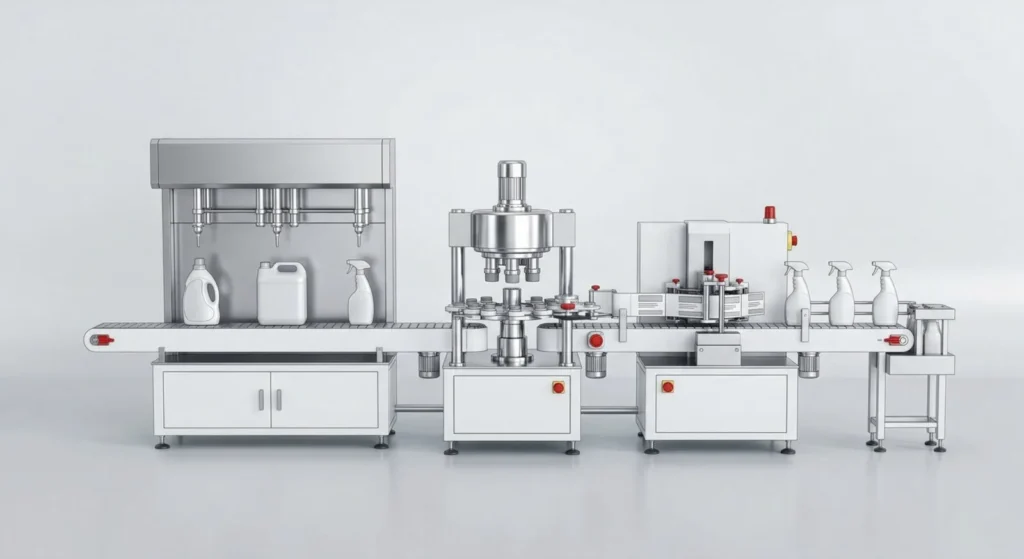
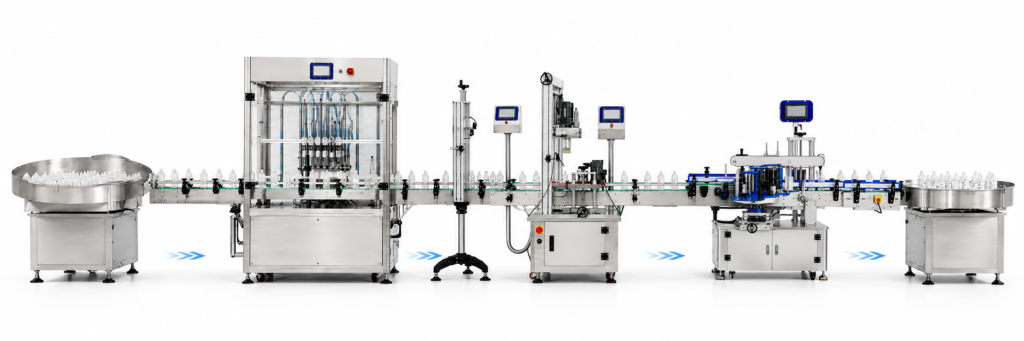
A fully integrated system connects labelling with filling, capping, coding, inspection and downstream handling. It suits projects seeking coordinated production rather than one standalone machine. LEKA’s bottle packaging line solutions illustrate this broader scope.
Label Technologies
Pressure-sensitive or self-adhesive labels
Pressure-sensitive labels arrive with adhesive already applied on a backing web. The machine separates the label from the backing and presses it onto the bottle. Selection depends on label material, backing, roll direction, bottle surface, transparency, operating conditions and position.
If labels are transparent, include their material in application testing so the supplier can confirm an appropriate detection method. Do not assume that every sensor will detect every label-and-backing construction.
Hot-melt glue labelling
Hot-melt systems use an adhesive process instead of a conventional self-adhesive label construction. The arrangement depends on whether the project uses pre-cut or roll-fed labels, as well as the container and label stock. Adhesive handling, cleaning and changeover should be addressed during specification.
Roll-fed labelling
Roll-fed systems feed label material from a reel and create the application within the machine process. Splatt Engineering identifies roll-fed, hot-melt, cold-glue and self-adhesive systems as distinct or combinable technologies. Buyers should provide roll specifications and confirm the cutting, adhesive and application method.
Cold-glue labelling
Cold-glue labelling is used with labels that do not arrive with pressure-sensitive adhesive. Suitability depends on the bottle surface, label stock, glue system, operating environment and cleaning requirements. It should be evaluated as a project-specific technology rather than treated as interchangeable with self-adhesive labelling.
Bottle Labelling Machine Selection Checklist
Prepare:
- Product type and handling conditions
- Bottle material, shape and stability
- Bottle height, width, diameter and profile
- Drawings, photographs and samples
- Label size, material, transparency and backing
- Label-roll diameter, core and unwind direction
- Required position, overlap or gap
- Number of labels per bottle
- Orientation reference
- Current and future product changeovers
- Required normal operating output
- Available floor space and operator access
- Conveyor height, direction and layout
- Filling and capping equipment
- Coding, inspection and rejection requirements
- Site power, air and utilities for engineering confirmation
These details allow the supplier to evaluate the whole application instead of matching the project to a machine name alone.
Application Examples
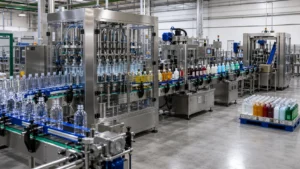
- Beverages: Round bottles may use wrap-around labels; shaped bottles may need front-and-back application. Confirm bottle stability and upstream transfers.
- Wine: Assess glass shape, front-and-back alignment, neck labels and any orientation requirement together.
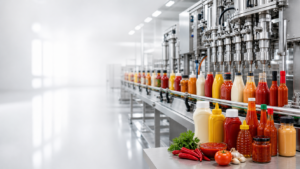
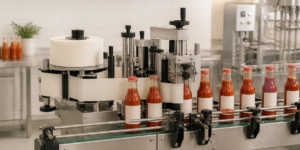
- Sauces: Round, oval and rectangular bottles need different handling. Match the applicator to the actual label panel.
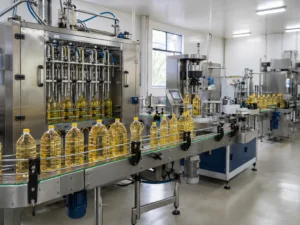
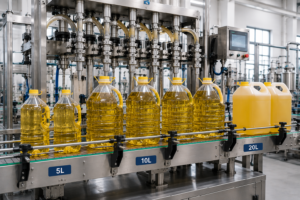
- Edible oil: Handles, broad panels and container stability can affect guidance and orientation.
- Cosmetics: Small or shaped containers and multiple presentation labels may need careful handling and repeatable changeovers.
- Chemicals: Supply the bottle material, label construction and operating conditions for project assessment.
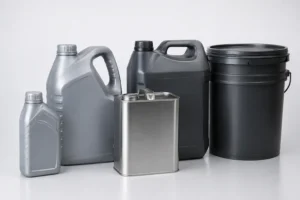
- Lubricants: Round bottles, rectangular packs and handled containers may require different arrangements and line interfaces.
No machine is universally suitable for an industry. The final configuration depends on the product, container, label and production line.
Frequently Asked Questions
What type of labelling machine is best for round bottles?
For a cylindrical bottle with one pressure-sensitive label, a wrap-around labeller is often the starting configuration. However, it must still match the bottle diameter, surface, stability, label size and any orientation requirement. A round bottle needing two panels or precise registration may require a different arrangement.
What is the difference between a linear and rotary labeller?
A linear labeller moves bottles along a conveyor through application stations. A rotary labeller controls bottles in positions around a rotating platform. The choice depends on container handling, application complexity, changeovers, available space, required output and integration—not on one universal production threshold.
Can one machine apply front and back labels?
Yes, a suitable multifunction or double-side machine can apply separate front and back labels during one pass. The supplier must confirm bottle panels, label sizes, reel arrangement, alignment and stability. Not every machine can cover every round, oval and rectangular SKU without adjustments or change parts.
Are semi-automatic labellers suitable for small production runs?
They can suit short runs, trials or frequent product changes when an operator can load each bottle. Consider labour, repeatability, changeover time and future requirements. Automatic equipment may be more suitable when the labeller must connect continuously with filling, capping or downstream machinery.
What is the difference between self-adhesive and hot-melt labelling?
Self-adhesive labels carry pressure-sensitive adhesive on a backing web. Hot-melt labelling uses an adhesive process within the machine and may work with different label formats. Choose according to the bottle, label stock, application method, operating environment, cleaning expectations and required line configuration.
How do I choose a labeller for irregular-shaped bottles?
Start with bottle samples and identify every stable contact surface. Define the label panels, orientation reference, guiding method and changeover range. An irregular bottle may need side guidance, top stabilisation or controlled rotation, so testing the intended bottle and label is more useful than selecting by catalogue category.
Can a bottle labelling machine integrate with a filling and capping line?
Yes, an automatic labeller can integrate with filling and capping equipment when bottle flow, conveyor height, direction, controls and accumulation are coordinated. Also define coding, inspection and rejection requirements. Integration must be evaluated against the actual machines and factory layout rather than assumed from connector dimensions alone.
About the Author
Slany Cheung is Technical Sales Director at LEKA Pack Line and leads its international sales work. He has worked in packaging machinery since 2014, including six years working directly with machine assembly and design. His current role covers overseas customer communication, project discussion, equipment matching, quotation follow-up and after-sales coordination.
Request a Bottle Labelling Recommendation
Choosing among bottle labelling machine types comes down to finding a configuration that controls your container, applies the label in the required position and fits the rest of the production line.
Send LEKA your product type, bottle material, bottle shape and dimensions, label size and position, desired output, existing filling or capping equipment, and factory-layout requirements. We can then prepare a tailored bottle labelling machine or complete packaging-line recommendation for your project. Send your project details to LEKA.